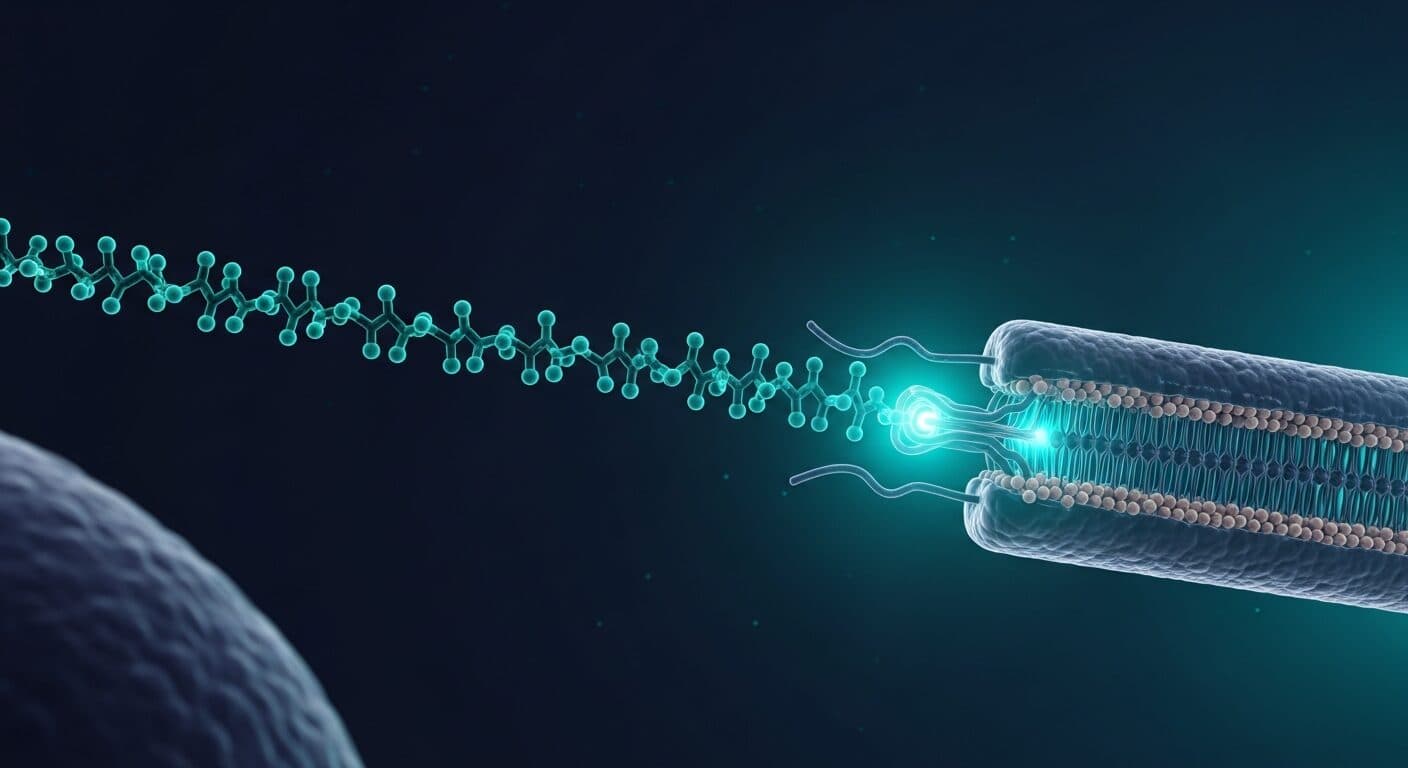
Tesamorelin is a growth hormone-releasing hormone (GHRH) analog that has been studied more extensively than most research peptides, with a published literature spanning structural chemistry, receptor pharmacology, pharmacokinetics, and clinical investigation. This guide reviews what that literature reports about the compound as a research chemical.
This guide covers tesamorelin’s mechanism of action, its receptor pharmacology and pharmacokinetic profile, the structural chemistry that distinguishes it from related GHRH analogs, and the practical handling considerations relevant to working with this compound in a research context.
For educational and research purposes only.
What Is Tesamorelin?
Tesamorelin is a synthetic analog of human growth hormone-releasing hormone (GHRH). The native GHRH peptide is a 44-amino acid peptide produced in the hypothalamus that stimulates the pituitary gland to release growth hormone (GH). Tesamorelin is structurally identical to the active form of GHRH(1-44) but with a trans-3-hexenoic acid group conjugated to its N-terminus. This modification significantly extends the molecule’s plasma stability compared to unmodified GHRH, which has a very short half-life in circulation due to rapid cleavage by dipeptidyl peptidase IV (DPP-IV).
The result is a GHRH analog that retains the native peptide’s receptor binding and signaling activity but survives long enough in the bloodstream to produce a sustained pharmacological effect. Tesamorelin binds to GHRH receptors on somatotroph cells in the anterior pituitary, triggering the synthesis and pulsatile release of growth hormone. The downstream consequence of elevated GH is increased hepatic production of insulin-like growth factor 1 (IGF-1), which mediates many of growth hormone’s peripheral effects on metabolism and body composition.
This mechanism is fundamentally different from growth hormone secretagogues like ipamorelin or the ghrelin mimetics, which act on a different receptor class (GHS-R1a) via a distinct signaling pathway. The distinction matters for understanding what tesamorelin does and does not do physiologically — a topic covered in detail in our comparison of tesamorelin vs ipamorelin.
Origin and Development as a GHRH Analog
Tesamorelin was developed by Theratechnologies Inc., a Canadian biopharmaceutical company. The molecule was designed as a stabilized GHRH(1-44) analog, and its clinical development program studied changes in visceral adipose tissue (VAT) — an intra-abdominal fat compartment that expresses a relatively high density of GH receptors and is therefore of mechanistic interest in GH-axis research.
The development program included two randomized, double-blind, placebo-controlled Phase III trials (commonly referred to as LIPO-010 and LIPO-011), published by Falutz et al. (2007) in the New England Journal of Medicine, which used CT imaging to quantify changes in visceral adipose tissue (DOI: 10.1056/NEJMoa072375). These trials are cited here as the published research record for the compound.
A subsequent Phase III analysis by Falutz et al. (2010) in the Journal of Clinical Endocrinology & Metabolism extended the dataset with a larger cohort and characterized changes in triglycerides and other lipid parameters alongside the imaging endpoints (DOI: 10.1210/jc.2010-0490).
Tesamorelin completed a full Phase III program and a regulatory review, which is uncommon for a compound otherwise studied as a research peptide. As a result, the published literature includes a structured pharmacokinetic and adverse-event dataset characterized under controlled conditions — a more complete pharmacological record than exists for most GHRH analogs.
A comprehensive review of tesamorelin’s drug profile by Grunfeld et al. (2011), published in Nature Reviews Drug Discovery, provides an accessible synthesis of the development history and clinical data (DOI: 10.1038/nrd3362).
Mechanism of Action: How Tesamorelin Works
The GHRH Axis
Growth hormone secretion follows a pulsatile pattern governed by the interplay between hypothalamic GHRH (stimulatory) and somatostatin (inhibitory). Under normal physiology, hypothalamic neurons release GHRH in pulses that travel through the portal blood to reach GHRH receptors on anterior pituitary somatotrophs. Receptor binding activates adenylyl cyclase, increases intracellular cAMP, and triggers both GH synthesis and secretion. Somatostatin opposes this effect by suppressing GH release during interpulse intervals, creating the characteristic pulsatile GH secretion profile.
Tesamorelin, as a GHRH analog, inserts into this axis at the hypothalamus-pituitary interface. Crucially, it preserves the pulsatile nature of GH release rather than producing continuous supraphysiological GH elevation. This is mechanistically relevant because somatostatin feedback remains intact — the system does not lose its regulatory brakes the way it would with exogenous recombinant human growth hormone (rhGH) administration.
From GH to IGF-1 to Metabolic Effects
Following pituitary GH release, growth hormone circulates and binds to GH receptors in the liver, stimulating hepatic IGF-1 production. IGF-1 then mediates many of GH’s downstream effects: lipolysis in adipose tissue (particularly visceral fat depots), protein anabolic effects in muscle, and effects on glucose metabolism. The IGF-1 axis also provides negative feedback to the hypothalamus and pituitary, modulating the overall output.
In GH-axis research, visceral adipose tissue is of particular mechanistic interest. VAT is more metabolically active than subcutaneous fat, expresses higher levels of lipolytic enzymes, and is more sensitive to GH-stimulated lipolysis. The differential GH receptor density across adipose compartments is the basis for the compartment-specific responses discussed in the adipose-biology literature.
The Published Research Record
Visceral Adipose Tissue Studies
The core Phase III research was published by Falutz et al. (2007), a randomized, placebo-controlled trial over 26 weeks that used CT imaging to measure visceral adipose tissue and tracked IGF-1 as the pharmacodynamic marker of GH-axis engagement (DOI: 10.1056/NEJMoa072375).
A follow-up publication by Falutz et al. (2010) characterized the lipid profile, including triglyceride and other metabolic parameters, alongside the imaging endpoints, with more variable glucose findings (DOI: 10.1097/QAI.0b013e3181cbdaff).
Longer-term data from an open-label extension were published by Falutz et al. (2008) in AIDS, with an adverse-event profile consistent with the mechanism (elevated IGF-1, injection site reactions, arthralgias) over an extended observation period (DOI: 10.1097/QAD.0b013e32830a5058).
Hepatic Lipid Studies: Stanley et al. (JAMA)
Stanley et al. (2014) published a randomized controlled trial in JAMA that examined both visceral and hepatic fat using imaging endpoints (DOI: 10.1001/jama.2014.8334). The hepatic findings are of mechanistic interest because the GH axis is involved in hepatic lipid handling.
The hepatic finding is consistent with the recognized role of GH signaling in hepatic lipid metabolism. It has generated mechanistic research interest in the liver-adipose axis under conditions of modulated GH pulsatility, an area that remains under investigation in preclinical and clinical research models.
Predictors of Response and Long-Term Durability
Mangili et al. (2015), published in PLOS ONE, analyzed the Phase III dataset to identify baseline characteristics associated with the magnitude of the VAT imaging response, a subgroup-analysis framework relevant to research study design (DOI: 10.1371/journal.pone.0140358).
Tesamorelin in Type 2 Diabetes: Safety Data
Clemmons et al. (2017), published in PLOS ONE, characterized the metabolic and safety profile of tesamorelin in a research population with type 2 diabetes — a context in which GH-axis stimulation is mechanistically relevant to insulin sensitivity and glucose handling (DOI: 10.1371/journal.pone.0179538).
Cognitive Function Research
One research direction that has attracted interest outside the metabolic domain is tesamorelin’s potential effects on cognitive function. Baker et al. (2012), published in Archives of Neurology, examined the effects of a growth hormone-releasing hormone analog on cognitive function in adults with mild cognitive impairment and healthy older adults — an early signal that GHRH axis modulation may have neurobiological relevance beyond body composition (DOI: 10.1001/archneurol.2012.1970). This remains a preliminary area of research with limited evidence.
Pharmacokinetics: What the Data Shows
Tesamorelin’s pharmacokinetic profile has been characterized in both HIV-infected patients and healthy subjects. González-Sales et al. (2015) published a population pharmacokinetic analysis in Clinical Pharmacokinetics, characterizing the absorption, distribution, and elimination of tesamorelin following subcutaneous administration (DOI: 10.1007/s40262-014-0202-x). A companion population pharmacokinetic and pharmacodynamic analysis in the Journal of Pharmacokinetics and Pharmacodynamics linked these PK parameters to GH and IGF-1 responses (DOI: 10.1007/s10928-015-9416-2).
Key pharmacokinetic characteristics from the published PK literature include a low subcutaneous bioavailability, a short plasma half-life, and a Tmax occurring within approximately 30 minutes of subcutaneous administration. The full PK profile is covered in detail in our dedicated article on tesamorelin pharmacokinetics for researchers.
Research Beyond the Original Indication
The tesamorelin research base is predominantly anchored in the HIV lipodystrophy research population — that is where the Phase III data exists. Outside that context the evidence is more limited. The mechanistic logic of GHRH-axis modulation has nonetheless generated investigational interest in other research populations.
Studies have examined tesamorelin in research contexts including type 2 diabetes, hepatic steatosis, and cognitive aging. The somatotropic-axis research angle — particularly age-related GH decline — is discussed in the GHRH-analog literature.
The age-related decline in GH and IGF-1 (somatopause) has long attracted interest as a research target for GHRH analogs. The evidence base for tesamorelin in research populations outside the original studies remains limited, and researchers should distinguish between the well-characterized data and the more exploratory research landscape.
Practical Research Considerations
Reconstitution and Handling
Tesamorelin is supplied as a lyophilized powder requiring reconstitution with sterile water. Standard research protocols involve reconstitution to a working concentration appropriate for the intended administration volume. The reconstituted peptide should be handled according to standard peptide storage practices: refrigerated at 2-8°C, protected from light, and used within the timeframe recommended by the manufacturer or within established stability data.
Reconstitution should follow standard peptide methodology appropriate to the intended working concentration, with attention to solvent choice, neutral-to-slightly-basic pH, and avoidance of repeated freeze-thaw cycles.
Quality and Purity Considerations
Given tesamorelin’s complexity as a 44-amino acid analog with a specific N-terminal modification, purity verification is particularly important. Researchers should obtain certificates of analysis (COA) confirming purity by HPLC, identity confirmation by mass spectrometry, and absence of microbial contamination. The structural complexity of tesamorelin means that synthesis errors or degradation are more consequential than with smaller peptides.
For research use, a certificate of analysis confirming HPLC purity, mass-spectrometry identity, and absence of microbial contamination should be obtained and reviewed before any quantitative experiment.
The Side Effect Profile: What Clinical Trials Document
The FDA Phase III program generated systematic adverse event data that is available in the tesamorelin prescribing information. The primary adverse events observed in clinical trials were injection site reactions (erythema, pruritus, pain, induration), arthralgia, extremity pain, and peripheral edema. IGF-1 elevation above the upper limit of normal was observed in a subset of patients and represents a pharmacodynamically expected consequence of GHRH stimulation that requires monitoring.
A review by Spooner and Olin (2012) in Annals of Pharmacotherapy provides a structured summary of the tesamorelin safety and pharmacology profile as documented in the published literature (DOI: 10.1345/aph.1Q629).
Tesamorelin vs Other GHRH Analogs
Tesamorelin is not the only GHRH analog that has been studied. Sermorelin (GHRH 1-29) was an earlier, shorter-fragment analog that was approved in the 1990s for GH deficiency in children but is no longer commercially available in that form. CJC-1295, a more recent analog, incorporates a drug affinity complex (DAC) technology that dramatically extends its half-life through albumin binding, resulting in sustained GH elevation rather than pulsatile release. These represent fundamentally different pharmacological profiles despite acting on the same receptor.
Tesamorelin’s distinction is its clinical validation: it has the only completed Phase III program among GHRH analogs in current research use, with the regulatory documentation, safety data, and peer-reviewed literature that this entails. For the mechanistic comparison with the non-GHRH secretagogue ipamorelin, see Tesamorelin vs Ipamorelin: Different Mechanisms, Different Research Profiles.
Key Takeaways
- Tesamorelin is a GHRH analog (not a GH secretagogue) that acts on the pituitary to stimulate pulsatile growth hormone release through the native physiological pathway.
- It is the only GHRH analog with a completed Phase III research program, giving it a more complete published pharmacological record than related analogs.
- The Phase III research (Falutz et al., 2007, NEJM, and subsequent publications) used CT-imaging endpoints to characterize visceral adipose tissue and associated lipid parameters.
- Stanley et al. (2014, JAMA) added hepatic lipid imaging data, extending mechanistic research interest to the liver-adipose axis.
- Research interest outside the HIV indication exists but is less evidentially grounded — researchers should clearly distinguish between the validated HIV indication and exploratory off-label research.
- The pharmacokinetic profile (short half-life, pulsatile GH stimulation) is mechanistically distinct from long-acting GHRH analogs and from direct GH secretagogues.
Related Research
- Tesamorelin vs Ipamorelin: Different Mechanisms, Different Research Profiles
- Tesamorelin Half-Life and Pharmacokinetics for Researchers
References
- Falutz J, Allas S, Blot K, et al. (2007). Metabolic Effects of a Growth Hormone-Releasing Factor in Patients with HIV. New England Journal of Medicine. DOI: 10.1056/NEJMoa072375
- Falutz J, Mamputu JC, Potvin D, et al. (2010). Effects of Tesamorelin (TH9507), a Growth Hormone-Releasing Factor Analog, in Human Immunodeficiency Virus-Infected Patients with Excess Abdominal Fat. Journal of Clinical Endocrinology & Metabolism. DOI: 10.1210/jc.2010-0490
- Falutz J, Potvin D, Mamputu JC, et al. (2010). Effects of tesamorelin, a growth hormone-releasing factor, in HIV-infected patients with abdominal fat accumulation. Journal of Acquired Immune Deficiency Syndromes. DOI: 10.1097/QAI.0b013e3181cbdaff
- Falutz J, Allas S, Mamputu JC, et al. (2008). Long-term safety and effects of tesamorelin, a growth hormone-releasing factor analogue, in HIV patients with abdominal fat accumulation. AIDS. DOI: 10.1097/QAD.0b013e32830a5058
- Stanley TL, Feldpausch MN, Oh J, et al. (2014). Effect of Tesamorelin on Visceral Fat and Liver Fat in HIV-Infected Patients with Abdominal Fat Accumulation. JAMA. DOI: 10.1001/jama.2014.8334
- Grunfeld C, Dritselis A, Kirkpatrick P. (2011). Tesamorelin. Nature Reviews Drug Discovery. DOI: 10.1038/nrd3362
- Spooner LM, Olin JL. (2012). Tesamorelin: a growth hormone-releasing factor analogue for HIV-associated lipodystrophy. Annals of Pharmacotherapy. DOI: 10.1345/aph.1Q629
- Mangili A, Falutz J, Mamputu JC, et al. (2015). Predictors of Treatment Response to Tesamorelin, a Growth Hormone-Releasing Factor Analog, in HIV-Infected Patients with Lipodystrophy. PLOS ONE. DOI: 10.1371/journal.pone.0140358
- González-Sales M, Barrière O, Tremblay PO, et al. (2015). Population pharmacokinetic analysis of tesamorelin in HIV-infected patients and healthy subjects. Clinical Pharmacokinetics. DOI: 10.1007/s40262-014-0202-x
- González-Sales M, Barrière O, Tremblay PO, et al. (2015). Population pharmacokinetic and pharmacodynamic analysis of tesamorelin in HIV-infected patients and healthy subjects. Journal of Pharmacokinetics and Pharmacodynamics. DOI: 10.1007/s10928-015-9416-2
- Baker LD, Barsness SM, Borson S, et al. (2012). Effects of growth hormone-releasing hormone on cognitive function in adults with mild cognitive impairment and healthy older adults. Archives of Neurology. DOI: 10.1001/archneurol.2012.1970
- Clemmons DR, Miller S, Mamputu JC. (2017). Safety and metabolic effects of tesamorelin, a growth hormone-releasing factor analogue, in patients with type 2 diabetes. PLOS ONE. DOI: 10.1371/journal.pone.0179538
All products are intended for research purposes only. Not for human consumption. This article is for educational purposes and does not constitute medical advice.
Researcher Q&A
These questions come from researchers working with tesamorelin and adjacent GH-axis research peptides in laboratory settings. Answers reflect the published preclinical and clinical literature, are for research-use-only contexts, and include no dosing guidance. CertaPeptides assembled this appendix from technical questions our QA team sees most often.
Q: Beyond HPLC purity, which third-party tests are worth running on a tesamorelin batch?
A: For pharmaceutical-grade QA of a synthetic research peptide, the information-per-dollar hierarchy is fairly consistent.
HPLC purity plus mass spectrometry confirmation is non-negotiable. HPLC at 220 nm characterises the fraction of the sample that is the target sequence versus related impurities such as truncations, deletions, and oxidised forms. Mass spectrometry confirms the molecular weight matches expectation — tesamorelin should come in at approximately 5135.8 Da monoisotopic. A certificate showing a purity number without an MS trace is effectively a retention-time result.
Endotoxin testing (LAL or recombinant Factor C) is worth including for any peptide intended for parenteral research use. Lyophilised material from reputable synthesis houses is usually fine, but the assay is inexpensive at most EU contract labs and it catches gram-negative contamination introduced during fill, finish, or water-for-injection handling. USP <85> defines the standard.
Sterility testing under USP <71> is less informative than it is often assumed to be for lyophilised powder in a sealed vial — the dry cake is inhospitable to most organisms. It becomes more relevant for reconstituted solutions or when a fill-line contamination is suspected.
Heavy metal testing by ICP-MS is last priority unless there is a specific reason to suspect metal catalysts were used in the synthesis route. For SPPS-produced peptides it is rarely where problems originate.
For tesamorelin specifically, prioritise HPLC+MS and endotoxin. A batch that passes those is unlikely to fail on the remaining panels.
Q: How do tesamorelin, CJC-1295+ipamorelin, and AOD-9604 compare mechanistically for visceral adipose tissue research?
A: These three are mechanistically distinct, and that matters more than a direct “which works best” comparison, because they act on different parts of the GH axis.
Tesamorelin is a GHRH(1-44) analog with an N-terminal trans-3-hexenoic acid modification that blocks dipeptidyl peptidase-IV cleavage and extends its circulating half-life. It produces pulsatile endogenous GH release via the pituitary GHRH receptor. Among the three compounds, it has the most extensive published clinical-research record characterizing visceral adipose tissue by imaging endpoints.
CJC-1295 combined with ipamorelin is a dual-arm GH pulse. CJC-1295 (a GHRH analog) drives the GHRH arm; ipamorelin (a GHRP) drives the ghrelin-receptor arm. The combination is synergistic on GH release in preclinical and early clinical work, but does not carry VAT-specific trial data comparable to tesamorelin.
AOD-9604 is mechanistically separate. It corresponds to the C-terminal hGH(177-191) fragment, studied to dissociate hGH’s adipose-related activity from its IGF-1-raising activity (Wilding 2004, PMID 15134286). It has been characterized in rodent models, while its human clinical-research program did not meet the endpoints required for approval, so the human data remain limited.
For research workflows concerned with the visceral versus subcutaneous distribution of adipose response, tesamorelin has the most fully characterized preclinical-to-clinical research record of the three. CJC-1295 with ipamorelin represents a broader GH-axis research combination, and AOD-9604 remains of historical research interest despite limited clinical data.
Verify before you research
Every compound we list ships against a supplier batch specification, and selected lots carry an independent third-party COA.