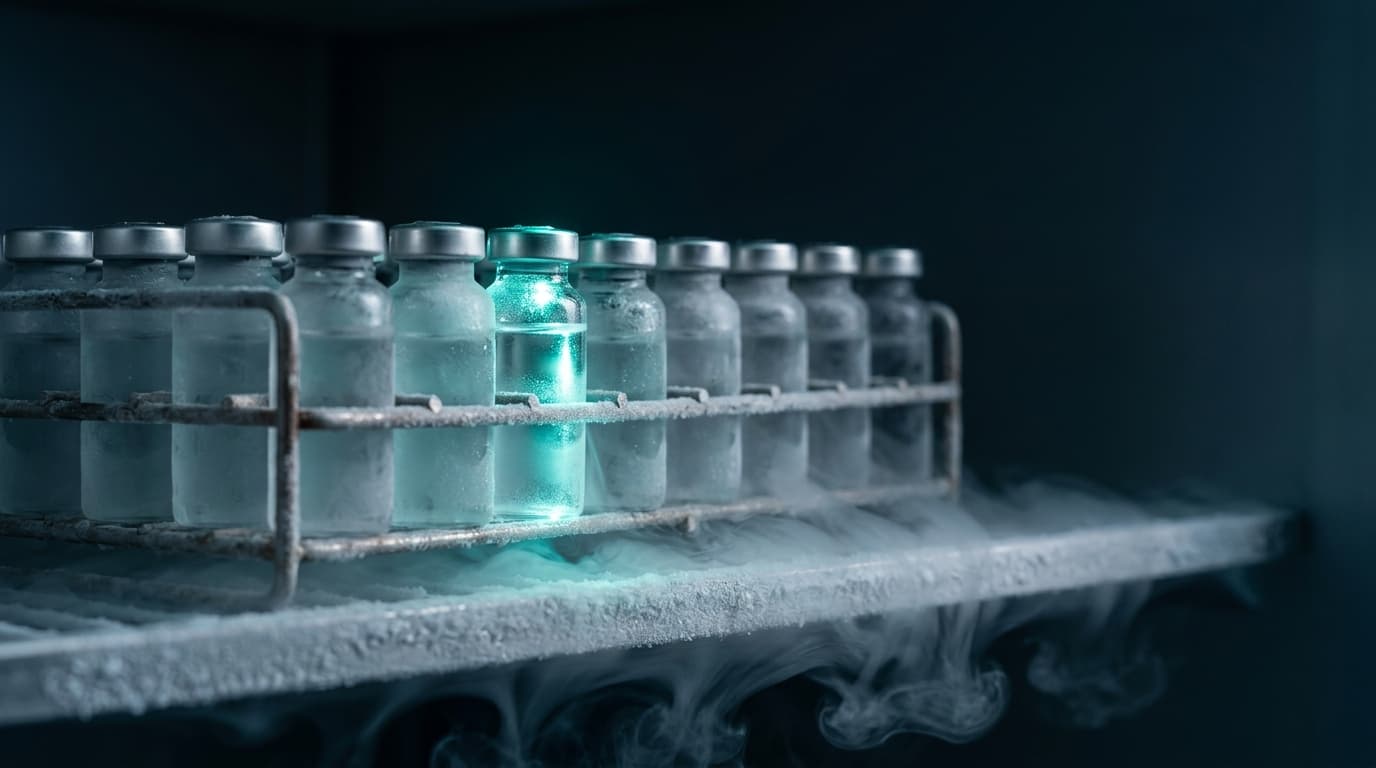
Why proper peptide storage matters
Research Peptides are sensitive biological molecules vulnerable to degradation through multiple pathways: thermal denaturation, photo-oxidation, hydrolysis, and microbial contamination. Improper storage can reduce peptide potency by 50% or more within weeks, rendering months of research invalid. The following covers the exact storage conditions required for each peptide category, optimal equipment, environmental monitoring, and verification procedures to ensure your research materials maintain maximum stability and efficacy throughout your studies.
The chemistry of peptide degradation
Temperature effects: thermal denaturation
Peptide bonds are held together by covalent linkages, but peptide tertiary structure (3D folding) is maintained by non-covalent interactions: hydrogen bonds, ionic interactions, and hydrophobic effects. Temperature elevation disrupts these interactions:
- 2-8°C: Minimal thermal motion; peptide structure stable
- Room Temperature (20-25°C): Increased molecular motion; gradual structural relaxation and unfolding
- 37°C (body temperature): Accelerated denaturation; 50%+ potency loss per month
- Above 40°C: Rapid aggregation and precipitation; essentially complete degradation within days
Temperature stability is the single most critical factor in peptide preservation. A peptide stored at room temperature for 1 month will be as potent as the same peptide stored at 37°C for approximately 1 week. Always prioritize refrigeration.
Light exposure: photo-oxidation and isomerization
UV light (particularly UV-A and UV-B) causes photo-oxidation of amino acid side chains, especially aromatic residues (tryptophan, tyrosine, phenylalanine). Visible light can also trigger oxidation through photosensitization mechanisms. Effects include:
- Oxidation of methionine and cysteine residues
- Photoisomerization of proline (cis/trans interconversion)
- Cross-linking and aggregation initiated by radical formation
- Loss of biological activity
Amber and brown glass vials are specifically formulated to filter light wavelengths that trigger peptide degradation. Transparent glass offers almost no protection.
Humidity: hydrolysis and moisture-induced degradation
Water is essential for amino acid function but excess moisture creates conditions for:
- Hydrolytic Cleavage: Peptide bonds can cleave through hydrolysis, especially at acidic pH
- Oxidation Acceleration: Water-soluble oxidation pathways accelerate in wet environments
- Microbial Growth: Moisture enables bacterial and fungal proliferation even with bacteriostatic agents present
- Crystallization: Hygroscopic Peptides absorb water, form hydrates, and crystallize—potentially altering bioavailability
Lyophilized (freeze-dried) Peptides have minimal residual moisture (<2%), creating a stable, anhydrous state ideal for long-term storage. Once reconstituted, humidity control becomes critical.
Standard storage conditions: lyophilized (unreconstituted) peptides
Optimal conditions
| Parameter | Optimal | Acceptable | Avoid |
|---|---|---|---|
| Temperature | 2-8°C (refrigerator) | 15-20°C (cool room) | Room temp (>25°C), heat sources |
| Light | Dark, amber/brown vial | Dark cabinet in refrigerator | Transparent vial, sunlight, UV |
| Humidity | <40% relative humidity | <50% relative humidity | >60% RH (moisture infiltration) |
| Packaging | Vacuum-sealed, desiccant included | Sealed amber vial, silica packet | Open air, transparent container |
Equipment recommendations
Laboratory refrigerator (2-8°C): Standard research-grade refrigerator maintaining precise 2-8°C. Benefits:
- Consistent temperature (vs. household refrigerators which cycle 4-15°C)
- Minimal frost accumulation (prevents humidity spikes)
- Separate storage from food (avoiding contamination)
- Optional temperature monitoring/alarm
Desiccator cabinet: A sealed cabinet with silica gel desiccant maintains <40% humidity. Ideal for:
- Long-term storage of multiple peptide vials
- Protection in humid climates (coastal regions, tropics)
- Organized vial management with inventory tracking
Vacuum-sealed storage containers: Barrier foil bags with oxygen absorbers and desiccants create optimal microenvironment. Benefits:
- Extended shelf life (2-4+ years vs. 1-2 years in standard vials)
- Protection during shipping and storage
- Reversible vacuum seal allows multiple openings without exposure
Peptide-specific storage guidance
Growth factor peptides (BPC-157, TB-500, GHK-Cu)
- Temperature: 2-8°C (mandatory)
- Light Protection: Amber vial, dark storage
- Humidity: <40% preferred; <50% acceptable
- Expected Shelf Life: 2-3 years at 2-8°C; 6-12 months at room temperature (not recommended)
- Special Considerations: Some studies suggest slow protein aggregation even under optimal conditions; shelf life estimates may be conservative
Product Links: BPC-157 2mg, BPC-157 5mg, TB-500 2mg, TB-500 5mg, GHK-Cu 50mg, GHK-Cu 100mg
GHRH peptides (CJC-1295 DAC)
- Temperature: 2-8°C (mandatory)
- Light Protection: Amber vial essential
- Humidity: <40% RH preferred
- Expected Shelf Life: 2-3 years at 2-8°C; stable at cool room temperature (15-20°C) for 12-18 months if protected from light
- Special Considerations: CJC-1295 DAC’s modified lysine structure provides some additional stability compared to unmodified GHRH. Can tolerate brief room-temperature excursions (24-48 hours) without significant loss.
Product Links: CJC-1295 DAC 2mg, CJC-1295 DAC 5mg
GHS-R agonists (Ipamorelin)
- Temperature: 2-8°C (optimal); 15-25°C (acceptable short-term)
- Light Protection: Amber vial, dark storage
- Humidity: <40% RH preferred
- Expected Shelf Life: 2-3 years at 2-8°C; 1-2 years at room temperature (with light protection)
- Special Considerations: Pentapeptide structure is relatively robust. Can tolerate room-temperature excursions better than longer Peptides. Still requires dark storage.
Product Links: Ipamorelin 5mg, Ipamorelin 10mg
Nootropic peptides (Selank, Semax)
- Temperature: 2-8°C preferred; 15-25°C acceptable
- Light Protection: Amber vial, dark storage
- Humidity: <50% RH acceptable (more tolerant than growth factors)
- Expected Shelf Life: 2-3 years at 2-8°C; 1-2 years at room temperature
- Special Considerations: Smaller Peptides with simpler structures. Relatively stable compared to larger growth factors. Can be stored at cool room temperature if light protection is maintained.
Product Links: Selank 5mg, Selank 10mg, Semax 5mg, Semax 10mg
Metabolic peptides (Semaglutide, tirzepatide, retatrutide)
- Temperature: 2-8°C (mandatory)
- Light Protection: Amber vial essential
- Humidity: <40% RH preferred; <50% acceptable
- Expected Shelf Life: 2-3 years at 2-8°C; degradation accelerates rapidly above 25°C
- Special Considerations: These Peptides are structurally complex with multiple modification sites vulnerable to oxidation. Thermal stability is poor; refrigeration is non-negotiable. Never allow excursions above 30°C.
Product Links: Semaglutide 5mg, Semaglutide 10mg, Semaglutide 30mg, Tirzepatide 5mg, Tirzepatide 60mg, Retatrutide 50mg
Accessories (bacteriostatic water, syringes, vials)
- Bacteriostatic Water: 2-8°C after opening. Benzyl alcohol acts as preservative for 28 days post-opening. After 28 days or visible contamination, discard.
- Syringes and Needles: Room temperature, dry, sealed packaging. Humidity accelerates corrosion of metal needles.
- Empty Storage Vials: Room temperature acceptable if sealed and dry. Light protection not necessary for empty containers.
Product Links: Bacteriostatic Water 3ml, Bacteriostatic Water 10ml, 1ml Graduated Syringes, Storage Vials
Reconstituted peptide storage
Reconstitution transition
Once lyophilized peptide is reconstituted in bacteriostatic water, storage conditions become more stringent:
- Temperature: 2-8°C (mandatory; do not freeze)
- Duration: 2-4 weeks typical; up to 8 weeks possible with perfect sterile technique
- Container: Sterile glass vials with rubber septa (not plastic syringes)
- Sterility: Any contamination dramatically reduces shelf life
Extending reconstituted peptide stability
- Aseptic Technique: Use sterile gloves, alcohol wipes, and sterile needles every time you withdraw solution. Contaminating bacteria or fungi will multiply rapidly.
- Minimize Air Exposure: Avoid creating air pockets in the vial. Oxygen promotes oxidation.
- Use Sterile Needles: Never reuse needles. A used needle carries bacteria and fibers from skin and clothing.
- Label With Date: Mark the vial with the reconstitution date and intended expiration (typically 28-30 days).
- Visual Inspection: Before each use, inspect for discoloration, cloudiness, or visible particles indicating contamination or degradation.
Freeze-thaw considerations
Do not freeze reconstituted Peptides. Ice crystal formation damages peptide structure irreversibly. If a reconstituted solution is accidentally frozen:
- Allow slow thaw at 2-8°C (do not warm rapidly)
- Inspect for cloudiness, crystallization, or precipitate
- If any visible changes present, discard (structure is compromised)
- If clear after thaw, may be usable but potency is likely reduced
Environmental monitoring and verification
Temperature monitoring
Verify your refrigerator maintains 2-8°C:
- Daily: Visual check of built-in thermometer (if present)
- Weekly: Use a calibrated digital thermometer. Place in a reference location and log readings.
- Optional: Data Logger: USB temperature data loggers (0-50) record temperature every 15 minutes, alerting you to excursions.
- Thermal Alarm: High-end laboratory refrigerators include audible alarms if temperature exceeds safe range (e.g., if refrigerator door is left open).
Humidity monitoring
For long-term storage or humid climates, monitor ambient humidity:
- Digital Hygrometer: Place in refrigerator or storage cabinet. Target <40% RH.
- Desiccant Packets: Replace silica gel desiccants monthly or when they change color (indicating saturation).
- Vacuum Seal Integrity: If storing Peptides in vacuum-sealed bags, inspect monthly for any loss of vacuum (indicating seal compromise).
Verification of peptide integrity
Visual inspection
Before use, inspect lyophilized Peptides:
- Color: Should match manufacturer’s description (usually white, off-white, or slightly tan). Browning indicates oxidation or degradation.
- Texture: Cake-like or crystalline appearance is normal. Caking or hardening indicates moisture infiltration.
- Vial Integrity: Check for cracks, leaks, or rubber septum deterioration.
Solution quality (post-reconstitution)
- Clarity: Solution should be clear to slightly opalescent. Cloudiness indicates precipitation, contamination, or degradation.
- Color: Should be colorless or match the expected color. Discoloration indicates oxidation.
- Particulates: No visible particles should be present. Any crystals or specks indicate contamination or structural damage.
- Smell: Peptide solutions should be odorless or nearly so. Any unusual odor (vinegar-like, putrid) indicates bacterial growth.
Storage during shipping and transport
Peptides are sensitive during shipping. Best practices:
- Insulated Packaging: Use insulated boxes with ice packs or cooling elements to maintain 2-8°C during transit.
- Gel Packs: Standard ice packs may freeze Peptides; use “cool packs” rated 4-8°C.
- Expedited Shipping: 2-day delivery minimizes exposure to temperature fluctuations. Overnight is ideal for long distances or warm climates.
- Receipt Inspection: Upon arrival, immediately check that cooling elements are still cold and Peptides have remained cool. Store promptly at 2-8°C.
Common storage mistakes to avoid
| Mistake | Impact | Solution |
|---|---|---|
| Storing in transparent vial on shelf | Photo-oxidation; 50%+ loss in weeks | Use amber vial; store in dark cabinet |
| Room-temperature storage (20-25°C) | Thermal denaturation; 30-50% loss per month | Always refrigerate at 2-8°C |
| Freezing reconstituted peptide | Crystal damage; irreversible loss of activity | Never freeze dissolved Peptides; refrigerate only |
| Opening vial without aseptic technique | Microbial contamination; solution becomes unusable within days | Use sterile gloves, alcohol wipes, sterile needles |
| Keeping reconstituted solution >30 days | Microbial proliferation despite bacteriostatic agents; degradation | Use reconstituted Peptides within 2-4 weeks |
| Humid storage (>60% RH) | Moisture infiltration; hydrolysis and crystallization | Use desiccator cabinet; monitor humidity <40% |
| Reusing needles for multiple withdrawals | Bacterial contamination; accelerated solution degradation | Use sterile needle for every withdrawal |
Long-term storage and stability testing
Accelerated stability studies
For research requiring validated peptide stability, consider accelerated stability testing:
- 3-Month Time Point: At 6 months storage, sample the peptide and verify potency via HPLC, mass spectrometry, or bioassay.
- 6-Month Time Point: Repeat testing to confirm linear degradation (if any) and extrapolate shelf life.
- Heat Stress Testing: Store samples at 25°C, 37°C, and 50°C for 4 weeks, then test potency to understand degradation kinetics under stress.
Stability monitoring program
For large organizations or long-term research programs:
- Maintain a reference standard peptide (certified potency) for comparison
- Periodically test in-use Peptides against the reference standard
- Document results and adjust expected shelf life based on real data
- Update storage protocols if unexpected degradation is observed
Conclusion
Proper peptide storage is foundational to research success. Temperature, light, humidity, and contamination control work synergistically to preserve peptide structure and bioactivity. Investing in adequate refrigeration, desiccant protection, and aseptic handling protocols ensures your research materials maintain maximum potency throughout your studies.
For detailed guidance on reconstitution, see our How to reconstitute lyophilized Peptides guide.
References
- Manning MC, et al. (2010). Stability of protein pharmaceuticals: an update. Pharmaceutical Research, 27(4), 544-575. PMID: 19953308.
- Chang BS, Hershenson S. (1996). Practical approaches to protein formulation development. Pharmaceutical Biotechnology, 9, 1-25. PMID: 8906170.
- Fosgerau K, Hoffmann T. (2015). Peptide therapeutics: current status and future directions. Drug Discovery Today, 20(1), 122-128. PMID: 25450771.
Verify before you research
Every compound we list ships against a supplier batch specification, and selected lots carry an independent third-party COA.