Research-grade compound. Laboratory use only. Not intended for human or animal use, ingestion, or injection. No medical claims are made or implied.
Supplier batch spec · ≥98% (class spec)
Dermatological and Skin Research CompoundsSKU: CP-MA10
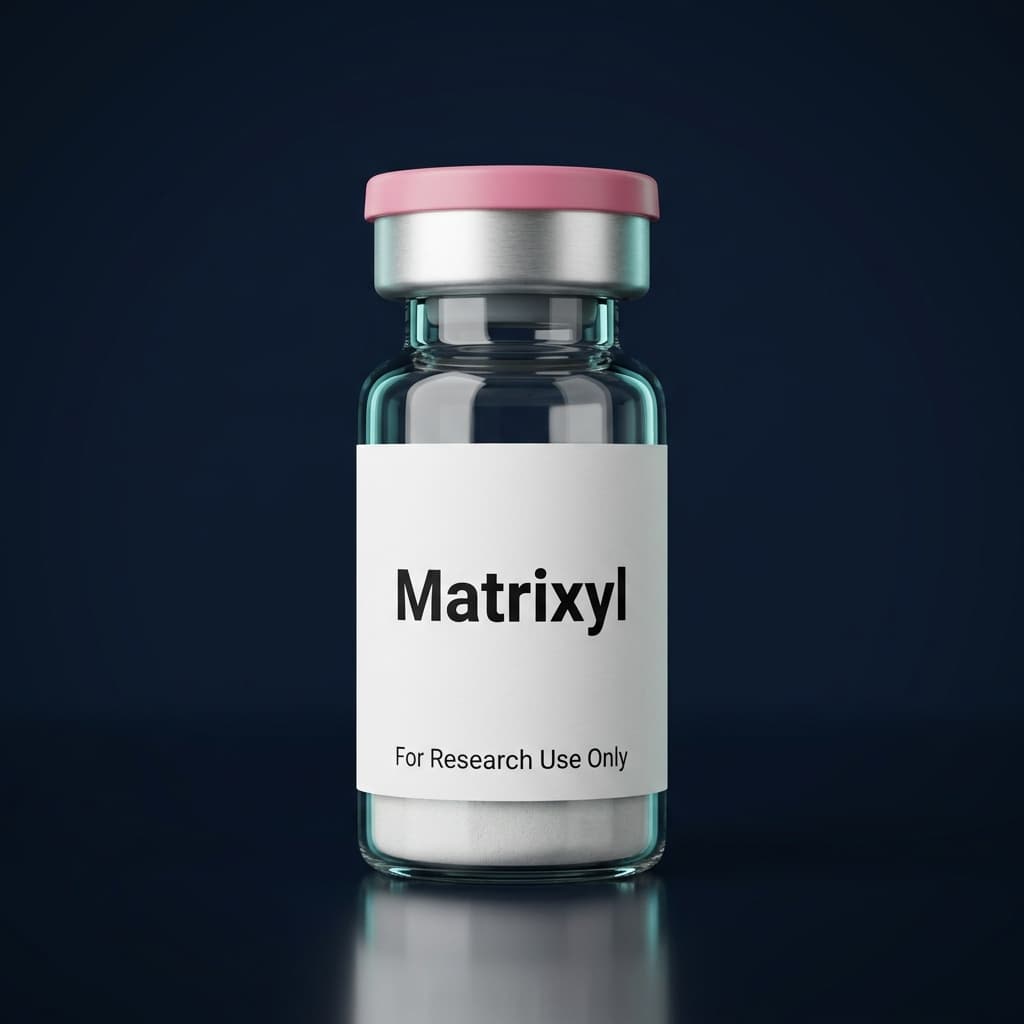
Matrixyl 10mg
≥98% PuritySupplier batch spec; selected lots Janoshik-tested
Related PeptidesDB entry (same owner)
peptidesdb.org
/p/matrixyl
€13.99In Stock
Only 3 left in stock — order soon
Delivers to EU in 3-7 business days
Free shipping over €200 · no customs paperwork (EU) · via EU carrier network
1
Total: €13.99
Free shipping on orders over €200
Matrixyl (Palmitoyl Pentapeptide-4) is a synthetic matrikine composed of a pro-collagen I fragment linked to a palmitoyl chain for enhanced membrane penetration. Studied for stimulating extracellular matrix production. Supplied as lyophilized powder shipped to a ≥98% supplier batch specification; selected lots are independently tested (99.4% avg across published reports). For research purposes only. Not for human consumption.
Volume PricingApplied automatically at checkout
| Quantity | Price Each | Total | Savings |
|---|---|---|---|
| 1 unit | €13.99 | €13.99 | -- |
| 3+ | €13.29 | €39.87 | 5% off |
| 5+Most Popular | €12.59 | €62.96 | 10% off |
| 10+ | €11.89 | €118.92 | 15% off |
Important Notice
This product is intended for laboratory and research use only. Not for human or veterinary use. By purchasing, you confirm this product will be used exclusively for in-vitro research purposes.
Reconstitution Required
This peptide ships lyophilized (dry powder) and requires bacteriostatic water to reconstitute before use. BAC water is sold separately.
When This Product May Not Suit Your Research
- ⚠If your research requires GMP-grade material for clinical applications — research-grade peptides are not intended for clinical use.
- ⚠If your lab lacks proper cold storage (-20°C freezer) — this peptide's stability may be compromised at higher temperatures.
- ⚠If your study protocol requires FDA-approved reference standards — contact USP or a certified reference material provider.
Purity HPLC
99.4% average HPLC purity across our published lab reports
Third-Party Tested
Janoshik report published when available
Fast Shipping
24h dispatch, EU-wide shipping from €4.99
Third-Party Tested
Supplier batch specification on every product; independent Janoshik report on selected lots
Last reviewed: 2026-07-28
About Matrixyl 10mg
Matrixyl is the trade name for palmitoyl pentapeptide-4 (Pal-KTTKS), a lipopeptide that emerged from wound-healing research in the early 2000s. The core sequence -- lysine-threonine-threonine-lysine-serine -- is a fragment of the procollagen I C-propeptide, and when palmitoylated it becomes membrane-permeable enough to reach dermal fibroblasts. That structural relationship to collagen's own signaling machinery is what drew cosmetic and dermatological researchers to it initially.
Research Context
In vitro, Pal-KTTKS upregulates collagen I, collagen III, and fibronectin synthesis in human dermal fibroblasts. The mechanism appears to involve TGF-beta-independent pathways, which is notable because most profibrotic signals run through TGF-beta and carry the risk of excess scarring. Whether this in vitro activity translates cleanly to in vivo outcomes is still being worked out -- the literature has some positive small trials and some results that are harder to interpret. The fatty acid tail matters for tissue penetration: without palmitoylation, the peptide stays largely at the surface.
Research applications include studies of extracellular matrix remodeling, fibroblast proliferation in cited models kinetics, and fibroblast behavior under aged conditions. Some groups have used Matrixyl to probe the signaling gap between procollagen processing and de novo synthesis initiation. Comparison with Matrixyl 3000 (which adds palmitoyl tripeptide-1) is another active area -- the two peptides seem to engage complementary receptor populations.
Specifications
| Parameter | Value |
|---|---|
| Active compound | Palmitoyl pentapeptide-4 (Pal-KTTKS) |
| Quantity | 10mg lyophilized powder |
| Purity | ≥98% (supplier batch spec; 99.4% avg across independently tested lots) |
| Molecular weight | 802.1 Da |
| Sequence | Pal-Lys-Thr-Thr-Lys-Ser |
| Form | Lyophilized powder |
| Certificate of Analysis | Available on request |
Storage
Store at -20°C, protected from light and moisture. Stable for at least 24 months under proper conditions. Reconstitute in sterile water or PBS for laboratory use. Avoid repeated freeze-thaw cycles. Intended for research use by qualified personnel.
What distinguishes Matrixyl from other collagen-stimulating research compounds?
Its structural derivation from the procollagen C-propeptide is the key differentiator. Rather than acting as a generic growth factor stimulus, Pal-KTTKS mimics a native feedback signal that fibroblasts use to gauge collagen turnover. It also operates through TGF-beta-independent pathways, which is useful for research contexts where the standard profibrotic axis would confound results.
Does the palmitoyl group affect experimental handling?
Yes. The fatty acid tail makes the compound somewhat lipophilic, so reconstitution may require a small amount of DMSO or ethanol before aqueous dilution. For cell culture experiments, carrier concentrations should be kept low (under 0.1% DMSO) to avoid cytotoxic effects that could confound fibroblast assays. Vortexing briefly after dilution usually achieves good dispersion.
Matrixyl (Pal-KTTKS) is supplied for laboratory research use only. Not approved for human administration. For research purposes only.
Specification Summary
FormLyophilized Powder
Storage-20\u00B0C
About Matrixyl 10mg
Matrixyl is the trade name for palmitoyl pentapeptide-4 (Pal-KTTKS), a lipopeptide that emerged from wound-healing research in the early 2000s. The core sequence -- lysine-threonine-threonine-lysine-serine -- is a fragment of the procollagen I C-propeptide, and when palmitoylated it becomes membrane-permeable enough to reach dermal fibroblasts. That structural relationship to collagen's own signaling machinery is what drew cosmetic and dermatological researchers to it initially.
Research Context
In vitro, Pal-KTTKS upregulates collagen I, collagen III, and fibronectin synthesis in human dermal fibroblasts. The mechanism appears to involve TGF-beta-independent pathways, which is notable because most profibrotic signals run through TGF-beta and carry the risk of excess scarring. Whether this in vitro activity translates cleanly to in vivo outcomes is still being worked out -- the literature has some positive small trials and some results that are harder to interpret. The fatty acid tail matters for tissue penetration: without palmitoylation, the peptide stays largely at the surface.
Research applications include studies of extracellular matrix remodeling, fibroblast proliferation in cited models kinetics, and fibroblast behavior under aged conditions. Some groups have used Matrixyl to probe the signaling gap between procollagen processing and de novo synthesis initiation. Comparison with Matrixyl 3000 (which adds palmitoyl tripeptide-1) is another active area -- the two peptides seem to engage complementary receptor populations.
Specifications
| Parameter | Value |
|---|---|
| Active compound | Palmitoyl pentapeptide-4 (Pal-KTTKS) |
| Quantity | 10mg lyophilized powder |
| Purity | ≥98% (supplier batch spec; 99.4% avg across independently tested lots) |
| Molecular weight | 802.1 Da |
| Sequence | Pal-Lys-Thr-Thr-Lys-Ser |
| Form | Lyophilized powder |
| Certificate of Analysis | Available on request |
Storage
Store at -20°C, protected from light and moisture. Stable for at least 24 months under proper conditions. Reconstitute in sterile water or PBS for laboratory use. Avoid repeated freeze-thaw cycles. Intended for research use by qualified personnel.
What distinguishes Matrixyl from other collagen-stimulating research compounds?
Its structural derivation from the procollagen C-propeptide is the key differentiator. Rather than acting as a generic growth factor stimulus, Pal-KTTKS mimics a native feedback signal that fibroblasts use to gauge collagen turnover. It also operates through TGF-beta-independent pathways, which is useful for research contexts where the standard profibrotic axis would confound results.
Does the palmitoyl group affect experimental handling?
Yes. The fatty acid tail makes the compound somewhat lipophilic, so reconstitution may require a small amount of DMSO or ethanol before aqueous dilution. For cell culture experiments, carrier concentrations should be kept low (under 0.1% DMSO) to avoid cytotoxic effects that could confound fibroblast assays. Vortexing briefly after dilution usually achieves good dispersion.
Matrixyl (Pal-KTTKS) is supplied for laboratory research use only. Not approved for human administration. For research purposes only.
Researcher Confidence
Why researchers choose CertaPeptides
Who actually tests this?
Selected lots are independently verified by Janoshik Analytical (Czech Republic) and published on the Janoshik public portal. Other lots ship with the supplier's batch specification. See /coa for the published wall.
View COAs →What if I get the wrong batch?
Every bottle label carries a lot number that maps to a specific Certificate of Analysis. If a batch fails spec, we don't ship it — full stop.
View COAs →Where does it ship from?
Romania (EU). We are CERTALAB SRL, CUI 54169956, VAT-registered. Sameday for Romania, GLS for most EU destinations, TCE Worldwide for the remaining cross-border EU and non-EU markets (UK, Switzerland, Iceland, Israel, Serbia). Delivery 1–15 business days depending on destination — exact window shown at checkout.
Shipping details →What if there's a problem?
You have a 14-day withdrawal right under OUG 34/2014 (Romanian/EU consumer law), with ANPC/ODR escalation available. Contact us at support@certapeptides.com.
Returns policy →Product Information
This product is intended for scientific research and development purposes only. It is a chemical substance that shall not be used as a drug, medicine, active substance, or ingredient in any product intended for human or animal consumption. Researchers must handle this compound in accordance with their institutional biosafety guidelines. Use only in properly equipped laboratory settings with appropriate personal protective equipment.
Frequently Asked
Research Library
Related Research Articles
Frequently researched together

Matrixyl 10mg€13.99
1