Research-grade compound. Laboratory use only. Not intended for human or animal use, ingestion, or injection. No medical claims are made or implied.
≥98% PuritySupplier batch spec · ≥98% (class spec)
Tissue Healing and Regeneration Research CompoundsSKU: CP-375
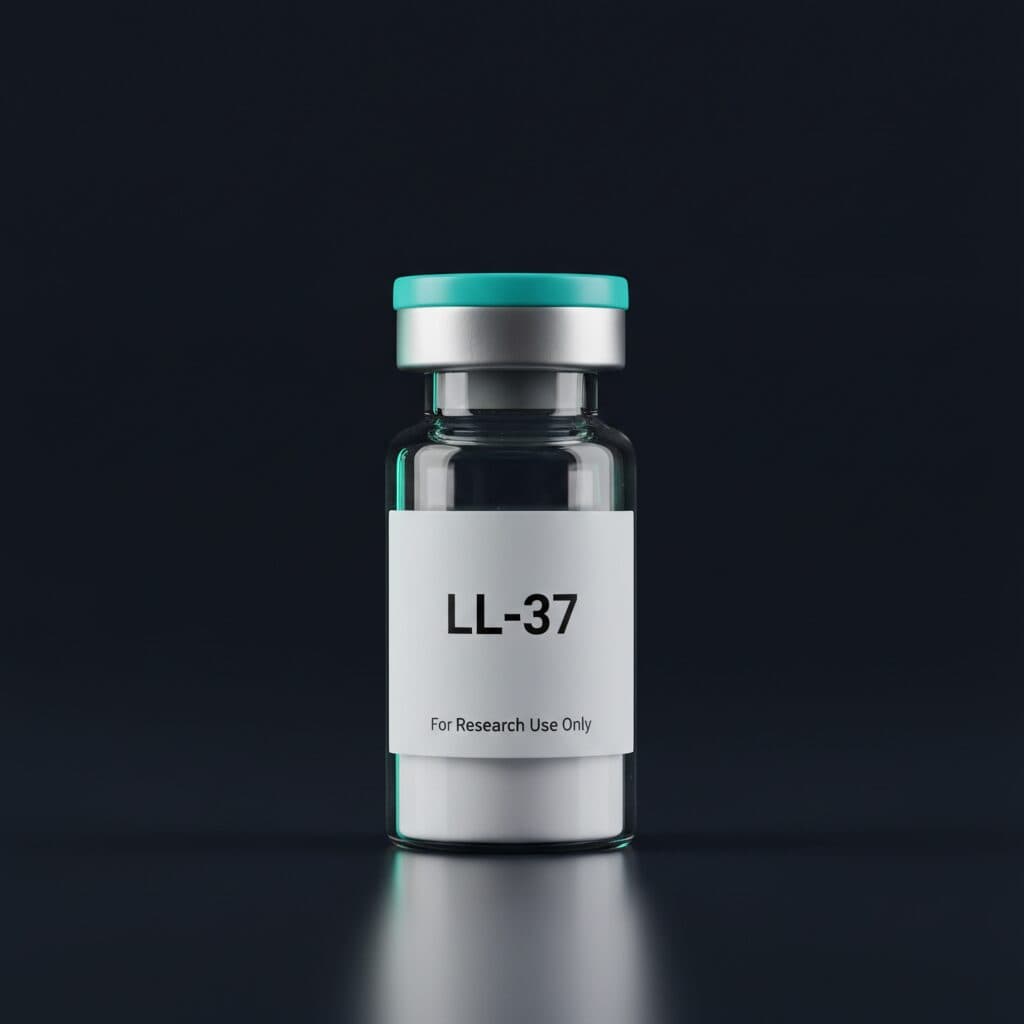
LL-37 5mg
≥98% PuritySupplier batch spec; selected lots Janoshik-tested
Related PeptidesDB entry (same owner)
peptidesdb.org
/p/ll-37
€76.99In Stock
Only 6 left in stock — order soon
Delivers to EU in 3-7 business days
Free shipping over €200 · no customs paperwork (EU) · via EU carrier network
1
Total: €76.99
Free shipping on orders over €200
LL-37 is a 37-amino acid peptide belonging to the cathelicidin family. It is the only human cathelicidin and has been widely studied for its role in innate immune signaling and host defense peptide research. Human cathelicidin host defense peptide Innate immune signaling and membrane interaction studies Biofilm disruption and microbiology research For research purposes only. Not for human consumption.
Volume PricingApplied automatically at checkout
| Quantity | Price Each | Total | Savings |
|---|---|---|---|
| 1 unit | €76.99 | €76.99 | -- |
| 3+ | €73.14 | €219.42 | 5% off |
| 5+Most Popular | €69.29 | €346.46 | 10% off |
| 10+ | €65.44 | €654.42 | 15% off |
Important Notice
This product is intended for laboratory and research use only. Not for human or veterinary use. By purchasing, you confirm this product will be used exclusively for in-vitro research purposes.
Reconstitution Required
This peptide ships lyophilized (dry powder) and requires bacteriostatic water to reconstitute before use. BAC water is sold separately.
Recommended: PBS · stable for 7 days at 2-8°C once mixed.
When This Product May Not Suit Your Research
- ⚠If your research requires GMP-grade material for clinical applications — research-grade peptides are not intended for clinical use.
- ⚠If your lab lacks proper cold storage (-20°C freezer) — this peptide's stability may be compromised at higher temperatures.
- ⚠If your study protocol requires FDA-approved reference standards — contact USP or a certified reference material provider.
Purity HPLC
99.2% average HPLC purity, verified by independent third-party testing
Third-Party Tested
Janoshik report published when available
Fast Shipping
24h dispatch, EU-wide shipping from €4.99
Third-Party Tested
Supplier batch specification on every product; independent Janoshik report on selected lots
Last reviewed: 2026-06-25
About LL-37 5mg
LL-37 is the only human cathelicidin -- a class of host defense peptides that bridge innate immunity and antimicrobial defense. It is derived from the C-terminus of the hCAP-18 protein (human cathelicidin antimicrobial protein 18), processed by serine proteases into the active 37-amino acid LL-37 form. The name reflects its structure: it begins with two leucine residues (LL) and is 37 amino acids long. Despite being the sole human cathelicidin, it is expressed in neutrophils, epithelial cells of the skin, gut, lung, and urogenital tract -- providing frontline defense at multiple barrier sites.
LL-37's antimicrobial mechanism involves disruption of bacterial membranes. Its amphipathic alpha-helical structure allows it to insert into and permeabilize bacterial lipid bilayers, killing a broad spectrum of gram-positive and gram-negative bacteria, fungi, and enveloped viruses. It also binds and neutralizes bacterial LPS (endotoxin), a mechanism studied in models of endotoxin signalling. Beyond direct killing, LL-37 has extensive immunomodulatory functions -- it activates epithelial cells, macrophages, and dendritic cells, modulates TLR signaling, and is studied for fibroblast and angiogenesis responses in tissue-repair model systems.
Research interest spans antimicrobial-peptide biology, tissue-repair model systems, skin-barrier-model and lung host-defense research, anti-biofilm strategies, and oncology research (LL-37 has context-dependent pro- and anti-tumor effects in different cancer models).
Specifications
| Parameter | Value |
|---|---|
| Compound | LL-37 (human cathelicidin antimicrobial peptide, 37 aa) |
| Amount per Vial | 5mg |
| Purity | ≥98% (supplier batch specification); selected lots independently tested by Janoshik (HPLC + mass spectrometry), searchable at certapeptides.com/verify |
| Format | Lyophilized powder |
| Reconstitution | Sterile water; avoid high salt concentrations |
| Storage | -20°C; 2-8°C after reconstitution |
Storage
Store at -20°C. LL-37 can aggregate in high ionic strength solutions -- reconstitute in low-salt buffer or sterile water and then add buffer. Refrigerate at 2-8°C after reconstitution and use within 14 days. Avoid repeated freeze-thaw.
How does LL-37 kill bacteria without killing host cells?
LL-37 kills bacteria by disrupting their membranes through its amphipathic alpha-helical structure -- one face of the helix is hydrophobic, the other cationic. Bacterial membranes are negatively charged due to high phosphatidylglycerol and cardiolipin content, attracting the cationic LL-37. Once bound, the peptide inserts into and permeabilizes the bacterial membrane. Mammalian cell membranes are primarily zwitterionic (net neutral) and are less susceptible to this mechanism, though selectivity is concentration-dependent. High LL-37 concentrations can lyse mammalian cells. Research protocols must account for this concentration-dependent selectivity.
Why is LL-37 the only human cathelicidin?
While mice and many other mammals have multiple cathelicidin genes, humans have only one -- the CAMP gene encoding the hCAP-18/LL-37 precursor. The reasons for this reduction to a single cathelicidin in human evolution are not fully understood, but it may relate to immune system specialization in humans toward other defense mechanisms. Despite being alone in its class, LL-37 is expressed at many epithelial surfaces and in immune cells, and its immunomodulatory functions extend well beyond direct antimicrobial killing -- suggesting it has evolved to serve multiple host defense roles that might be distributed across multiple cathelicidins in other species.
What is LL-37's role in tissue-repair model research?
LL-37 is studied for tissue-repair responses in model systems through several mechanisms. In cited models it is associated with keratinocyte migration and proliferation, angiogenesis signalling through VEGF and FGF receptor pathways, and modulation of the inflammatory phase of tissue-repair models, alongside anti-biofilm activity studied in antimicrobial-model systems. These properties have made LL-37 of interest in barrier-model and anti-biofilm research. LL-37-functionalised dressings and scaffolds have also been investigated in tissue-repair model systems.
LL-37 is supplied for laboratory research use only. Not for human use. Handle in compliance with institutional biosafety guidelines.
Specification Summary
Purity99.2% avg
FormLyophilized Powder
Storage-20\u00B0C
About LL-37 5mg
LL-37 is the only human cathelicidin -- a class of host defense peptides that bridge innate immunity and antimicrobial defense. It is derived from the C-terminus of the hCAP-18 protein (human cathelicidin antimicrobial protein 18), processed by serine proteases into the active 37-amino acid LL-37 form. The name reflects its structure: it begins with two leucine residues (LL) and is 37 amino acids long. Despite being the sole human cathelicidin, it is expressed in neutrophils, epithelial cells of the skin, gut, lung, and urogenital tract -- providing frontline defense at multiple barrier sites.
LL-37's antimicrobial mechanism involves disruption of bacterial membranes. Its amphipathic alpha-helical structure allows it to insert into and permeabilize bacterial lipid bilayers, killing a broad spectrum of gram-positive and gram-negative bacteria, fungi, and enveloped viruses. It also binds and neutralizes bacterial LPS (endotoxin), a mechanism studied in models of endotoxin signalling. Beyond direct killing, LL-37 has extensive immunomodulatory functions -- it activates epithelial cells, macrophages, and dendritic cells, modulates TLR signaling, and is studied for fibroblast and angiogenesis responses in tissue-repair model systems.
Research interest spans antimicrobial-peptide biology, tissue-repair model systems, skin-barrier-model and lung host-defense research, anti-biofilm strategies, and oncology research (LL-37 has context-dependent pro- and anti-tumor effects in different cancer models).
Specifications
| Parameter | Value |
|---|---|
| Compound | LL-37 (human cathelicidin antimicrobial peptide, 37 aa) |
| Amount per Vial | 5mg |
| Purity | ≥98% (supplier batch specification); selected lots independently tested by Janoshik (HPLC + mass spectrometry), searchable at certapeptides.com/verify |
| Format | Lyophilized powder |
| Reconstitution | Sterile water; avoid high salt concentrations |
| Storage | -20°C; 2-8°C after reconstitution |
Storage
Store at -20°C. LL-37 can aggregate in high ionic strength solutions -- reconstitute in low-salt buffer or sterile water and then add buffer. Refrigerate at 2-8°C after reconstitution and use within 14 days. Avoid repeated freeze-thaw.
How does LL-37 kill bacteria without killing host cells?
LL-37 kills bacteria by disrupting their membranes through its amphipathic alpha-helical structure -- one face of the helix is hydrophobic, the other cationic. Bacterial membranes are negatively charged due to high phosphatidylglycerol and cardiolipin content, attracting the cationic LL-37. Once bound, the peptide inserts into and permeabilizes the bacterial membrane. Mammalian cell membranes are primarily zwitterionic (net neutral) and are less susceptible to this mechanism, though selectivity is concentration-dependent. High LL-37 concentrations can lyse mammalian cells. Research protocols must account for this concentration-dependent selectivity.
Why is LL-37 the only human cathelicidin?
While mice and many other mammals have multiple cathelicidin genes, humans have only one -- the CAMP gene encoding the hCAP-18/LL-37 precursor. The reasons for this reduction to a single cathelicidin in human evolution are not fully understood, but it may relate to immune system specialization in humans toward other defense mechanisms. Despite being alone in its class, LL-37 is expressed at many epithelial surfaces and in immune cells, and its immunomodulatory functions extend well beyond direct antimicrobial killing -- suggesting it has evolved to serve multiple host defense roles that might be distributed across multiple cathelicidins in other species.
What is LL-37's role in tissue-repair model research?
LL-37 is studied for tissue-repair responses in model systems through several mechanisms. In cited models it is associated with keratinocyte migration and proliferation, angiogenesis signalling through VEGF and FGF receptor pathways, and modulation of the inflammatory phase of tissue-repair models, alongside anti-biofilm activity studied in antimicrobial-model systems. These properties have made LL-37 of interest in barrier-model and anti-biofilm research. LL-37-functionalised dressings and scaffolds have also been investigated in tissue-repair model systems.
LL-37 is supplied for laboratory research use only. Not for human use. Handle in compliance with institutional biosafety guidelines.
What research shows
Selected peer-reviewed studies from the published literature. Each describes laboratory or preclinical findings and is attributed to the cited study, not to this product. For research use only — not medical guidance.
[1]
Wound healing
In in-vitro and in-vivo research, the human cathelicidin LL-37 was reported to promote wound-healing-associated activities.
In vitro and in vivo wound healing-promoting activities of human cathelicidin LL-37. Journal of Investigative Dermatology (2008). PMID: 17805349[2]
Immunomodulation
In cultured macrophages, LL-37 was shown to inhibit LPS/ATP-induced pyroptosis through a dual mechanism in in-vitro research.
Antimicrobial cathelicidin peptide LL-37 inhibits the LPS/ATP-induced pyroptosis of macrophages by dual mechanism. PLoS One (2014). PMID: 24454930[3]
Endotoxin neutralization
In in-vitro research, CAP18/LL-37-derived antimicrobial peptides displayed lipopolysaccharide-neutralizing activity enhanced by hydrophobic and cationic residue substitutions.
Augmentation of the lipopolysaccharide-neutralizing activities of human cathelicidin CAP18/LL-37-derived antimicrobial peptides by replacement with hydrophobic and cationic amino acid residues. Clinical and Diagnostic Laboratory Immunology (2002). PMID: 12204946Citations are provided for research reference. CertaPeptides (CERTALAB S.R.L.) is a reseller, not a manufacturer, and makes no medical, therapeutic, or efficacy claims. Products are for laboratory research use only and are not for human or animal consumption.
Researcher Confidence
Why researchers choose CertaPeptides
Who actually tests this?
Selected lots are independently verified by Janoshik Analytical (Czech Republic) and published on the Janoshik public portal. Other lots ship with the supplier's batch specification. See /coa for the published wall.
View COAs →What if I get the wrong batch?
Every bottle label carries a lot number that maps to a specific Certificate of Analysis. If a batch fails spec, we don't ship it — full stop.
View COAs →Where does it ship from?
Romania (EU). We are CERTALAB SRL, CUI 54169956, VAT-registered. Sameday for Romania, GLS for most EU destinations, TCE Worldwide for the remaining cross-border EU and non-EU markets (UK, Switzerland, Norway, Iceland, Israel, Serbia). Delivery 1–15 business days depending on destination — exact window shown at checkout.
Shipping details →What if there's a problem?
You have a 14-day withdrawal right under OUG 34/2014 (Romanian/EU consumer law), with ANPC/ODR escalation available. Contact us at support@certapeptides.com.
Returns policy →Product Information
This product is intended for scientific research and development purposes only. It is a chemical substance that shall not be used as a drug, medicine, active substance, or ingredient in any product intended for human or animal consumption. Researchers must handle this compound in accordance with their institutional biosafety guidelines. Use only in properly equipped laboratory settings with appropriate personal protective equipment.
Frequently Asked
Research Library
Related Research Articles
Frequently researched together
LL-37 5mg€76.99
1