Research-grade compound. Laboratory use only. Not intended for human or animal use, ingestion, or injection. No medical claims are made or implied.
≥98% PuritySupplier batch spec · ≥98% (class spec)Sale
Endocrine and Hormone Research PeptidesSKU: CP-HEX
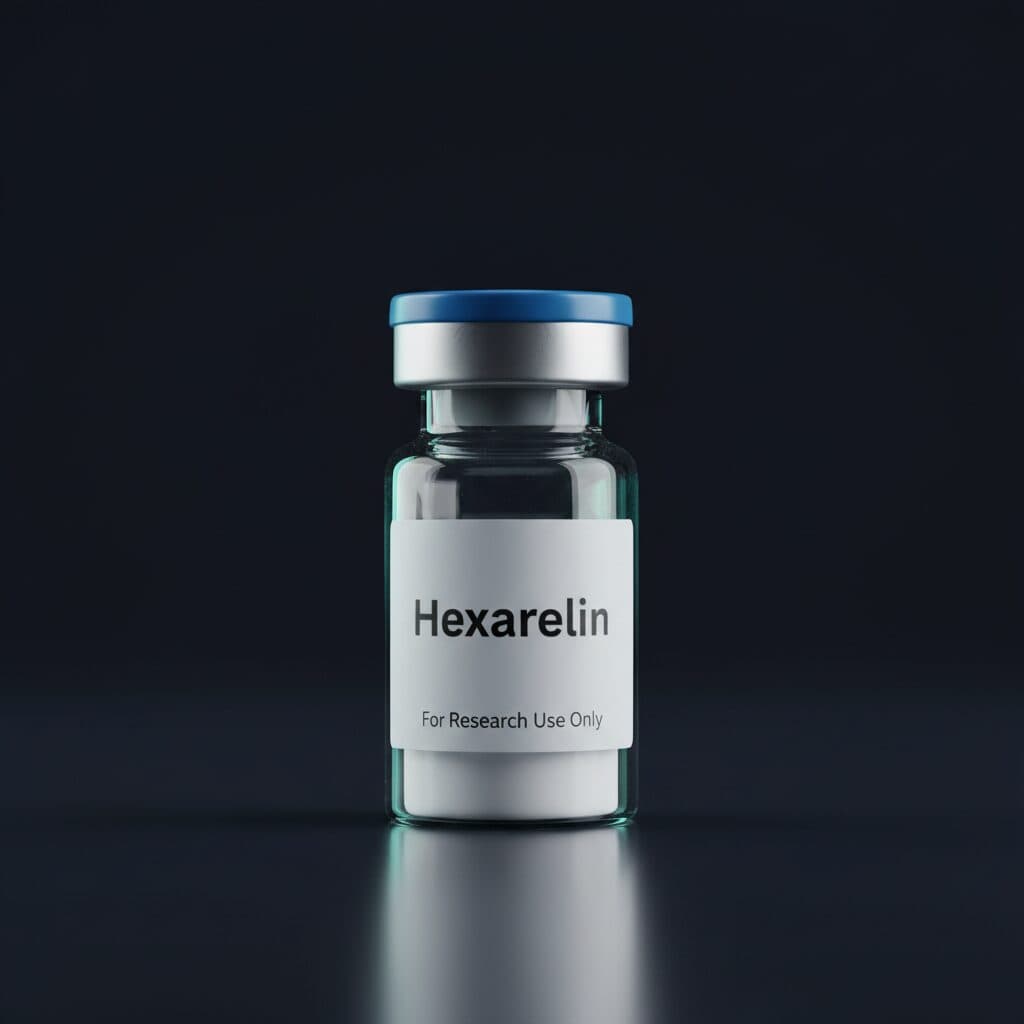
Hexarelin Acetate
≥98% PuritySupplier batch spec; selected lots Janoshik-tested
Related PeptidesDB entry (same owner)
peptidesdb.org
/p/hexarelin
Delivers to EU in 3-7 business days
Free shipping over €200 · no customs paperwork (EU) · via EU carrier network
Size2mg
€25.99€27.99
1
Total: €25.99
Free shipping on orders over €200
Hexarelin is a synthetic hexapeptide growth hormone secretagogue and one of the most potent GHS-R1a receptor agonists studied. It has been researched for its strong growth hormone-releasing properties and cardioprotective effects. Potent synthetic GH secretagogue hexapeptide Growth hormone release and axis stimulation Cardiovascular and cardioprotective research For research purposes only.
Important Notice
This product is intended for laboratory and research use only. Not for human or veterinary use. By purchasing, you confirm this product will be used exclusively for in-vitro research purposes.
Reconstitution Required
This peptide ships lyophilized (dry powder) and requires bacteriostatic water to reconstitute before use. BAC water is sold separately.
When This Product May Not Suit Your Research
- ⚠If your research requires GMP-grade material for clinical applications — research-grade peptides are not intended for clinical use.
- ⚠If your lab lacks proper cold storage (-20°C freezer) — this peptide's stability may be compromised at higher temperatures.
- ⚠If your study protocol requires FDA-approved reference standards — contact USP or a certified reference material provider.
Purity HPLC
99.2% average HPLC purity, verified by independent third-party testing
Third-Party Tested
Janoshik report published when available
Fast Shipping
24h dispatch, EU-wide shipping from €4.99
Third-Party Tested
Supplier batch specification on every product; independent Janoshik report on selected lots
Last reviewed: 2026-06-11
About Hexarelin Acetate
Hexarelin is His-D-2-methyl-Trp-Ala-Trp-D-Phe-Lys-NH2 — a synthetic hexapeptide GHS-R1a agonist developed as an analog of GHRP-6, with two structural changes that increase receptor binding affinity and metabolic stability. The result is one of the most potent synthetic GHS peptides in terms of GH release per unit dose. Arvat's 1997 comparison study ran hexarelin, GHRP-2, GHRP-6, and GHRH side by side in research models. Hexarelin produced the highest GH peak of the group. CAS: 140703-51-1. MW 887.0 Da.
The trade-off for that potency is selectivity. Ipamorelin's value in research is a clean GHS-R1a signal without off-target effects. Hexarelin doesn't offer that — it stimulates modest but measurable increases in prolactin, ACTH, and cortisol alongside GH, a consequence of receptor affinity extending to non-somatotroph populations. For experiments where clean GH-axis isolation matters, that's a limitation. For experiments characterizing the full downstream consequences of potent GHS-R1a activation, it's the relevant profile.
The Cardiac Signal
Beyond the pituitary, hexarelin has a documented GH-independent cardiac activity. It binds CD36 — a scavenger receptor expressed on cardiomyocytes — through a mechanism distinct from GHS-R1a. This cardiac signaling pathway has been studied in ischemia-reperfusion models, where hexarelin shows cardioprotective effects that persist in GH-deficient animals, confirming the effect is independent of GH axis activation. Two independent receptor systems in one compound: the pituitary GHS-R1a signal and the cardiac CD36 signal. Researchers working in GH pharmacology and those studying cardiac peptide biology can both find use here, though the experimental designs needed to isolate each pathway differ substantially.
Specifications
| Molecular Weight | 887.0 Da |
|---|---|
| Sequence | His-D-2-Me-Trp-Ala-Trp-D-Phe-Lys-NH2 |
| CAS | 140703-51-1 |
| Purity | ≥98% (supplier batch spec; 99.3% avg across independently tested lots) |
| Form | Lyophilized powder |
| Sizes | 2mg, 5mg |
Storage: −20°C, protected from light. Reconstitute in sterile water or 0.1% acetic acid; use within 4 weeks at 4°C.
Quality: Shipped to a ≥98% supplier batch specification; selected lots are independently tested by Janoshik Analytical (HPLC + mass spectrometry; 99.3% average purity across published reports), searchable by batch code at certapeptides.com/verify. EU-based QC under CERTALAB S.R.L.
Frequently Asked Questions
What is hexarelin's cardiac mechanism?
Hexarelin binds CD36, a scavenger receptor expressed on cardiomyocytes, independently of GHS-R1a. In ischemia-reperfusion models, this produces cardioprotective effects that persist in GH-deficient animals — confirming the effect is not mediated through GH axis activation. The CD36-binding activity is a distinct pharmacological property of hexarelin not shared by other GHRP family members like GHRP-2, GHRP-6, or ipamorelin.
When would you choose hexarelin over GHRP-2 or ipamorelin?
Hexarelin is the right choice when maximum GH stimulation is the goal and off-target effects are acceptable or part of the experimental question. It's also the appropriate tool for any research on the CD36 cardiac pathway, where neither GHRP-2 nor ipamorelin provides activity. For clean GH research without cortisol or prolactin confounds, ipamorelin is the better choice. For positive controls requiring the highest GH output, hexarelin or GHRP-2 are appropriate depending on how the cortisol/prolactin effects factor into the design.
For research purposes only. Not for human consumption.
Specification Summary
Purity99.2% avg
FormLyophilized Powder
Storage-20\u00B0C
About Hexarelin Acetate
Hexarelin is His-D-2-methyl-Trp-Ala-Trp-D-Phe-Lys-NH2 — a synthetic hexapeptide GHS-R1a agonist developed as an analog of GHRP-6, with two structural changes that increase receptor binding affinity and metabolic stability. The result is one of the most potent synthetic GHS peptides in terms of GH release per unit dose. Arvat's 1997 comparison study ran hexarelin, GHRP-2, GHRP-6, and GHRH side by side in research models. Hexarelin produced the highest GH peak of the group. CAS: 140703-51-1. MW 887.0 Da.
The trade-off for that potency is selectivity. Ipamorelin's value in research is a clean GHS-R1a signal without off-target effects. Hexarelin doesn't offer that — it stimulates modest but measurable increases in prolactin, ACTH, and cortisol alongside GH, a consequence of receptor affinity extending to non-somatotroph populations. For experiments where clean GH-axis isolation matters, that's a limitation. For experiments characterizing the full downstream consequences of potent GHS-R1a activation, it's the relevant profile.
The Cardiac Signal
Beyond the pituitary, hexarelin has a documented GH-independent cardiac activity. It binds CD36 — a scavenger receptor expressed on cardiomyocytes — through a mechanism distinct from GHS-R1a. This cardiac signaling pathway has been studied in ischemia-reperfusion models, where hexarelin shows cardioprotective effects that persist in GH-deficient animals, confirming the effect is independent of GH axis activation. Two independent receptor systems in one compound: the pituitary GHS-R1a signal and the cardiac CD36 signal. Researchers working in GH pharmacology and those studying cardiac peptide biology can both find use here, though the experimental designs needed to isolate each pathway differ substantially.
Specifications
| Molecular Weight | 887.0 Da |
|---|---|
| Sequence | His-D-2-Me-Trp-Ala-Trp-D-Phe-Lys-NH2 |
| CAS | 140703-51-1 |
| Purity | ≥98% (supplier batch spec; 99.3% avg across independently tested lots) |
| Form | Lyophilized powder |
| Sizes | 2mg, 5mg |
Storage: −20°C, protected from light. Reconstitute in sterile water or 0.1% acetic acid; use within 4 weeks at 4°C.
Quality: Shipped to a ≥98% supplier batch specification; selected lots are independently tested by Janoshik Analytical (HPLC + mass spectrometry; 99.3% average purity across published reports), searchable by batch code at certapeptides.com/verify. EU-based QC under CERTALAB S.R.L.
Frequently Asked Questions
What is hexarelin's cardiac mechanism?
Hexarelin binds CD36, a scavenger receptor expressed on cardiomyocytes, independently of GHS-R1a. In ischemia-reperfusion models, this produces cardioprotective effects that persist in GH-deficient animals — confirming the effect is not mediated through GH axis activation. The CD36-binding activity is a distinct pharmacological property of hexarelin not shared by other GHRP family members like GHRP-2, GHRP-6, or ipamorelin.
When would you choose hexarelin over GHRP-2 or ipamorelin?
Hexarelin is the right choice when maximum GH stimulation is the goal and off-target effects are acceptable or part of the experimental question. It's also the appropriate tool for any research on the CD36 cardiac pathway, where neither GHRP-2 nor ipamorelin provides activity. For clean GH research without cortisol or prolactin confounds, ipamorelin is the better choice. For positive controls requiring the highest GH output, hexarelin or GHRP-2 are appropriate depending on how the cortisol/prolactin effects factor into the design.
For research purposes only. Not for human consumption.
What research shows
Selected peer-reviewed studies from the published literature. Each describes laboratory or preclinical findings and is attributed to the cited study, not to this product. For research use only — not medical guidance.
[1]
Growth hormone secretion
In cell-culture studies of human pituitary somatotroph cells, Hexarelin was investigated as a GH secretagogue for its effects on GH secretion and phosphatidylinositol hydrolysis.
Effects of the novel GH secretagogue hexarelin on GH secretion and phosphatidylinositol hydrolysis by human pituitary somatotrophinomas in cell culture. Journal of Tongji Medical University (1999). PMID: 12840903[2]
Cardiac function
In rat models of myocardial infarction, oral administration of Hexarelin was studied for its association with preserved chronic cardiac function.
One dose of oral hexarelin protects chronic cardiac function after myocardial infarction. Peptides (2014). PMID: 24747279[3]
Cardiovascular mechanism (CD36)
In preclinical cardiac research, the CD36 receptor was identified as a mediator of the cardiovascular action of growth hormone-releasing peptides such as Hexarelin in the heart.
CD36 mediates the cardiovascular action of growth hormone-releasing peptides in the heart. Circulation Research (2002). PMID: 11988484Citations are provided for research reference. CertaPeptides (CERTALAB S.R.L.) is a reseller, not a manufacturer, and makes no medical, therapeutic, or efficacy claims. Products are for laboratory research use only and are not for human or animal consumption.
Researcher Confidence
Why researchers choose CertaPeptides
Who actually tests this?
Selected lots are independently verified by Janoshik Analytical (Czech Republic) and published on the Janoshik public portal. Other lots ship with the supplier's batch specification. See /coa for the published wall.
View COAs →What if I get the wrong batch?
Every bottle label carries a lot number that maps to a specific Certificate of Analysis. If a batch fails spec, we don't ship it — full stop.
View COAs →Where does it ship from?
Romania (EU). We are CERTALAB SRL, CUI 54169956, VAT-registered. Sameday for Romania, GLS for most EU destinations, TCE Worldwide for the remaining cross-border EU and non-EU markets (UK, Switzerland, Norway, Iceland, Israel, Serbia). Delivery 1–15 business days depending on destination — exact window shown at checkout.
Shipping details →What if there's a problem?
You have a 14-day withdrawal right under OUG 34/2014 (Romanian/EU consumer law), with ANPC/ODR escalation available. Contact us at support@certapeptides.com.
Returns policy →Product Information
This product is intended for scientific research and development purposes only. It is a chemical substance that shall not be used as a drug, medicine, active substance, or ingredient in any product intended for human or animal consumption. Researchers must handle this compound in accordance with their institutional biosafety guidelines. Use only in properly equipped laboratory settings with appropriate personal protective equipment.
Frequently Asked
Research Library
Related Research Articles
Frequently researched together
Hexarelin Acetate€25.99