Research-grade compound. Laboratory use only. Not intended for human or animal use, ingestion, or injection. No medical claims are made or implied.
≥98% PuritySupplier batch spec · ≥98% (class spec)Sale
Metabolic and Cellular-Aging Research CompoundsSKU: CP-ADI
Adipotide
≥98% PuritySupplier batch spec; selected lots Janoshik-tested
Related PeptidesDB entry (same owner)
peptidesdb.org
/p/adipotide
Delivers to EU in 3-7 business days
Free shipping over €200 · no customs paperwork (EU) · via EU carrier network
Size2mg
€36.99€39.99
1
Total: €36.99
Free shipping on orders over €200
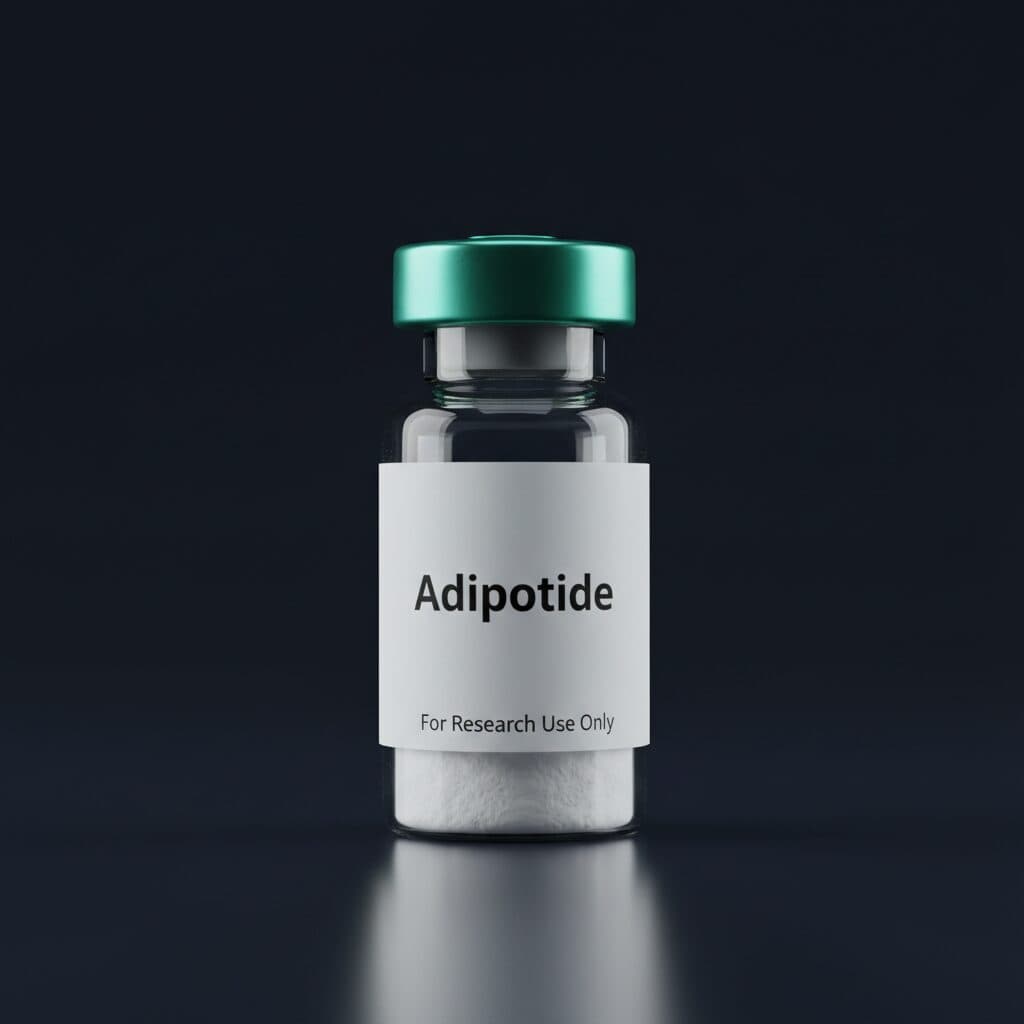
Research-grade Adipotide. ≥98% supplier batch specification; selected lots independently tested (99.3% avg across published reports). Lyophilized powder in sealed glass vial. For laboratory research use only. Not for human consumption.
Important Notice
This product is intended for laboratory and research use only. Not for human or veterinary use. By purchasing, you confirm this product will be used exclusively for in-vitro research purposes.
Reconstitution Required
This peptide ships lyophilized (dry powder) and requires bacteriostatic water to reconstitute before use. BAC water is sold separately.
When This Product May Not Suit Your Research
- ⚠If your research requires GMP-grade material for clinical applications — research-grade peptides are not intended for clinical use.
- ⚠If your lab lacks proper cold storage (-20°C freezer) — this peptide's stability may be compromised at higher temperatures.
- ⚠If your study protocol requires FDA-approved reference standards — contact USP or a certified reference material provider.
Purity HPLC
99.2% average HPLC purity, verified by independent third-party testing
Third-Party Tested
Janoshik report published when available
Fast Shipping
24h dispatch, EU-wide shipping from €4.99
Third-Party Tested
Supplier batch specification on every product; independent Janoshik report on selected lots
Last reviewed: 2026-07-02
About Adipotide
For research purposes only. Not for human or veterinary use. Not a drug, food, or cosmetic.
Overview
Adipotide (also written as FTPP, or by its sequence CKGGRAKDC-GG-D(KLAKLAK)2) is a proapoptotic peptidomimetic built for vascular targeting of white adipose tissue. Two functional halves are joined in a single molecule: a homing peptide, CKGGRAKDC, that binds prohibitin displayed on the endothelium of blood vessels feeding white fat, and a proapoptotic domain, D(KLAKLAK)2, that disrupts mitochondrial membranes once it is internalised. The homing sequence was originally isolated through in vivo phage-display screening for peptides that localise to white adipose tissue vasculature, which is what gives the conjugate its tissue selectivity in research models.
The molecule was characterised by researchers at the University of Texas MD Anderson Cancer Center. It is frequently discussed as a conceptual parallel to antibody-drug conjugates: the cytotoxic payload is only delivered where the targeting element has bound, so activity is concentrated at the intended vascular bed rather than distributed systemically. CertaPeptides is a reseller and supplies Adipotide as a research reagent; we do not manufacture, formulate, or select the salt form of this compound.
Research Areas
Published literature has investigated Adipotide primarily as a tool for studying adipose-tissue vascular biology and the metabolic consequences of ablating fat-feeding vasculature. In the foundational mouse work, targeted ablation of adipose vasculature was studied as a route to reversing diet-induced obesity in the model, establishing prohibitin on adipose endothelium as an addressable target (Kolonin et al., 2004). A later study in obese rhesus monkeys reported reductions in body weight and improvements in insulin resistance in the model animals over a short treatment window, with the authors examining tissue selectivity and renal markers (Barnhart et al., 2011). These two datasets remain the most cited reference points for researchers modelling vascular-targeting approaches to adipose tissue. Typical research questions include how selective prohibitin targeting is across different vascular beds, how model organisms respond to rapid loss of adipose mass, and how the conjugate format governs where apoptosis is triggered.
Specifications
| Compound | Adipotide / CKGGRAKDC-GG-D(KLAKLAK)2 |
|---|---|
| Purity | ≥98% (supplier batch specification) |
| Format | Lyophilized powder |
| Reconstitution | Sterile water or PBS |
| Storage | −20°C lyophilized; 2–8°C after reconstitution, use within 14 days |
Quality & Verification
Every unit ships to a ≥98% supplier batch specification. In addition, selected lots are independently tested by Janoshik Analytical (HPLC and mass spectrometry), and those reports are searchable by batch code at certapeptides.com/verify. We do not claim in-house testing and we do not test every batch — the verification tier is transparent by design: a baseline supplier specification on all units, plus third-party reports on selected lots. EU-based handling under CERTALAB S.R.L.
Frequently Asked Questions
What is adipotide used for in research?
In the published literature, adipotide is used as a research tool to study vascular targeting of white adipose tissue. It combines a peptide that homes to prohibitin on adipose-feeding blood vessels with a proapoptotic domain, letting researchers investigate what happens in model systems when that specific vasculature is ablated. It is supplied for laboratory research only and is not approved for human or veterinary use.
How does adipotide target fat tissue specifically?
The CKGGRAKDC portion of the molecule was identified through in vivo phage-display screening for peptides that home to white adipose tissue vasculature. Its target, prohibitin, is displayed on the endothelium of fat-feeding vessels. Once the homing peptide binds, the D(KLAKLAK)2 domain is internalised and disrupts mitochondrial membranes, so activity is concentrated at the targeted vascular bed rather than distributed broadly.
What did the primate study report?
Barnhart and colleagues (2011, Science Translational Medicine) studied adipotide in obese rhesus monkeys and reported reductions in body weight and improvements in insulin resistance in the model animals over a short treatment period, alongside analysis of tissue selectivity and renal markers. This primate dataset is the most advanced preclinical reference point cited for the compound.
What is a proapoptotic peptide-drug conjugate?
It is a molecule that pairs a targeting peptide with a cell-death-inducing payload, conceptually similar to an antibody-drug conjugate. In adipotide, the targeting peptide delivers the D(KLAKLAK)2 domain to adipose endothelial cells; the payload only acts where the targeting element has bound, which is the source of the conjugate's selectivity in research models.
How should adipotide be stored?
Store the lyophilized powder at −20°C, protected from light. After reconstitution with sterile water or PBS, keep refrigerated at 2–8°C and use within roughly 14 days. Handle in line with standard peptide-handling and institutional biosafety guidelines.
For research purposes only. Not for human consumption.
Specification Summary
Purity99.2% avg
FormLyophilized Powder
Storage-20\u00B0C
About Adipotide
For research purposes only. Not for human or veterinary use. Not a drug, food, or cosmetic.
Overview
Adipotide (also written as FTPP, or by its sequence CKGGRAKDC-GG-D(KLAKLAK)2) is a proapoptotic peptidomimetic built for vascular targeting of white adipose tissue. Two functional halves are joined in a single molecule: a homing peptide, CKGGRAKDC, that binds prohibitin displayed on the endothelium of blood vessels feeding white fat, and a proapoptotic domain, D(KLAKLAK)2, that disrupts mitochondrial membranes once it is internalised. The homing sequence was originally isolated through in vivo phage-display screening for peptides that localise to white adipose tissue vasculature, which is what gives the conjugate its tissue selectivity in research models.
The molecule was characterised by researchers at the University of Texas MD Anderson Cancer Center. It is frequently discussed as a conceptual parallel to antibody-drug conjugates: the cytotoxic payload is only delivered where the targeting element has bound, so activity is concentrated at the intended vascular bed rather than distributed systemically. CertaPeptides is a reseller and supplies Adipotide as a research reagent; we do not manufacture, formulate, or select the salt form of this compound.
Research Areas
Published literature has investigated Adipotide primarily as a tool for studying adipose-tissue vascular biology and the metabolic consequences of ablating fat-feeding vasculature. In the foundational mouse work, targeted ablation of adipose vasculature was studied as a route to reversing diet-induced obesity in the model, establishing prohibitin on adipose endothelium as an addressable target (Kolonin et al., 2004). A later study in obese rhesus monkeys reported reductions in body weight and improvements in insulin resistance in the model animals over a short treatment window, with the authors examining tissue selectivity and renal markers (Barnhart et al., 2011). These two datasets remain the most cited reference points for researchers modelling vascular-targeting approaches to adipose tissue. Typical research questions include how selective prohibitin targeting is across different vascular beds, how model organisms respond to rapid loss of adipose mass, and how the conjugate format governs where apoptosis is triggered.
Specifications
| Compound | Adipotide / CKGGRAKDC-GG-D(KLAKLAK)2 |
|---|---|
| Purity | ≥98% (supplier batch specification) |
| Format | Lyophilized powder |
| Reconstitution | Sterile water or PBS |
| Storage | −20°C lyophilized; 2–8°C after reconstitution, use within 14 days |
Quality & Verification
Every unit ships to a ≥98% supplier batch specification. In addition, selected lots are independently tested by Janoshik Analytical (HPLC and mass spectrometry), and those reports are searchable by batch code at certapeptides.com/verify. We do not claim in-house testing and we do not test every batch — the verification tier is transparent by design: a baseline supplier specification on all units, plus third-party reports on selected lots. EU-based handling under CERTALAB S.R.L.
Frequently Asked Questions
What is adipotide used for in research?
In the published literature, adipotide is used as a research tool to study vascular targeting of white adipose tissue. It combines a peptide that homes to prohibitin on adipose-feeding blood vessels with a proapoptotic domain, letting researchers investigate what happens in model systems when that specific vasculature is ablated. It is supplied for laboratory research only and is not approved for human or veterinary use.
How does adipotide target fat tissue specifically?
The CKGGRAKDC portion of the molecule was identified through in vivo phage-display screening for peptides that home to white adipose tissue vasculature. Its target, prohibitin, is displayed on the endothelium of fat-feeding vessels. Once the homing peptide binds, the D(KLAKLAK)2 domain is internalised and disrupts mitochondrial membranes, so activity is concentrated at the targeted vascular bed rather than distributed broadly.
What did the primate study report?
Barnhart and colleagues (2011, Science Translational Medicine) studied adipotide in obese rhesus monkeys and reported reductions in body weight and improvements in insulin resistance in the model animals over a short treatment period, alongside analysis of tissue selectivity and renal markers. This primate dataset is the most advanced preclinical reference point cited for the compound.
What is a proapoptotic peptide-drug conjugate?
It is a molecule that pairs a targeting peptide with a cell-death-inducing payload, conceptually similar to an antibody-drug conjugate. In adipotide, the targeting peptide delivers the D(KLAKLAK)2 domain to adipose endothelial cells; the payload only acts where the targeting element has bound, which is the source of the conjugate's selectivity in research models.
How should adipotide be stored?
Store the lyophilized powder at −20°C, protected from light. After reconstitution with sterile water or PBS, keep refrigerated at 2–8°C and use within roughly 14 days. Handle in line with standard peptide-handling and institutional biosafety guidelines.
For research purposes only. Not for human consumption.
Researcher Confidence
Why researchers choose CertaPeptides
Who actually tests this?
Selected lots are independently verified by Janoshik Analytical (Czech Republic) and published on the Janoshik public portal. Other lots ship with the supplier's batch specification. See /coa for the published wall.
View COAs →What if I get the wrong batch?
Every bottle label carries a lot number that maps to a specific Certificate of Analysis. If a batch fails spec, we don't ship it — full stop.
View COAs →Where does it ship from?
Romania (EU). We are CERTALAB SRL, CUI 54169956, VAT-registered. Sameday for Romania, GLS for most EU destinations, TCE Worldwide for the remaining cross-border EU and non-EU markets (UK, Switzerland, Norway, Iceland, Israel, Serbia). Delivery 1–15 business days depending on destination — exact window shown at checkout.
Shipping details →What if there's a problem?
You have a 14-day withdrawal right under OUG 34/2014 (Romanian/EU consumer law), with ANPC/ODR escalation available. Contact us at support@certapeptides.com.
Returns policy →Product Information
This product is intended for scientific research and development purposes only. It is a chemical substance that shall not be used as a drug, medicine, active substance, or ingredient in any product intended for human or animal consumption. Researchers must handle this compound in accordance with their institutional biosafety guidelines. Use only in properly equipped laboratory settings with appropriate personal protective equipment.
Frequently Asked
Research Library
Related Research Articles
Frequently researched together
Combined Price
€158.46
Adipotide€36.99