Composto de grau de investigação. Apenas para uso laboratorial. Não se destina a uso, ingestão ou injeção em humanos ou animais. Não são feitas nem implícitas quaisquer alegações médicas.
Especificação de lote do fornecedor · ≥97% (recombinant peptide fragment, by HPLC)
Endocrine and Hormone Research PeptidesSKU: CP-TER10
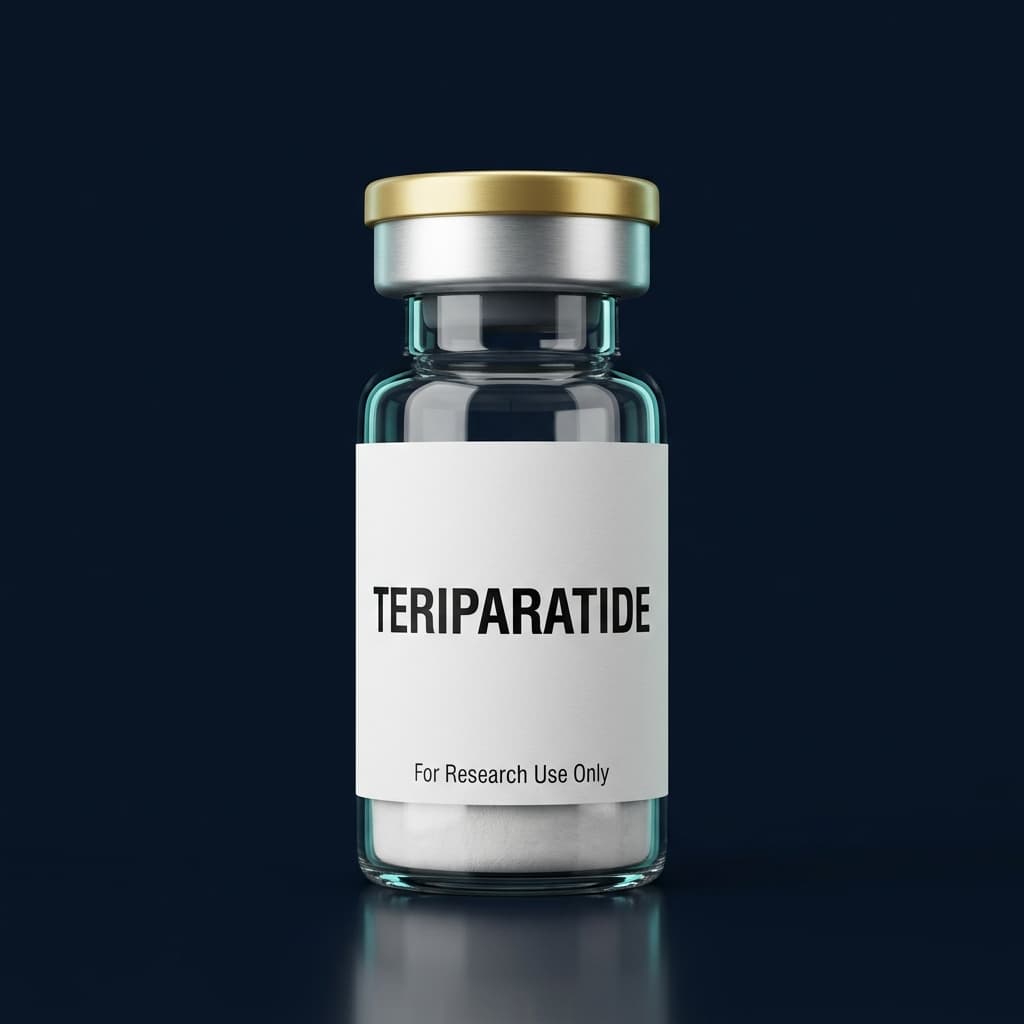
Teriparatide 10mg
≥97% (recombinant peptide fragment, by HPLC)
Entrada PeptidesDB relacionada (mesmo proprietário)
peptidesdb.org
/p/teriparatide
119,99 €Em stock
Restam apenas 10 em stock — encomende em breve
Entrega em EU em 3-7 dias úteis
Envio gratuito acima de €200 · sem formalidades alfandegárias (UE) · via EU carrier network
1
Total: 119,99 €
Envio gratuito em encomendas acima de €200
Research-grade Teriparatide. 99.4% avg purity, HPLC & MS verified. Lyophilized powder in sealed glass vial. For laboratory research use only. Not for human consumption.
Preços por volumeAplicado automaticamente no checkout
| Quantidade | Preço unitário | Total | Poupança |
|---|---|---|---|
| 1 unit | 119,99 € | 119,99 € | -- |
| 3+ | 113,99 € | 341,97 € | 5% de desconto |
| 5+Mais popular | 107,99 € | 539,96 € | 10% de desconto |
| 10+ | 101,99 € | 1019,91 € | 15% de desconto |
Aviso Importante
Este produto destina-se apenas a utilização laboratorial e de investigação. Não se destina a uso humano ou veterinário. Ao efetuar a compra, confirma que este produto será utilizado exclusivamente para fins de investigação in vitro.
Reconstituição Necessária
Este péptido é fornecido liofilizado (pó seco) e requer água bacteriostática para reconstituição antes da utilização. A água BAC é vendida separadamente.
Quando este produto pode não ser adequado à sua investigação
- ⚠Se a sua investigação exigir material de grau GMP para aplicações clínicas — os péptidos de grau de investigação não se destinam a uso clínico.
- ⚠Se o seu laboratório não dispuser de armazenamento a frio adequado (congelador a -20°C) — a estabilidade deste péptido pode ficar comprometida a temperaturas mais elevadas.
- ⚠Se o protocolo do seu estudo exigir padrões de referência aprovados pela FDA — contacte a USP ou um fornecedor de material de referência certificado.
Pureza por HPLC
99,4% de pureza HPLC média no conjunto dos nossos relatórios laboratoriais publicados
Testado por terceiros
Relatório Janoshik publicado quando disponível
Envio rápido
Expedição em 24h, envio para toda a UE a partir de 4,99 EUR
Testado por terceiros
Especificação de lote do fornecedor em cada produto; relatório Janoshik independente em lotes selecionados
Última revisão: 2026-08-03
Acerca de Teriparatide 10mg
About Teriparatide 10mg
What is Teriparatide?
Teriparatide is the 1-34 N-terminal fragment of parathyroid hormone — 34 amino acids that contain the full receptor-binding domain required for PTH1R (parathyroid hormone receptor 1) activation. The intact PTH molecule is 84 amino acids, but the first 34 are sufficient for complete biological activity at the receptor. Teriparatide is FDA-approved as Forteo for osteoporosis, and it's mechanistically distinct from every other osteoporosis agent in one critical way: it builds new bone rather than simply preventing bone loss.
The central research interest in teriparatide is the PTH administration paradox. Continuous PTH exposure — as in primary hyperparathyroidism — causes net bone resorption and calcium mobilization. But intermittent teriparatide dosing stimulates bone formation over resorption, resulting in increased bone density and improved bone architecture. The mechanism involves activation of canonical Wnt/beta-catenin signaling in osteoblasts, suppression of sclerostin (an osteocyte-derived Wnt inhibitor), and promotion of osteoblast differentiation and survival while transiently increasing RANKL-mediated osteoclast activity. Understanding exactly how the temporal pattern of PTH1R stimulation determines whether anabolic or catabolic pathways dominate is an active area of bone biology research, and teriparatide is the primary pharmacological tool for these studies.
Mechanism of Action
FAQ
Why does intermittent PTH build bone while continuous PTH breaks it down?
The paradox lies in the kinetics of receptor signaling and downstream gene expression. PTH1R is a GPCR that activates both cAMP/PKA and IP3/calcium pathways. Brief, pulsatile activation (as with once-daily teriparatide dosing) preferentially engages the cAMP pathway and activates Wnt signaling — pathways that promote osteoblast differentiation, survival, and bone formation. Sustained receptor activation (continuous exposure, as in hyperparathyroidism) downregulates cAMP signaling and shifts toward RANKL upregulation in osteoblasts, which recruits and activates osteoclasts (bone-resorbing cells) at a rate that exceeds formation. The same receptor, the same ligand — but timing determines whether net effect is anabolic or catabolic. This is one of the most instructive examples in pharmacology of how temporal dosing patterns fundamentally alter physiological outcomes.
What bone cell types does teriparatide act on?
PTH1R is expressed on osteoblasts (bone-forming cells) and osteocytes (the embedded mature bone cells that coordinate bone remodeling), but not meaningfully on osteoclasts (bone-resorbing cells). Teriparatide's direct effects are on osteoblast lineage cells. In osteoblasts, intermittent PTH1R activation drives Wnt/beta-catenin signaling and suppresses apoptosis, increasing their number and activity. In osteocytes, it suppresses sclerostin expression — sclerostin normally inhibits Wnt signaling in osteoblasts, so reducing it amplifies the anabolic effect. The indirect effects on osteoclasts (via RANKL/OPG changes in osteoblasts) produce a transient increase in resorption that's outweighed by the larger formation response under intermittent dosing conditions.
Research Overview
Specifications
Molecular weight~4,118 Da
SequencePTH residues 1-34 (34 amino acids)
Presentation10mg lyophilized
Purity≥98% HPLC
CAS52232-67-4
Storage
Store at -20°C. Reconstitute in sterile PBS or 0.9% saline; stable at 4°C for 2-3 weeks after reconstitution. The 1-34 fragment is more stable than full-length PTH but benefits from the same cold, light-protected storage conditions applied to other medium-size peptides.
Quality
HPLC purity analysis, mass spec identity confirmation, endotoxin testing on every batch. COA ships with every order. EU-based QC under CERTALAB S.R.L.
Product Specifications
- Purity: 99.4% avg (HPLC verified)
- Form: Lyophilized powder
- SKU: CP-TER10
Certificate of Analysis available for every batch. View COAs →
For research purposes only. Not for human consumption.
Resumo da especificação
FormaPó liofilizado
Conservação-20\u00B0C
Acerca de Teriparatide 10mg
About Teriparatide 10mg
What is Teriparatide?
Teriparatide is the 1-34 N-terminal fragment of parathyroid hormone — 34 amino acids that contain the full receptor-binding domain required for PTH1R (parathyroid hormone receptor 1) activation. The intact PTH molecule is 84 amino acids, but the first 34 are sufficient for complete biological activity at the receptor. Teriparatide is FDA-approved as Forteo for osteoporosis, and it's mechanistically distinct from every other osteoporosis agent in one critical way: it builds new bone rather than simply preventing bone loss.
The central research interest in teriparatide is the PTH administration paradox. Continuous PTH exposure — as in primary hyperparathyroidism — causes net bone resorption and calcium mobilization. But intermittent teriparatide dosing stimulates bone formation over resorption, resulting in increased bone density and improved bone architecture. The mechanism involves activation of canonical Wnt/beta-catenin signaling in osteoblasts, suppression of sclerostin (an osteocyte-derived Wnt inhibitor), and promotion of osteoblast differentiation and survival while transiently increasing RANKL-mediated osteoclast activity. Understanding exactly how the temporal pattern of PTH1R stimulation determines whether anabolic or catabolic pathways dominate is an active area of bone biology research, and teriparatide is the primary pharmacological tool for these studies.
Mechanism of Action
FAQ
Why does intermittent PTH build bone while continuous PTH breaks it down?
The paradox lies in the kinetics of receptor signaling and downstream gene expression. PTH1R is a GPCR that activates both cAMP/PKA and IP3/calcium pathways. Brief, pulsatile activation (as with once-daily teriparatide dosing) preferentially engages the cAMP pathway and activates Wnt signaling — pathways that promote osteoblast differentiation, survival, and bone formation. Sustained receptor activation (continuous exposure, as in hyperparathyroidism) downregulates cAMP signaling and shifts toward RANKL upregulation in osteoblasts, which recruits and activates osteoclasts (bone-resorbing cells) at a rate that exceeds formation. The same receptor, the same ligand — but timing determines whether net effect is anabolic or catabolic. This is one of the most instructive examples in pharmacology of how temporal dosing patterns fundamentally alter physiological outcomes.
What bone cell types does teriparatide act on?
PTH1R is expressed on osteoblasts (bone-forming cells) and osteocytes (the embedded mature bone cells that coordinate bone remodeling), but not meaningfully on osteoclasts (bone-resorbing cells). Teriparatide's direct effects are on osteoblast lineage cells. In osteoblasts, intermittent PTH1R activation drives Wnt/beta-catenin signaling and suppresses apoptosis, increasing their number and activity. In osteocytes, it suppresses sclerostin expression — sclerostin normally inhibits Wnt signaling in osteoblasts, so reducing it amplifies the anabolic effect. The indirect effects on osteoclasts (via RANKL/OPG changes in osteoblasts) produce a transient increase in resorption that's outweighed by the larger formation response under intermittent dosing conditions.
Research Overview
Specifications
Molecular weight~4,118 Da
SequencePTH residues 1-34 (34 amino acids)
Presentation10mg lyophilized
Purity≥98% HPLC
CAS52232-67-4
Storage
Store at -20°C. Reconstitute in sterile PBS or 0.9% saline; stable at 4°C for 2-3 weeks after reconstitution. The 1-34 fragment is more stable than full-length PTH but benefits from the same cold, light-protected storage conditions applied to other medium-size peptides.
Quality
HPLC purity analysis, mass spec identity confirmation, endotoxin testing on every batch. COA ships with every order. EU-based QC under CERTALAB S.R.L.
Product Specifications
- Purity: 99.4% avg (HPLC verified)
- Form: Lyophilized powder
- SKU: CP-TER10
Certificate of Analysis available for every batch. View COAs →
For research purposes only. Not for human consumption.
Confiança do investigador
Porque é que os investigadores escolhem a CertaPeptides
Quem testa isto efetivamente?
Lotes selecionados são verificados de forma independente pela Janoshik Analytical (República Checa) e publicados no portal público da Janoshik. Outros lotes são enviados com a especificação de lote do fornecedor. Consulte /coa para ver a lista publicada.
Ver COA →E se eu receber o lote errado?
Cada rótulo de frasco contém um número de lote que corresponde a um Certificado de Análise específico. Se um lote não cumprir a especificação, não o enviamos — ponto final.
Ver COA →De onde é enviado?
Roménia (UE). Somos a CERTALAB SRL, CUI 54169956, registada para efeitos de IVA. Sameday para a Roménia, GLS para a maioria dos destinos da UE, TCE Worldwide para os restantes mercados transfronteiriços da UE e fora da UE (Reino Unido, Suíça, Islândia, Israel, Sérvia). Entrega em 1–15 dias úteis, dependendo do destino — janela exata apresentada no checkout.
Detalhes de envio →E se houver um problema?
Tem um direito de livre resolução de 14 dias ao abrigo da OUG 34/2014 (legislação romena/da UE em matéria de consumidores), com possibilidade de escalonamento para ANPC/ODR. Contacte-nos em support@certapeptides.com.
Política de devoluções →Informações do produto
Este produto destina-se apenas a fins de investigação e desenvolvimento científico. É uma substância química que não deve ser utilizada como fármaco, medicamento, substância ativa ou ingrediente em qualquer produto destinado ao consumo humano ou animal. Os investigadores devem manusear este composto em conformidade com as diretrizes de biossegurança da sua instituição. Utilize apenas em instalações laboratoriais devidamente equipadas e com equipamento de proteção individual adequado.
Perguntas frequentes
Biblioteca de investigação
Artigos de investigação relacionados
Frequentemente investigados em conjunto
Teriparatide 10mg119,99 €
1