Research-grade compound. Laboratory use only. Not intended for human or animal use, ingestion, or injection. No medical claims are made or implied.
≥98% PuritySupplier batch spec · ≥98% (class spec)Sale
Endocrine and Hormone Research PeptidesSKU: CP-GH6
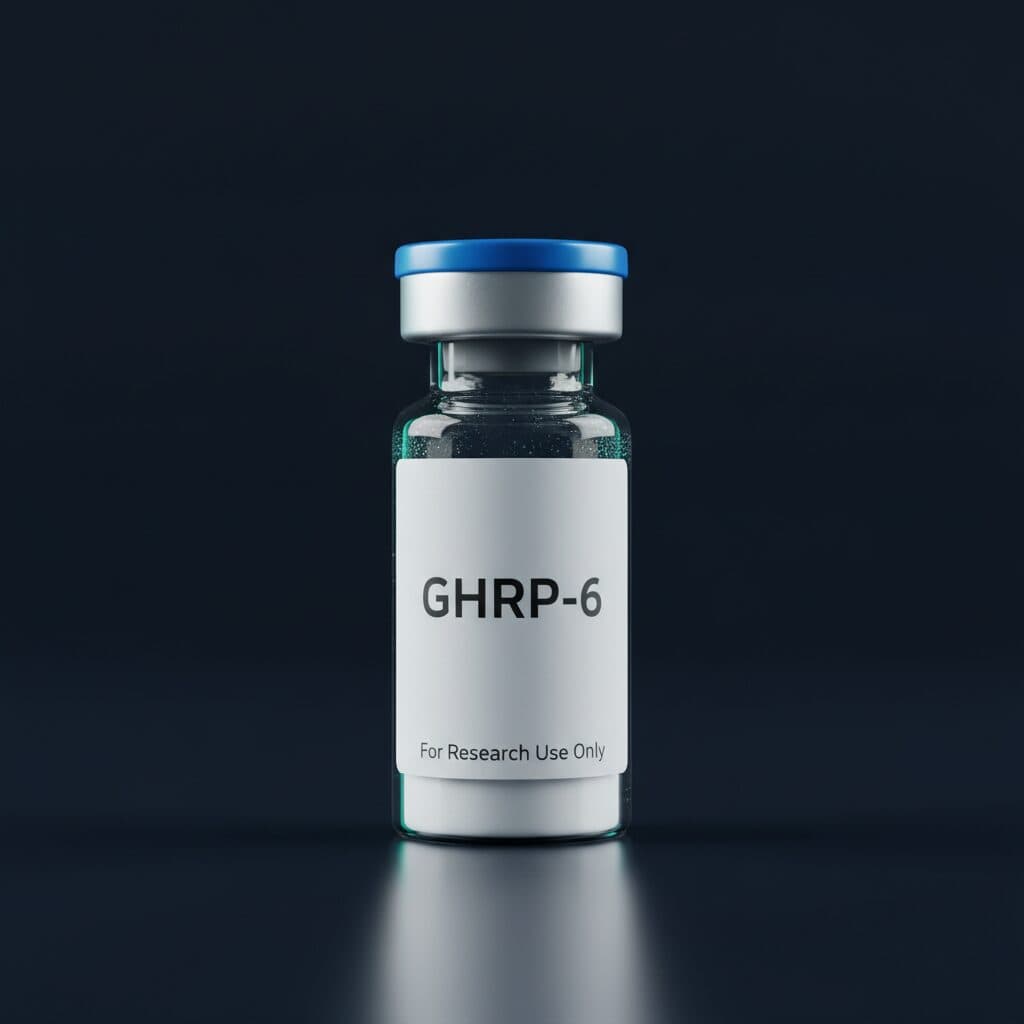
GHRP-6 Acetate
≥98% PuritySupplier batch spec; selected lots Janoshik-tested
Related PeptidesDB entry (same owner)
peptidesdb.org
/p/ghrp-6
Delivers to EU in 3-7 business days
Free shipping over €200 · no customs paperwork (EU) · via EU carrier network
Size5mg
€22.99€25.49
1
Total: €22.99
Free shipping on orders over €200
Research-grade GHRP-6 Acetate. ≥98% supplier batch specification; selected lots independently tested (99.3% avg across published reports). Lyophilized powder in sealed glass vial. For laboratory research use only. Not for human consumption.
Important Notice
This product is intended for laboratory and research use only. Not for human or veterinary use. By purchasing, you confirm this product will be used exclusively for in-vitro research purposes.
Reconstitution Required
This peptide ships lyophilized (dry powder) and requires bacteriostatic water to reconstitute before use. BAC water is sold separately.
When This Product May Not Suit Your Research
- ⚠If your research requires GMP-grade material for clinical applications — research-grade peptides are not intended for clinical use.
- ⚠If your lab lacks proper cold storage (-20°C freezer) — this peptide's stability may be compromised at higher temperatures.
- ⚠If your study protocol requires FDA-approved reference standards — contact USP or a certified reference material provider.
Purity HPLC
99.2% average HPLC purity, verified by independent third-party testing
Third-Party Tested
Janoshik report published when available
Fast Shipping
24h dispatch, EU-wide shipping from €4.99
Third-Party Tested
Supplier batch specification on every product; independent Janoshik report on selected lots
Last reviewed: 2026-06-19
About GHRP-6 Acetate
GHRP-6 is a synthetic hexapeptide GHS-R1a agonist and one of the original growth hormone secretagogues. Two things distinguish it from the rest of the GHRP family: it produces robust GH release, and it produces the strongest appetite stimulation of the group. Those two effects come from the same receptor — GHS-R1a — but expressed in different tissues. Pituitary GHS-R activation drives GH release. Hypothalamic GHS-R activation, particularly on NPY/AgRP neurons, drives hunger. CAS: 87616-84-0. MW 873.0 Da.
The Appetite Angle
GHRP-6 is worth having independently of its GH effects. If the research question is ghrelin signaling in GLP-1 receptor-mediated signalling, gut-brain axis communication, or orexigenic peptide pharmacology, GHRP-6 is a more tractable tool than working with native ghrelin, which has a very short half-life and complex production sites. GHRP-6 activates GHS-R in the hypothalamus and gut with predictable kinetics.
The comparison that matters: GHRP-2 produces more GH per unit dose than GHRP-6. GHRP-6 produces more appetite stimulation. Ipamorelin is selective for GH release with minimal appetite or cortisol effects. Each occupies a specific niche based on which GHS-R-mediated pathways are under study. For pure GH research with clean experimental design, ipamorelin wins. For appetite and feeding behavior research, GHRP-6 is the appropriate tool.
Specifications
| Molecular Weight | 873.0 Da |
|---|---|
| CAS | 87616-84-0 |
| Purity | ≥98% (supplier batch spec; 99.3% avg across independently tested lots) |
| Form | Lyophilized powder |
| Sizes | 5mg, 10mg |
Storage: Lyophilized: −20°C, away from light. Once reconstituted: 2–8°C, use within 4 weeks.
Quality: Every product ships to a ≥98% supplier batch specification; selected lots are independently tested by Janoshik Analytical (HPLC + mass spectrometry; 99.3% average purity across published reports), searchable by batch code at certapeptides.com/verify. EU-based QC under CERTALAB S.R.L.
Frequently Asked Questions
Why does GHRP-6 cause more hunger than other GHRPs?
GHRP-6 activates GHS-R1a in both pituitary (driving GH release) and hypothalamus (driving appetite via NPY/AgRP neurons). The hypothalamic effect is notably stronger with GHRP-6 than with GHRP-2 or ipamorelin, for reasons that aren't fully characterized but likely involve differences in receptor binding kinetics or tissue distribution of GHS-R subtypes. The appetite effect is the same receptor pathway as ghrelin's orexigenic signal — ghrelin is sometimes called the "hunger hormone" for exactly this reason.
When is GHRP-6 preferred over GHRP-2?
When appetite stimulation or gut-brain GHS-R signaling is part of the experimental question. GHRP-2 is the better choice when maximizing GH pulse amplitude is the primary goal. GHRP-6 is better for research on orexigenic peptide pathways, appetite circuit pharmacology, or gut GHS-R biology, where the appetite effect is a feature rather than a confound.
For research purposes only. Not for human consumption.
Specification Summary
Purity99.2% avg
FormLyophilized Powder
Storage-20\u00B0C
About GHRP-6 Acetate
GHRP-6 is a synthetic hexapeptide GHS-R1a agonist and one of the original growth hormone secretagogues. Two things distinguish it from the rest of the GHRP family: it produces robust GH release, and it produces the strongest appetite stimulation of the group. Those two effects come from the same receptor — GHS-R1a — but expressed in different tissues. Pituitary GHS-R activation drives GH release. Hypothalamic GHS-R activation, particularly on NPY/AgRP neurons, drives hunger. CAS: 87616-84-0. MW 873.0 Da.
The Appetite Angle
GHRP-6 is worth having independently of its GH effects. If the research question is ghrelin signaling in GLP-1 receptor-mediated signalling, gut-brain axis communication, or orexigenic peptide pharmacology, GHRP-6 is a more tractable tool than working with native ghrelin, which has a very short half-life and complex production sites. GHRP-6 activates GHS-R in the hypothalamus and gut with predictable kinetics.
The comparison that matters: GHRP-2 produces more GH per unit dose than GHRP-6. GHRP-6 produces more appetite stimulation. Ipamorelin is selective for GH release with minimal appetite or cortisol effects. Each occupies a specific niche based on which GHS-R-mediated pathways are under study. For pure GH research with clean experimental design, ipamorelin wins. For appetite and feeding behavior research, GHRP-6 is the appropriate tool.
Specifications
| Molecular Weight | 873.0 Da |
|---|---|
| CAS | 87616-84-0 |
| Purity | ≥98% (supplier batch spec; 99.3% avg across independently tested lots) |
| Form | Lyophilized powder |
| Sizes | 5mg, 10mg |
Storage: Lyophilized: −20°C, away from light. Once reconstituted: 2–8°C, use within 4 weeks.
Quality: Every product ships to a ≥98% supplier batch specification; selected lots are independently tested by Janoshik Analytical (HPLC + mass spectrometry; 99.3% average purity across published reports), searchable by batch code at certapeptides.com/verify. EU-based QC under CERTALAB S.R.L.
Frequently Asked Questions
Why does GHRP-6 cause more hunger than other GHRPs?
GHRP-6 activates GHS-R1a in both pituitary (driving GH release) and hypothalamus (driving appetite via NPY/AgRP neurons). The hypothalamic effect is notably stronger with GHRP-6 than with GHRP-2 or ipamorelin, for reasons that aren't fully characterized but likely involve differences in receptor binding kinetics or tissue distribution of GHS-R subtypes. The appetite effect is the same receptor pathway as ghrelin's orexigenic signal — ghrelin is sometimes called the "hunger hormone" for exactly this reason.
When is GHRP-6 preferred over GHRP-2?
When appetite stimulation or gut-brain GHS-R signaling is part of the experimental question. GHRP-2 is the better choice when maximizing GH pulse amplitude is the primary goal. GHRP-6 is better for research on orexigenic peptide pathways, appetite circuit pharmacology, or gut GHS-R biology, where the appetite effect is a feature rather than a confound.
For research purposes only. Not for human consumption.
What research shows
Selected peer-reviewed studies from the published literature. Each describes laboratory or preclinical findings and is attributed to the cited study, not to this product. For research use only — not medical guidance.
[1]
Growth hormone secretion
In pituitary cell research, GHRP-6-induced GH synthesis was shown to be regulated by miR-709 via targeting of PRKCA in in-vitro studies.
miR-709 inhibits GHRP6 induced GH synthesis by targeting PRKCA in pituitary. Molecular and Cellular Endocrinology (2020). PMID: 32084499[2]
Cardioprotection
In rats with heart failure, GH-releasing peptides including GHRP-6 were associated with improved cardiac dysfunction and cachexia and with suppression of cardiomyocyte apoptosis in preclinical research.
GH-releasing peptides improve cardiac dysfunction and cachexia and suppress stress-related hormones and cardiomyocyte apoptosis in rats with heart failure. American Journal of Physiology - Heart and Circulatory Physiology (2005). PMID: 15951341[3]
Neuroprotection (experimental stroke)
In an experimental stroke model, GHRP-6 combined with epidermal growth factor produced a neuroprotective effect resembling hypothermia in preclinical research.
Neuroprotective effect of epidermal growth factor plus growth hormone-releasing peptide-6 resembles hypothermia in experimental stroke. Neurological Research (2016). PMID: 27665924Citations are provided for research reference. CertaPeptides (CERTALAB S.R.L.) is a reseller, not a manufacturer, and makes no medical, therapeutic, or efficacy claims. Products are for laboratory research use only and are not for human or animal consumption.
Researcher Confidence
Why researchers choose CertaPeptides
Who actually tests this?
Selected lots are independently verified by Janoshik Analytical (Czech Republic) and published on the Janoshik public portal. Other lots ship with the supplier's batch specification. See /coa for the published wall.
View COAs →What if I get the wrong batch?
Every bottle label carries a lot number that maps to a specific Certificate of Analysis. If a batch fails spec, we don't ship it — full stop.
View COAs →Where does it ship from?
Romania (EU). We are CERTALAB SRL, CUI 54169956, VAT-registered. Sameday for Romania, GLS for most EU destinations, TCE Worldwide for the remaining cross-border EU and non-EU markets (UK, Switzerland, Norway, Iceland, Israel, Serbia). Delivery 1–15 business days depending on destination — exact window shown at checkout.
Shipping details →What if there's a problem?
You have a 14-day withdrawal right under OUG 34/2014 (Romanian/EU consumer law), with ANPC/ODR escalation available. Contact us at support@certapeptides.com.
Returns policy →Product Information
This product is intended for scientific research and development purposes only. It is a chemical substance that shall not be used as a drug, medicine, active substance, or ingredient in any product intended for human or animal consumption. Researchers must handle this compound in accordance with their institutional biosafety guidelines. Use only in properly equipped laboratory settings with appropriate personal protective equipment.
Frequently Asked
Research Library
Related Research Articles
Frequently researched together
Combined Price
€153.46
GHRP-6 Acetate€22.99