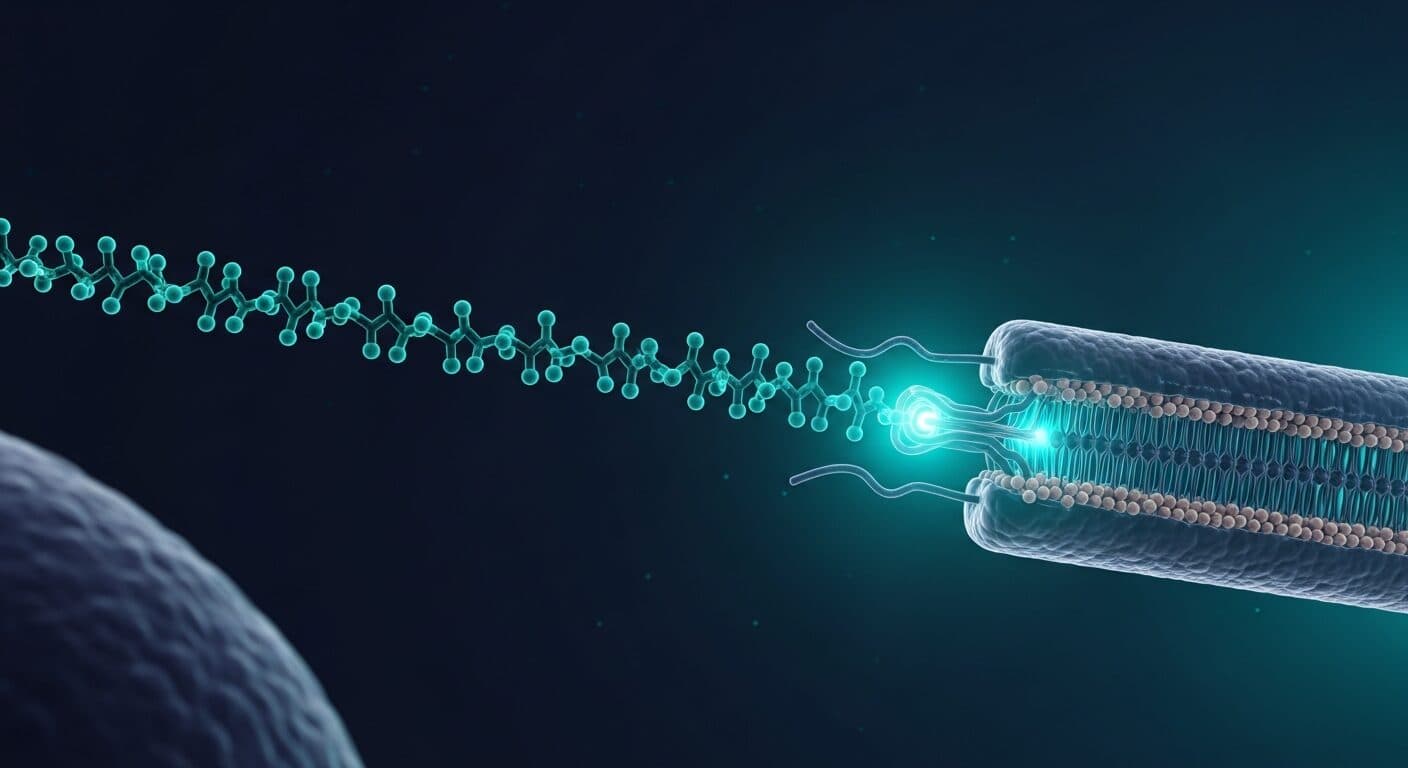
Tesamorelin yra augimo hormoną atpalaiduojančio hormono (GHRH) analogas, ištirtas išsamiau nei dauguma tyrimų peptidų; jo paskelbta literatūra apima struktūrinę chemiją, receptorių farmakologiją, farmakokinetiką ir klinikinius tyrimus. Šiame vadove apžvelgiama, ką ta literatūra praneša apie šį junginį kaip tyrimų cheminę medžiagą.
Šiame vadove aptariamas tesamorelin veikimo mechanizmas, jo receptorių farmakologija ir farmakokinetikos profilis, struktūrinė chemija, skirianti jį nuo giminingų GHRH analogų, ir praktiniai tvarkymo aspektai, svarbūs dirbant su šiuo junginiu tyrimų kontekste.
Tik švietimo ir tyrimų tikslais.
Kas yra Tesamorelin?
Tesamorelin yra sintetinis žmogaus augimo hormoną atpalaiduojančio hormono (GHRH) analogas. Natūralus GHRH peptidas yra 44 aminorūgščių peptidas, gaminamas pagumburyje, kuris skatina hipofizę išskirti augimo hormoną (GH). Tesamorelin struktūriškai identiškas aktyviajai GHRH(1-44) formai, tačiau prie jo N-galo prijungta trans-3-hekseno rūgšties grupė. Ši modifikacija reikšmingai pailgina molekulės stabilumą plazmoje, palyginti su nemodifikuotu GHRH, kurio pusėjimo trukmė kraujotakoje yra labai trumpa dėl greito skaidymo dipeptidilpeptidaze IV (DPP-IV).
Rezultatas yra GHRH analogas, kuris išlaiko natūralaus peptido jungimąsi prie receptorių ir signalinį aktyvumą, tačiau kraujyje išlieka pakankamai ilgai, kad sukeltų ilgalaikį farmakologinį poveikį. Tesamorelin jungiasi prie GHRH receptorių ant priekinės hipofizės somatotropinių ląstelių ir taip skatina augimo hormono sintezę bei pulsuojantį išsiskyrimą. Tolimesnė padidėjusio GH pasekmė yra padidėjusi į insuliną panašaus augimo faktoriaus 1 (IGF-1) gamyba kepenyse; jis tarpininkauja daugeliui periferinių augimo hormono poveikių metabolizmui ir kūno sudėčiai.
Šis mechanizmas iš esmės skiriasi nuo augimo hormono sekretagogų, tokių kaip ipamorelin, ar grelino mimetikų, kurie veikia kitą receptorių klasę (GHS-R1a) per atskirą signalinį kelią. Šis skirtumas svarbus norint suprasti, ką tesamorelin fiziologiškai daro ir ko nedaro — ši tema išsamiai aptariama mūsų tesamorelin ir ipamorelin palyginime.
Kilmė ir kūrimas kaip GHRH analogas
Tesamorelin sukūrė Kanados biofarmacijos bendrovė Theratechnologies Inc. Molekulė buvo sukurta kaip stabilizuotas GHRH(1-44) analogas, o jos klinikinio kūrimo programoje buvo tiriami visceralinio (vidinio pilvo) riebalinio audinio (VAT) pokyčiai — tai vidinis pilvo riebalinis kompartmentas, pasižymintis santykinai dideliu GH receptorių tankiu ir todėl mechanistiškai įdomus GH ašies tyrimuose.
Kūrimo programą sudarė du atsitiktinių imčių, dvigubai akli, placebu kontroliuojami III fazės tyrimai (dažnai vadinami LIPO-010 ir LIPO-011), kuriuos Falutz et al. (2007) paskelbė žurnale New England Journal of Medicine ir kuriuose KT vaizdinimas buvo naudojamas visceralinio riebalinio audinio pokyčiams įvertinti (DOI: 10.1056/NEJMoa072375). Šie tyrimai čia cituojami kaip paskelbti šio junginio tyrimų duomenys.
Vėlesnė Falutz et al. (2010) III fazės analizė žurnale Journal of Clinical Endocrinology & Metabolism papildė duomenų rinkinį didesne kohorta ir apibūdino trigliceridų bei kitų lipidų parametrų pokyčius kartu su vaizdinimo baigtimis (DOI: 10.1210/jc.2010-0490).
Tesamorelin užbaigė visą III fazės programą ir reguliavimo vertinimą, o tai nebūdinga junginiui, kitu atveju tiriamam kaip tyrimų peptidas. Todėl paskelbta literatūra apima struktūrizuotą farmakokinetikos ir nepageidaujamų reiškinių duomenų rinkinį, apibūdintą kontroliuojamomis sąlygomis — išsamesnį farmakologinį įrašą nei egzistuoja daugumai GHRH analogų.
Išsami tesamorelin vaisto profilio apžvalga, kurią Grunfeld et al. (2011) paskelbė žurnale Nature Reviews Drug Discovery, pateikia prieinamą kūrimo istorijos ir klinikinių duomenų sintezę (DOI: 10.1038/nrd3362).
Veikimo mechanizmas: kaip veikia Tesamorelin
GHRH ašis
Augimo hormono sekrecija vyksta pulsuojančiu būdu, kurį valdo pagumburio GHRH (skatinamojo) ir somatostatino (slopinamojo) sąveika. Esant normaliai fiziologijai, pagumburio neuronai išskiria GHRH pulsais, kurie per vartų kraujotaką pasiekia GHRH receptorius ant priekinės hipofizės somatotropų. Jungimasis prie receptorių aktyvina adenilatciklazę, didina tarpląstelinį cAMP ir sukelia tiek GH sintezę, tiek sekreciją. Somatostatinas priešinasi šiam poveikiui, slopindamas GH išsiskyrimą tarppulsiniais intervalais, ir taip sukuria būdingą pulsuojantį GH sekrecijos profilį.
Tesamorelin, būdamas GHRH analogas, įsiterpia į šią ašį pagumburio ir hipofizės sandūroje. Svarbu tai, kad jis išlaiko pulsuojantį GH išsiskyrimo pobūdį, o ne sukelia nuolatinį suprafiziologinį GH padidėjimą. Tai mechanistiškai svarbu, nes somatostatino grįžtamasis ryšys išlieka nepažeistas — sistema nepraranda savo reguliacinių stabdžių, kaip nutiktų skiriant egzogeninį rekombinantinį žmogaus augimo hormoną (rhGH).
Nuo GH prie IGF-1 ir metabolinių poveikių
Po GH išsiskyrimo iš hipofizės augimo hormonas cirkuliuoja ir jungiasi prie GH receptorių kepenyse, skatindamas IGF-1 gamybą kepenyse. Tuomet IGF-1 tarpininkauja daugeliui tolimesnių GH poveikių: lipolizei riebaliniame audinyje (ypač visceralinio riebalo sankaupose), baltymų anaboliniam poveikiui raumenyse ir poveikiui gliukozės metabolizmui. IGF-1 ašis taip pat teikia neigiamą grįžtamąjį ryšį pagumburiui ir hipofizei, moduliuodama bendrą išeigą.
GH ašies tyrimuose visceralinis riebalinis audinys yra ypač mechanistiškai įdomus. VAT yra metaboliškai aktyvesnis nei poodinis riebalas, pasižymi didesniu lipolitinių fermentų kiekiu ir yra jautresnis GH skatinamai lipolizei. Skirtingas GH receptorių tankis įvairiuose riebaliniuose kompartmentuose yra kompartmentui specifinių atsakų, aptariamų riebalų biologijos literatūroje, pagrindas.
Paskelbtų tyrimų duomenys
Visceralinio riebalinio audinio tyrimai
Pagrindinį III fazės tyrimą paskelbė Falutz et al. (2007) — tai atsitiktinių imčių, placebu kontroliuojamas 26 savaičių tyrimas, kuriame KT vaizdinimas buvo naudojamas visceraliniam riebaliniam audiniui matuoti, o IGF-1 buvo stebimas kaip farmakodinaminis GH ašies įsitraukimo žymuo (DOI: 10.1056/NEJMoa072375).
Tolesnėje Falutz et al. (2010) publikacijoje kartu su vaizdinimo baigtimis apibūdintas lipidų profilis, įskaitant trigliceridų ir kitus metabolinius parametrus, o gliukozės rezultatai buvo kintamesni (DOI: 10.1097/QAI.0b013e3181cbdaff).
Ilgesnės trukmės duomenis iš atviro tęsinio Falutz et al. (2008) paskelbė žurnale AIDS; per pailgintą stebėjimo laikotarpį nepageidaujamų reiškinių profilis atitiko mechanizmą (padidėjęs IGF-1, injekcijos vietos reakcijos, artralgijos) (DOI: 10.1097/QAD.0b013e32830a5058).
Kepenų lipidų tyrimai: Stanley et al. (JAMA)
Stanley et al. (2014) žurnale JAMA paskelbė atsitiktinių imčių kontroliuojamą tyrimą, kuriame naudojant vaizdinimo baigtis buvo tiriami tiek visceraliniai, tiek kepenų riebalai (DOI: 10.1001/jama.2014.8334). Kepenų rezultatai yra mechanistiškai įdomūs, nes GH ašis dalyvauja kepenų lipidų apykaitoje.
Kepenų rezultatas atitinka pripažintą GH signalizacijos vaidmenį kepenų lipidų metabolizme. Tai paskatino mechanistinį tyrimų susidomėjimą kepenų–riebalų ašimi esant moduliuotam GH pulsavimui — sritis, kuri toliau tiriama ikiklinikiniuose ir klinikiniuose tyrimų modeliuose.
Atsako prognostiniai veiksniai ir ilgalaikis tvarumas
Mangili et al. (2015) žurnale PLOS ONE išanalizavo III fazės duomenų rinkinį, siekdami nustatyti pradinius rodiklius, susijusius su VAT vaizdinimo atsako dydžiu — tai pogrupių analizės sistema, aktuali tyrimo planavimui (DOI: 10.1371/journal.pone.0140358).
Tesamorelin sergant 2 tipo cukriniu diabetu: saugumo duomenys
Clemmons et al. (2017) žurnale PLOS ONE apibūdino tesamorelin metabolinį ir saugumo profilį tyrimų populiacijoje, sergančioje 2 tipo cukriniu diabetu — kontekste, kuriame GH ašies stimuliacija yra mechanistiškai svarbi jautrumui insulinui ir gliukozės apykaitai (DOI: 10.1371/journal.pone.0179538).
Kognityvinės funkcijos tyrimai
Viena tyrimų kryptis, sulaukusi susidomėjimo už metabolinės srities ribų, yra galimas tesamorelin poveikis kognityvinei funkcijai. Baker et al. (2012) žurnale Archives of Neurology tyrė augimo hormoną atpalaiduojančio hormono analogo poveikį kognityvinei funkcijai suaugusiesiems, turintiems lengvą kognityvinį sutrikimą, ir sveikiems vyresnio amžiaus asmenims — tai ankstyvas signalas, kad GHRH ašies moduliavimas gali turėti neurobiologinės reikšmės ne tik kūno sudėčiai (DOI: 10.1001/archneurol.2012.1970). Tai tebėra preliminari tyrimų sritis su ribotais įrodymais.
Farmakokinetika: ką rodo duomenys
Tesamorelin farmakokinetikos profilis apibūdintas tiek ŽIV užsikrėtusiems pacientams, tiek sveikiems asmenims. González-Sales et al. (2015) žurnale Clinical Pharmacokinetics paskelbė populiacinę farmakokinetikos analizę, apibūdinančią tesamorelin absorbciją, pasiskirstymą ir šalinimą po poodinio suleidimo (DOI: 10.1007/s40262-014-0202-x). Papildoma populiacinė farmakokinetikos ir farmakodinamikos analizė žurnale Journal of Pharmacokinetics and Pharmacodynamics susiejo šiuos PK parametrus su GH ir IGF-1 atsakais (DOI: 10.1007/s10928-015-9416-2).
Pagrindinės farmakokinetinės savybės iš paskelbtos PK literatūros apima mažą poodinį biologinį prieinamumą, trumpą pusėjimo trukmę plazmoje ir Tmax, pasiekiamą maždaug per 30 minučių po poodinio suleidimo. Visas PK profilis išsamiai aptariamas mūsų specialiame straipsnyje apie tesamorelin farmakokinetiką tyrėjams.
Tyrimai už pradinės indikacijos ribų
Tesamorelin tyrimų bazė daugiausia grindžiama ŽIV lipodistrofijos tyrimų populiacija — būtent ten egzistuoja III fazės duomenys. Už šio konteksto ribų įrodymų yra mažiau. Vis dėlto GHRH ašies moduliavimo mechanistinė logika paskatino tiriamąjį susidomėjimą kitose tyrimų populiacijose.
Tyrimuose tesamorelin buvo nagrinėtas tokiuose tyrimų kontekstuose kaip 2 tipo cukrinis diabetas, kepenų steatozė ir kognityvinis senėjimas. Somatotropinės ašies tyrimų aspektas — ypač su amžiumi susijęs GH mažėjimas — aptariamas GHRH analogų literatūroje.
Su amžiumi susijęs GH ir IGF-1 mažėjimas (somatopauzė) jau seniai domina kaip GHRH analogų tyrimų taikinys. Tesamorelin įrodymų bazė tyrimų populiacijose už pradinių tyrimų ribų tebėra ribota, todėl tyrėjai turėtų atskirti gerai apibūdintus duomenis nuo labiau tiriamojo pobūdžio tyrimų.
Praktiniai tyrimų aspektai
Rekonstitucija ir tvarkymas
Tesamorelin tiekiamas kaip liofilizuoti milteliai, kuriuos reikia rekonstituoti steriliu vandeniu. Pagal standartinius tyrimų protokolus rekonstituojama iki darbinės koncentracijos, tinkamos numatytam suleidimo tūriui. Rekonstituotą peptidą reikia tvarkyti pagal standartinę peptidų laikymo praktiką: laikyti šaldytuve 2-8°C temperatūroje, saugoti nuo šviesos ir sunaudoti per gamintojo rekomenduojamą laikotarpį arba pagal nustatytus stabilumo duomenis.
Rekonstitucija turėtų atitikti standartinę peptidų metodiką, tinkamą numatytai darbinei koncentracijai, atkreipiant dėmesį į tirpiklio pasirinkimą, neutralų arba šiek tiek šarminį pH ir vengiant pakartotinių užšaldymo–atšildymo ciklų.
Kokybės ir grynumo aspektai
Atsižvelgiant į tesamorelin, kaip 44 aminorūgščių analogo su specifine N-galo modifikacija, sudėtingumą, grynumo patikrinimas yra ypač svarbus. Tyrėjai turėtų gauti analizės sertifikatus (COA), patvirtinančius grynumą pagal HPLC, tapatybės patvirtinimą masių spektrometrija ir mikrobinio užterštumo nebuvimą. Dėl tesamorelin struktūrinio sudėtingumo sintezės klaidos ar skilimas turi didesnės reikšmės nei mažesnių peptidų atveju.
Naudojant tyrimams, prieš bet kokį kiekybinį eksperimentą reikia gauti ir peržiūrėti analizės sertifikatą, patvirtinantį grynumą pagal HPLC, tapatybę pagal masių spektrometriją ir mikrobinio užterštumo nebuvimą.
Šalutinių poveikių profilis: ką dokumentuoja klinikiniai tyrimai
FDA III fazės programa sukaupė sisteminius nepageidaujamų reiškinių duomenis, kurie pateikiami tesamorelin skyrimo informacijoje. Pagrindiniai klinikiniuose tyrimuose stebėti nepageidaujami reiškiniai buvo injekcijos vietos reakcijos (eritema, niežulys, skausmas, sukietėjimas), artralgija, galūnių skausmas ir periferinė edema. IGF-1 padidėjimas virš viršutinės normos ribos buvo stebimas daliai pacientų ir yra farmakodinamiškai tikėtina GHRH stimuliacijos pasekmė, reikalaujanti stebėsenos.
Spooner ir Olin (2012) apžvalga žurnale Annals of Pharmacotherapy pateikia struktūrizuotą tesamorelin saugumo ir farmakologijos profilio santrauką, kaip dokumentuota paskelbtoje literatūroje (DOI: 10.1345/aph.1Q629).
Tesamorelin ir kiti GHRH analogai
Tesamorelin nėra vienintelis tirtas GHRH analogas. Sermorelin (GHRH 1-29) buvo ankstesnis, trumpesnio fragmento analogas, dešimtajame dešimtmetyje patvirtintas vaikų GH stokai gydyti, tačiau ta forma nebeprieinamas rinkoje. CJC-1295, naujesnis analogas, naudoja vaisto giminingumo komplekso (DAC) technologiją, kuri smarkiai pailgina jo pusėjimo trukmę jungdamasi prie albumino, todėl GH padidėjimas yra ilgalaikis, o ne pulsuojantis. Nepaisant to, kad veikia tą patį receptorių, jie atspindi iš esmės skirtingus farmakologinius profilius.
Tesamorelin išskirtinumas yra jo klinikinis patvirtinimas: tai vienintelė užbaigta III fazės programa tarp šiuo metu tyrimams naudojamų GHRH analogų, su tai lydinčia reguliavimo dokumentacija, saugumo duomenimis ir recenzuota literatūra. Mechanistinį palyginimą su ne GHRH sekretagogu ipamorelin rasite čia: Tesamorelin ir Ipamorelin: skirtingi mechanizmai, skirtingi tyrimų profiliai.
Pagrindinės išvados
- Tesamorelin yra GHRH analogas (ne GH sekretagogas), kuris veikia hipofizę ir per natūralų fiziologinį kelią skatina pulsuojantį augimo hormono išsiskyrimą.
- Tai vienintelis GHRH analogas su užbaigta III fazės tyrimų programa, todėl jis turi išsamesnį paskelbtą farmakologinį įrašą nei giminingi analogai.
- III fazės tyrimuose (Falutz et al., 2007, NEJM, ir vėlesnės publikacijos) buvo naudojamos KT vaizdinimo baigtys visceraliniam riebaliniam audiniui ir susijusiems lipidų parametrams apibūdinti.
- Stanley et al. (2014, JAMA) papildė kepenų lipidų vaizdinimo duomenimis ir taip išplėtė mechanistinį tyrimų susidomėjimą kepenų–riebalų ašimi.
- Tyrimų susidomėjimas už ŽIV indikacijos ribų egzistuoja, tačiau yra mažiau pagrįstas įrodymais — tyrėjai turėtų aiškiai atskirti patvirtintą ŽIV indikaciją nuo tiriamojo, ne pagal indikaciją, tyrimo.
- Farmakokinetikos profilis (trumpa pusėjimo trukmė, pulsuojanti GH stimuliacija) mechanistiškai skiriasi nuo ilgai veikiančių GHRH analogų ir nuo tiesioginių GH sekretagogų.
Susiję tyrimai
- Tesamorelin ir Ipamorelin: skirtingi mechanizmai, skirtingi tyrimų profiliai
- Tesamorelin pusėjimo trukmė ir farmakokinetika tyrėjams
Literatūra
- Falutz J, Allas S, Blot K, et al. (2007). Metabolic Effects of a Growth Hormone-Releasing Factor in Patients with HIV. New England Journal of Medicine. DOI: 10.1056/NEJMoa072375
- Falutz J, Mamputu JC, Potvin D, et al. (2010). Effects of Tesamorelin (TH9507), a Growth Hormone-Releasing Factor Analog, in Human Immunodeficiency Virus-Infected Patients with Excess Abdominal Fat. Journal of Clinical Endocrinology & Metabolism. DOI: 10.1210/jc.2010-0490
- Falutz J, Potvin D, Mamputu JC, et al. (2010). Effects of tesamorelin, a growth hormone-releasing factor, in HIV-infected patients with abdominal fat accumulation. Journal of Acquired Immune Deficiency Syndromes. DOI: 10.1097/QAI.0b013e3181cbdaff
- Falutz J, Allas S, Mamputu JC, et al. (2008). Long-term safety and effects of tesamorelin, a growth hormone-releasing factor analogue, in HIV patients with abdominal fat accumulation. AIDS. DOI: 10.1097/QAD.0b013e32830a5058
- Stanley TL, Feldpausch MN, Oh J, et al. (2014). Effect of Tesamorelin on Visceral Fat and Liver Fat in HIV-Infected Patients with Abdominal Fat Accumulation. JAMA. DOI: 10.1001/jama.2014.8334
- Grunfeld C, Dritselis A, Kirkpatrick P. (2011). Tesamorelin. Nature Reviews Drug Discovery. DOI: 10.1038/nrd3362
- Spooner LM, Olin JL. (2012). Tesamorelin: a growth hormone-releasing factor analogue for HIV-associated lipodystrophy. Annals of Pharmacotherapy. DOI: 10.1345/aph.1Q629
- Mangili A, Falutz J, Mamputu JC, et al. (2015). Predictors of Treatment Response to Tesamorelin, a Growth Hormone-Releasing Factor Analog, in HIV-Infected Patients with Lipodystrophy. PLOS ONE. DOI: 10.1371/journal.pone.0140358
- González-Sales M, Barrière O, Tremblay PO, et al. (2015). Population pharmacokinetic analysis of tesamorelin in HIV-infected patients and healthy subjects. Clinical Pharmacokinetics. DOI: 10.1007/s40262-014-0202-x
- González-Sales M, Barrière O, Tremblay PO, et al. (2015). Population pharmacokinetic and pharmacodynamic analysis of tesamorelin in HIV-infected patients and healthy subjects. Journal of Pharmacokinetics and Pharmacodynamics. DOI: 10.1007/s10928-015-9416-2
- Baker LD, Barsness SM, Borson S, et al. (2012). Effects of growth hormone-releasing hormone on cognitive function in adults with mild cognitive impairment and healthy older adults. Archives of Neurology. DOI: 10.1001/archneurol.2012.1970
- Clemmons DR, Miller S, Mamputu JC. (2017). Safety and metabolic effects of tesamorelin, a growth hormone-releasing factor analogue, in patients with type 2 diabetes. PLOS ONE. DOI: 10.1371/journal.pone.0179538
Visi produktai skirti tik tyrimų tikslais. Nevartoti žmonėms. Šis straipsnis skirtas švietimo tikslais ir nėra medicininis patarimas.
Tyrėjų klausimai ir atsakymai
Šie klausimai kyla tyrėjams, dirbantiems su tesamorelin ir gretimais GH ašies tyrimų peptidais laboratorinėje aplinkoje. Atsakymai atspindi paskelbtą ikiklinikinę ir klinikinę literatūrą, skirti tik tyrimų kontekstams ir neapima jokių dozavimo nurodymų. CertaPeptides parengė šį priedą iš techninių klausimų, kuriuos mūsų kokybės užtikrinimo (QA) komanda mato dažniausiai.
K: Be grynumo pagal HPLC, kuriuos trečiųjų šalių tyrimus verta atlikti su tesamorelin partija?
A: Sintetinio tyrimų peptido farmacinės kokybės QA atveju informacijos ir kainos santykio hierarchija yra gana pastovi.
Grynumas pagal HPLC kartu su patvirtinimu masių spektrometrija yra neatsiejami. HPLC prie 220 nm apibūdina, kokią mėginio dalį sudaro tikslinė seka, palyginti su susijusiomis priemaišomis, tokiomis kaip sutrumpinimai, delecijos ir oksiduotos formos. Masių spektrometrija patvirtina, kad molekulinė masė atitinka lūkesčius — tesamorelin turėtų būti apie 5135.8 Da monoizotopinės masės. Sertifikatas, rodantis grynumo skaičių be MS spektro, iš esmės yra tik sulaikymo laiko rezultatas.
Endotoksinų tyrimą (LAL arba rekombinantinis faktorius C) verta įtraukti bet kuriam peptidui, skirtam parenteriniam tyrimų naudojimui. Liofilizuota medžiaga iš patikimų sintezės įmonių paprastai yra tinkama, tačiau šis tyrimas yra nebrangus daugumoje ES sutartinių laboratorijų ir aptinka gramneigiamų bakterijų užterštumą, patenkantį pildymo, užbaigimo ar injekcinio vandens tvarkymo metu. Standartą apibrėžia USP <85>.
Sterilumo tyrimas pagal USP <71> yra mažiau informatyvus, nei dažnai manoma, liofilizuotų miltelių sandariame flakone atveju — sausa masė yra netinkama daugumai organizmų. Jis tampa svarbesnis rekonstituotiems tirpalams arba įtarus pildymo linijos užterštumą.
Sunkiųjų metalų tyrimas ICP-MS metodu yra paskutinis prioritetas, nebent yra konkreti priežastis įtarti, kad sintezės kelyje buvo naudojami metaliniai katalizatoriai. SPPS būdu pagamintų peptidų atveju problemos retai kyla būtent čia.
Konkrečiai tesamorelin atveju pirmenybę teikite HPLC+MS ir endotoksinams. Partija, praėjusi šiuos tyrimus, mažai tikėtina, kad neatitiks likusių tyrimų reikalavimų.
K: Kaip tesamorelin, CJC-1295+ipamorelin ir AOD-9604 palyginti mechanistiškai visceralinio riebalinio audinio tyrimuose?
A: Šie trys yra mechanistiškai skirtingi, ir tai svarbiau nei tiesioginis “kuris veikia geriausiai” palyginimas, nes jie veikia skirtingas GH ašies dalis.
Tesamorelin yra GHRH(1-44) analogas su N-galo trans-3-hekseno rūgšties modifikacija, kuri blokuoja dipeptidilpeptidazės IV skaidymą ir pailgina jo cirkuliavimo pusėjimo trukmę. Jis sukelia pulsuojantį endogeninį GH išsiskyrimą per hipofizės GHRH receptorių. Tarp šių trijų junginių jis turi išsamiausią paskelbtą klinikinių tyrimų įrašą, apibūdinantį visceralinį riebalinį audinį pagal vaizdinimo baigtis.
CJC-1295 kartu su ipamorelin yra dviejų šakų GH pulsas. CJC-1295 (GHRH analogas) aktyvina GHRH šaką; ipamorelin (GHRP) aktyvina grelino receptorių šaką. Ikiklinikiniuose ir ankstyvuosiuose klinikiniuose darbuose šis derinys sinergiškai veikia GH išsiskyrimą, tačiau neturi VAT specifinių tyrimų duomenų, palyginamų su tesamorelin.
AOD-9604 yra mechanistiškai atskiras. Jis atitinka C-galo hGH(177-191) fragmentą, tirtą siekiant atskirti su riebalais susijusį hGH aktyvumą nuo jo IGF-1 didinančio aktyvumo (Wilding 2004, PMID 15134286). Jis apibūdintas graužikų modeliuose, o jo klinikinių tyrimų su žmonėmis programa nepasiekė patvirtinimui reikalingų baigčių, todėl duomenų apie žmones lieka nedaug.
Tyrimų darbo eigoms, susijusioms su visceraliniu ir poodiniu riebalinio atsako pasiskirstymu, tesamorelin turi išsamiausiai apibūdintą ikiklinikinių ir klinikinių tyrimų įrašą iš šių trijų. CJC-1295 su ipamorelin atspindi platesnį GH ašies tyrimų derinį, o AOD-9604 tebėra istorinio tyrimų susidomėjimo objektas, nepaisant ribotų klinikinių duomenų.
Patikrinkite prieš pradėdami tyrimą
Kiekvienas mūsų siūlomas junginys siunčiamas pagal tiekėjo partijos specifikaciją, o atrinktos partijos turi nepriklausomą trečiosios šalies COA.