Composé de qualité recherche. Usage exclusivement en laboratoire. Non destiné à un usage humain ou animal, à l'ingestion ou à l'injection. Aucune allégation médicale n'est formulée ni sous-entendue.
Spécification de lot du fournisseur · ≥97% (recombinant peptide fragment, by HPLC)
Endocrine and Hormone Research PeptidesSKU : CP-TER10
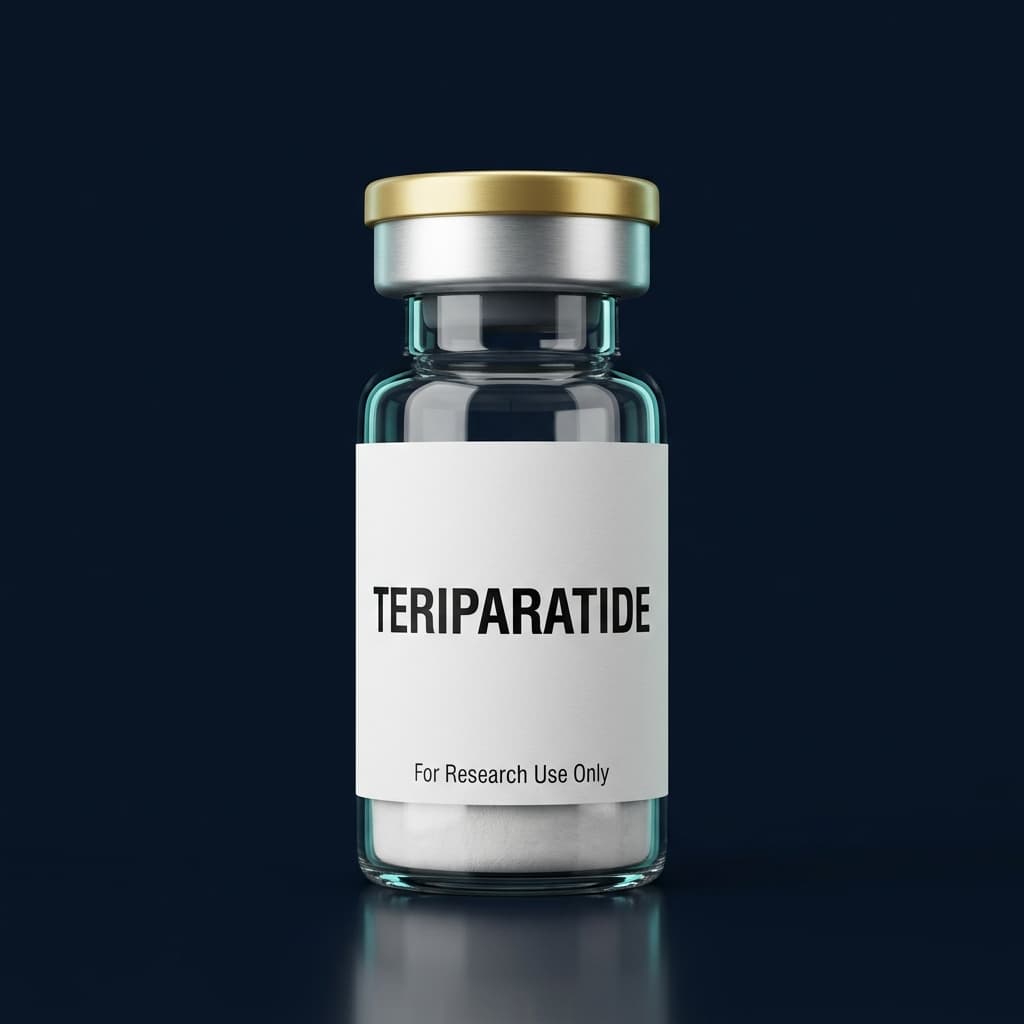
Teriparatide 10mg
≥97% (recombinant peptide fragment, by HPLC)
Fiche PeptidesDB associée (même propriétaire)
peptidesdb.org
/p/teriparatide
119,99 €En stock
Plus que 10 en stock — commandez vite
Livraison en EU sous 3-7 jours ouvrés
Livraison gratuite au-delà de €200 · aucune formalité douanière (UE) · via EU carrier network
1
Total : 119,99 €
Livraison gratuite pour les commandes de plus de €200
Research-grade Teriparatide. 99.4% avg purity, HPLC & MS verified. Lyophilized powder in sealed glass vial. For laboratory research use only. Not for human consumption.
Tarifs dégressifsAppliqué automatiquement lors du passage à la caisse
| Quantité | Prix unitaire | Total | Économies |
|---|---|---|---|
| 1 unit | 119,99 € | 119,99 € | -- |
| 3+ | 113,99 € | 341,97 € | 5% de réduction |
| 5+Le plus populaire | 107,99 € | 539,96 € | 10% de réduction |
| 10+ | 101,99 € | 1 019,91 € | 15% de réduction |
Avis important
Ce produit est destiné uniquement à un usage de laboratoire et de recherche. Ne convient pas à un usage humain ou vétérinaire. En procédant à l'achat, vous confirmez que ce produit sera utilisé exclusivement à des fins de recherche in vitro.
Reconstitution requise
Ce peptide est expédié lyophilisé (poudre sèche) et nécessite de l'eau bactériostatique pour être reconstitué avant utilisation. L'eau BAC est vendue séparément.
Lorsque ce produit peut ne pas convenir à vos recherches
- ⚠Si vos recherches nécessitent du matériel de qualité GMP pour des applications cliniques — les peptides de qualité recherche ne sont pas destinés à un usage clinique.
- ⚠Si votre laboratoire ne dispose pas d'un stockage à froid adéquat (congélateur à -20°C) — la stabilité de ce peptide peut être compromise à des températures plus élevées.
- ⚠Si votre protocole d'étude requiert des étalons de référence approuvés par la FDA — contactez l'USP ou un fournisseur de matériel de référence certifié.
Pureté HPLC
99,4 % de pureté HPLC moyenne sur l'ensemble de nos rapports de laboratoire publiés
Testé par un tiers
Rapport Janoshik publié dès qu'il est disponible
Expédition rapide
Expédition sous 24h, livraison dans toute l'UE à partir de €4.99
Testé par un tiers
Spécification de lot fournisseur sur chaque produit ; rapport Janoshik indépendant sur des lots sélectionnés
Dernière révision : 2026-08-03
À propos de Teriparatide 10mg
About Teriparatide 10mg
What is Teriparatide?
Teriparatide is the 1-34 N-terminal fragment of parathyroid hormone — 34 amino acids that contain the full receptor-binding domain required for PTH1R (parathyroid hormone receptor 1) activation. The intact PTH molecule is 84 amino acids, but the first 34 are sufficient for complete biological activity at the receptor. Teriparatide is FDA-approved as Forteo for osteoporosis, and it's mechanistically distinct from every other osteoporosis agent in one critical way: it builds new bone rather than simply preventing bone loss.
The central research interest in teriparatide is the PTH administration paradox. Continuous PTH exposure — as in primary hyperparathyroidism — causes net bone resorption and calcium mobilization. But intermittent teriparatide dosing stimulates bone formation over resorption, resulting in increased bone density and improved bone architecture. The mechanism involves activation of canonical Wnt/beta-catenin signaling in osteoblasts, suppression of sclerostin (an osteocyte-derived Wnt inhibitor), and promotion of osteoblast differentiation and survival while transiently increasing RANKL-mediated osteoclast activity. Understanding exactly how the temporal pattern of PTH1R stimulation determines whether anabolic or catabolic pathways dominate is an active area of bone biology research, and teriparatide is the primary pharmacological tool for these studies.
Mechanism of Action
FAQ
Why does intermittent PTH build bone while continuous PTH breaks it down?
The paradox lies in the kinetics of receptor signaling and downstream gene expression. PTH1R is a GPCR that activates both cAMP/PKA and IP3/calcium pathways. Brief, pulsatile activation (as with once-daily teriparatide dosing) preferentially engages the cAMP pathway and activates Wnt signaling — pathways that promote osteoblast differentiation, survival, and bone formation. Sustained receptor activation (continuous exposure, as in hyperparathyroidism) downregulates cAMP signaling and shifts toward RANKL upregulation in osteoblasts, which recruits and activates osteoclasts (bone-resorbing cells) at a rate that exceeds formation. The same receptor, the same ligand — but timing determines whether net effect is anabolic or catabolic. This is one of the most instructive examples in pharmacology of how temporal dosing patterns fundamentally alter physiological outcomes.
What bone cell types does teriparatide act on?
PTH1R is expressed on osteoblasts (bone-forming cells) and osteocytes (the embedded mature bone cells that coordinate bone remodeling), but not meaningfully on osteoclasts (bone-resorbing cells). Teriparatide's direct effects are on osteoblast lineage cells. In osteoblasts, intermittent PTH1R activation drives Wnt/beta-catenin signaling and suppresses apoptosis, increasing their number and activity. In osteocytes, it suppresses sclerostin expression — sclerostin normally inhibits Wnt signaling in osteoblasts, so reducing it amplifies the anabolic effect. The indirect effects on osteoclasts (via RANKL/OPG changes in osteoblasts) produce a transient increase in resorption that's outweighed by the larger formation response under intermittent dosing conditions.
Research Overview
Specifications
Molecular weight~4,118 Da
SequencePTH residues 1-34 (34 amino acids)
Presentation10mg lyophilized
Purity≥98% HPLC
CAS52232-67-4
Storage
Store at -20°C. Reconstitute in sterile PBS or 0.9% saline; stable at 4°C for 2-3 weeks after reconstitution. The 1-34 fragment is more stable than full-length PTH but benefits from the same cold, light-protected storage conditions applied to other medium-size peptides.
Quality
HPLC purity analysis, mass spec identity confirmation, endotoxin testing on every batch. COA ships with every order. EU-based QC under CERTALAB S.R.L.
Product Specifications
- Purity: 99.4% avg (HPLC verified)
- Form: Lyophilized powder
- SKU: CP-TER10
Certificate of Analysis available for every batch. View COAs →
For research purposes only. Not for human consumption.
Résumé des spécifications
FormePoudre lyophilisée
Conservation-20\u00B0C
À propos de Teriparatide 10mg
About Teriparatide 10mg
What is Teriparatide?
Teriparatide is the 1-34 N-terminal fragment of parathyroid hormone — 34 amino acids that contain the full receptor-binding domain required for PTH1R (parathyroid hormone receptor 1) activation. The intact PTH molecule is 84 amino acids, but the first 34 are sufficient for complete biological activity at the receptor. Teriparatide is FDA-approved as Forteo for osteoporosis, and it's mechanistically distinct from every other osteoporosis agent in one critical way: it builds new bone rather than simply preventing bone loss.
The central research interest in teriparatide is the PTH administration paradox. Continuous PTH exposure — as in primary hyperparathyroidism — causes net bone resorption and calcium mobilization. But intermittent teriparatide dosing stimulates bone formation over resorption, resulting in increased bone density and improved bone architecture. The mechanism involves activation of canonical Wnt/beta-catenin signaling in osteoblasts, suppression of sclerostin (an osteocyte-derived Wnt inhibitor), and promotion of osteoblast differentiation and survival while transiently increasing RANKL-mediated osteoclast activity. Understanding exactly how the temporal pattern of PTH1R stimulation determines whether anabolic or catabolic pathways dominate is an active area of bone biology research, and teriparatide is the primary pharmacological tool for these studies.
Mechanism of Action
FAQ
Why does intermittent PTH build bone while continuous PTH breaks it down?
The paradox lies in the kinetics of receptor signaling and downstream gene expression. PTH1R is a GPCR that activates both cAMP/PKA and IP3/calcium pathways. Brief, pulsatile activation (as with once-daily teriparatide dosing) preferentially engages the cAMP pathway and activates Wnt signaling — pathways that promote osteoblast differentiation, survival, and bone formation. Sustained receptor activation (continuous exposure, as in hyperparathyroidism) downregulates cAMP signaling and shifts toward RANKL upregulation in osteoblasts, which recruits and activates osteoclasts (bone-resorbing cells) at a rate that exceeds formation. The same receptor, the same ligand — but timing determines whether net effect is anabolic or catabolic. This is one of the most instructive examples in pharmacology of how temporal dosing patterns fundamentally alter physiological outcomes.
What bone cell types does teriparatide act on?
PTH1R is expressed on osteoblasts (bone-forming cells) and osteocytes (the embedded mature bone cells that coordinate bone remodeling), but not meaningfully on osteoclasts (bone-resorbing cells). Teriparatide's direct effects are on osteoblast lineage cells. In osteoblasts, intermittent PTH1R activation drives Wnt/beta-catenin signaling and suppresses apoptosis, increasing their number and activity. In osteocytes, it suppresses sclerostin expression — sclerostin normally inhibits Wnt signaling in osteoblasts, so reducing it amplifies the anabolic effect. The indirect effects on osteoclasts (via RANKL/OPG changes in osteoblasts) produce a transient increase in resorption that's outweighed by the larger formation response under intermittent dosing conditions.
Research Overview
Specifications
Molecular weight~4,118 Da
SequencePTH residues 1-34 (34 amino acids)
Presentation10mg lyophilized
Purity≥98% HPLC
CAS52232-67-4
Storage
Store at -20°C. Reconstitute in sterile PBS or 0.9% saline; stable at 4°C for 2-3 weeks after reconstitution. The 1-34 fragment is more stable than full-length PTH but benefits from the same cold, light-protected storage conditions applied to other medium-size peptides.
Quality
HPLC purity analysis, mass spec identity confirmation, endotoxin testing on every batch. COA ships with every order. EU-based QC under CERTALAB S.R.L.
Product Specifications
- Purity: 99.4% avg (HPLC verified)
- Form: Lyophilized powder
- SKU: CP-TER10
Certificate of Analysis available for every batch. View COAs →
For research purposes only. Not for human consumption.
La confiance des chercheurs
Pourquoi les chercheurs choisissent CertaPeptides
Qui teste réellement ce produit ?
Les lots sélectionnés sont vérifiés de manière indépendante par Janoshik Analytical (République tchèque) et publiés sur le portail public de Janoshik. Les autres lots sont expédiés avec la spécification de lot du fournisseur. Consultez /coa pour le mur publié.
Voir les COA →Et si je reçois le mauvais lot ?
Chaque étiquette de flacon porte un numéro de lot qui correspond à un certificat d'analyse spécifique. Si un lot n'est pas conforme à la spécification, nous ne l'expédions pas — un point c'est tout.
Voir les COA →D'où le produit est-il expédié ?
Roumanie (UE). Nous sommes CERTALAB SRL, CUI 54169956, immatriculée à la TVA. Sameday pour la Roumanie, GLS pour la plupart des destinations de l'UE, TCE Worldwide pour les autres marchés transfrontaliers de l'UE et hors UE (Royaume-Uni, Suisse, Islande, Israël, Serbie). Livraison sous 1–15 jours ouvrés selon la destination — le délai exact est indiqué lors du passage à la caisse.
Détails de l'expédition →Et en cas de problème ?
Vous disposez d'un droit de rétractation de 14 jours en vertu de l'OUG 34/2014 (droit de la consommation roumain/UE), avec possibilité de recours auprès de l'ANPC/ODR. Contactez-nous à support@certapeptides.com.
Politique de retour →Informations sur le produit
Ce produit est destiné uniquement à des fins de recherche et de développement scientifiques. Il s'agit d'une substance chimique qui ne doit pas être utilisée comme médicament, produit thérapeutique, substance active ou ingrédient dans un quelconque produit destiné à la consommation humaine ou animale. Les chercheurs doivent manipuler ce composé conformément aux directives de biosécurité de leur établissement. À utiliser uniquement dans des environnements de laboratoire correctement équipés, avec un équipement de protection individuelle approprié.
Questions fréquentes
Bibliothèque de recherche
Articles de recherche connexes
Fréquemment étudiés ensemble
Teriparatide 10mg119,99 €
1