
How to Read a Peptide Certificate of Analysis and Verify a Janoshik Report
For laboratory research purposes only. Not for human consumption. A Certificate of Analysis (COA) is the single most useful document [...]
Protocoles, guides et profils de peptides pour appuyer votre recherche. Tout le contenu est révisé par notre équipe scientifique.


129 articles

For laboratory research purposes only. Not for human consumption. A Certificate of Analysis (COA) is the single most useful document [...]

For laboratory research purposes only. Not for human consumption. This article is general regulatory information, not legal advice; see the [...]

For laboratory research purposes only. Not for human consumption. This article is written for researchers and procurement teams evaluating suppliers; [...]

For laboratory research purposes only. Not for human consumption. Researchers in Spain sourcing peptide compounds for in-vitro and preclinical studies [...]

For laboratory research purposes only. Not for human consumption. Italian researchers sourcing peptide compounds for in-vitro and preclinical studies are [...]

For laboratory research purposes only. Not for human consumption. Belgian researchers sourcing peptide compounds for in-vitro and preclinical studies are [...]

For laboratory research purposes only. Not for human consumption. French researchers sourcing peptide compounds for in-vitro and preclinical studies are [...]

For laboratory research purposes only. Not for human consumption. Dutch researchers sourcing peptide compounds for in-vitro and preclinical studies are [...]

This article summarises a regulatory document published by the European Medicines Agency for informational and research context. All peptides referenced [...]

Where to source research peptides in Germany in 2026: EU-internal shipping, what an independent Certificate of Analysis should show (HPLC purity, mass-spec identity), and how to verify a batch code before you buy. For research use only.

A research overview of oral BPC-157 capsules in enteric-coated format — what enteric coating does, why researchers use oral over injectable in certain models, and how to evaluate a reputable source. For in vitro research use only.

Anti-aging research has produced a range of peptide compounds with proposed roles in cellular maintenance, tissue repair, and longevity-related signaling. [...]

Epitalon is a synthetic tetrapeptide — just four amino acids (Ala-Glu-Asp-Gly) — yet it has accumulated a substantial body of [...]

Among research stacks involving growth hormone secretagogues, the combination of ipamorelin and CJC-1295 is one of the most frequently cited [...]

Among growth hormone secretagogues (GHS) — compounds that stimulate the pituitary to release growth hormone — ipamorelin and GHRP-6 are [...]

The relationship between exercise and mitochondrial function is one of the most intensively studied areas in physiology. Exercise is widely [...]

Mitochondria are increasingly recognized not merely as cellular energy factories but as signaling hubs that communicate with the rest of [...]

Accurate reconstitution and proper storage are foundational skills for any researcher working with lyophilized peptides. AOD-9604 — a stabilized analog [...]

When researchers explore peptide compounds related to fat metabolism and body composition, two names frequently appear in the same breath: [...]

For Research Purposes Only — This article discusses the history of Thymosin Beta-4 (TB-500) research. Content is intended for educational [...]

For Research Purposes Only — This article describes dosage ranges and administration parameters as they appear in published preclinical and [...]

For Research Purposes Only — This article discusses Thymosin Beta-4 (TB-500) as a laboratory research compound. Content is intended for [...]

For Research Purposes Only — This article discusses BPC-157 and TB-500 (Thymosin Beta-4) as laboratory research compounds. Content is intended [...]

A technical overview of bacteriostatic water (0.9% benzyl alcohol), sterile water, and acetic acid as peptide reconstitution solvents in laboratory research contexts.

Preclinical review of Dihexa (PNB-0408/N-hexanoic-Tyr-Ile-(6)aminohexanoic amide): HGF/c-Met signaling, synaptogenesis, and cognition research in animal models.

Preclinical review of Delta Sleep-Inducing Peptide (DSIP): sequence, neuroendocrine actions in animal models, stress research, and long-standing mechanistic puzzles.

Preclinical review of follistatin biology, myostatin and activin binding, and muscle physiology research, including follistatin-344 isoform context.

A research monograph on AOD-9604 (HGH fragment 176-191): structural biology, lipolysis mechanism, preclinical metabolic studies, and Phase II obesity trial history.

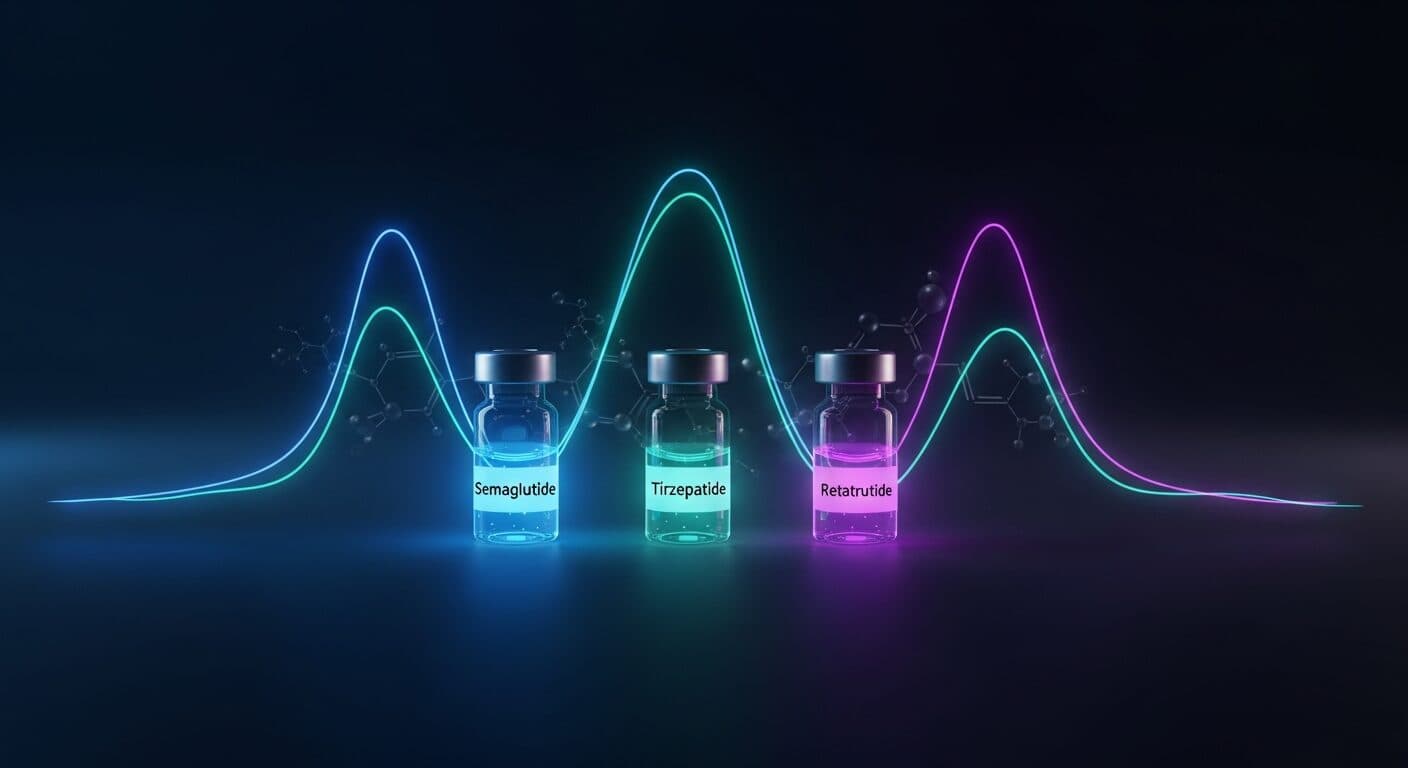
A technical comparison of semaglutide, tirzepatide, and retatrutide — receptor targets, structural design, half-life data, and preclinical research context.

A technical overview of hexarelin, a synthetic growth-hormone-releasing peptide studied for GHSR/CD36 signaling, cardioprotection, and neuroprotection in preclinical models.

A research-lab comparison of RP-HPLC, LC-MS, and MALDI-TOF for peptide purity and identity testing — when to use each, how to read the data, and what the numbers mean.

A technical overview of humanin, a 24-residue mitochondrial-derived peptide studied for neuroprotection, apoptosis regulation, and mitonuclear signaling.

A research-lab overview of Kisspeptin-10, the KISS1R/GPR54 receptor, and its role in HPG axis regulation, GnRH pulse generation, and preclinical reproductive studies.

Technical review of LL-37 cathelicidin research: antimicrobial mechanisms, immunomodulation, wound repair models, and laboratory handling considerations.

Preclinical review of MGF (mechano growth factor / IGF-1Ec): splice variant biology, satellite cell activation, muscle repair models, and research limitations.

A technical overview of MOTS-c, a 16-residue mitochondrial-derived peptide under investigation in metabolic, aging, and exercise physiology research models.

A technical deep dive into peptide freeze-drying: cycle stages, excipients, cryoprotectants, cake structure, residual moisture, and stability science for research labs.

A research monograph on PT-141 (Bremelanotide), its melanocortin receptor biology (MC3R/MC4R), preclinical neuroscience data, and the approved drug context for reference only.

A research monograph on sermorelin, the GHRH(1-29) analog: structural biology, pituitary GH-release mechanism, preclinical pharmacology, and anti-doping detection context.

A comprehensive research monograph on TB-500 (Thymosin Beta-4) covering actin sequestration, wound healing, cardiac repair, and angiogenesis in preclinical models.

A technical research overview of tesamorelin, a synthetic GHRH(1-44) analog, covering its biochemistry, mechanism, preclinical models, and laboratory handling.

A detailed research guide on Thymosin Alpha-1 (TA1): structure, T-cell modulation, antiviral research, and preclinical immunology across hepatitis, cancer, and sepsis models.

A technical overview of KPV (Lys-Pro-Val), the α-MSH C-terminal tripeptide studied in colitis, airway inflammation, wound healing, and targeted nanoparticle research.

Most research peptides exist in a regulatory vacuum — they are studied in preclinical models, sold as research chemicals, and [...]

A research compound’s pharmacokinetic (PK) profile tells you how the body processes it: how fast it absorbs, how long it [...]

Tesamorelin’s approved indication is specific: reduction of excess abdominal fat in HIV-infected adults with lipodystrophy. But the growth hormone axis [...]

Few comparisons in peptide research are more frequently misunderstood than tesamorelin vs ipamorelin. Both compounds affect the growth hormone axis. [...]

When a peptide has an FDA-approved indication, it comes with something most research peptides lack: a systematically collected adverse event [...]

Tesamorelin occupies a unique position in peptide research: it is the only growth hormone-releasing hormone (GHRH) analog to have completed [...]

GHK-Cu occupies an unusual position in the cosmetic science literature. It began as a biochemistry research compound — Pickart’s 1973 [...]

GHK-Cu has one handling characteristic that distinguishes it immediately from most research peptides: it turns blue. The copper chelate’s characteristic [...]

The distinction between GHK and GHK-Cu is not a marketing technicality — it is a structural and functional difference that [...]

If there is one area where the GHK-Cu literature has genuine depth, it is wound healing. From Pickart’s early rodent [...]

Hair follicle research occupies a peculiar position in peptide science. It demands molecular precision — the follicle is a structurally [...]

In 1973, a biochemist named Loren Pickart made an observation that would quietly reshape a corner of peptide research for [...]

Quick answer: Five European peptide suppliers have a documented history of submitting products to Janoshik Analytical, an independent Czech laboratory [...]

Insulin-like Growth Factor 1 Long R3, commonly known as IGF-1 LR3, is one of the most studied peptide analogs in [...]

What is an Ipamorelin pre-mixed pen? An ipamorelin pre-mixed pen is a ready-to-use peptide delivery device that contains ipamorelin in [...]

This article is intended for educational and research purposes only. It is not medical advice. Peptides discussed herein are research [...]

Introduction: why peptides interest longevity researchers Aging is not a single process but a convergence of molecular deterioration — telomere [...]

All products discussed in this article are sold strictly for in-vitro research and laboratory use. Nothing in this guide constitutes [...]

PHP Warning: Constant WP_DEBUG already defined in /home/user/htdocs/srv1267524.hstgr.cloud/wp-config-debug.php on line 2 PHP Warning: Constant WP_DEBUG_LOG already defined in phar:///usr/bin/wp/vendor/wp-cli/wp-cli/php/WP_CLI/Runner.php(1334) : [...]

Peptides for bodybuilding research represent one of the fastest-growing areas of interest in exercise science and sports pharmacology. From growth [...]

PHP Warning: Constant WP_DEBUG already defined in /home/user/htdocs/srv1267524.hstgr.cloud/wp-config-debug.php on line 2 PHP Warning: Constant WP_DEBUG_LOG already defined in phar:///usr/bin/wp/vendor/wp-cli/wp-cli/php/WP_CLI/Runner.php(1334) : [...]

GLP-1 receptor agonists rewrote what metabolic research thought was achievable with peptide-based interventions. Then dual agonists did it again. Now [...]

Discover the top peptides studied for muscle growth research in 2026, including CJC-1295, IGF-1 LR3, BPC-157, and follistatin 344. Research-grade EU peptides.

We sent three products to Janoshik Analytical for independent testing. Two came back above 99.7% purity. One did not. Here are the real numbers — and how to verify them yourself.

The research peptide market is unregulated. Anyone can put up a website, list compounds, and ship vials. Some suppliers run [...]

For research purposes only. Not for human consumption. All references to “cycles,” “protocols,” “on/off schedules,” and “administration windows” in this [...]

Finding peptide half-life data usually means digging through a dozen Reddit threads and hoping someone cited an actual study. This [...]

Most of the peptide industry gets this wrong. Vendors list “Thymosin Beta-4 (TB-500)” as if they’re the same thing. Forums [...]

Short answer: peptides as a molecular class have strong safety profiles in published research. The real danger isn’t the peptide [...]

The GLP-1 receptor agonist space has gone from one major compound to three in less than a decade. Semaglutide proved [...]

Introduction: when does combining peptides make scientific sense? Combining peptides in research protocols is not simply a matter of adding [...]

Introduction: why pharmacokinetics matter more than mechanism alone When evaluating GLP-1 class peptides for research, most attention goes to their [...]

Home / Blog / Retatrutide Triple Receptor Agonism Peptide Research March 29, 2026 18 min read Retatrutide: How Triple Receptor [...]

Introduction BPC-157 and TB-500 are among the most extensively studied peptides in tissue biology research, yet their molecular mechanisms operate [...]

Eli Lilly TRIUMPH-4 Phase 3 data shows retatrutide achieved -23.7% body weight loss at 12mg dose plus 75.8% osteoarthritis pain reduction. Full clinical data analysis.

HHS Secretary RFK Jr. restored 14 research peptides to legal compounding access in February 2026. Understand the regulatory shift and its impact on European peptide research.

GHK-Cu search interest grew +1,016% YoY in 2026, making it the fastest-growing research peptide. Explore the science, mechanisms, and research driving the copper peptide boom.
Introduction MOTS-c is a short peptide with an unusually interesting address. Unlike almost every other bioactive peptide in human biology, [...]
Introduction The skin is the body’s largest organ — and among the most studied targets in peptide research. Over the [...]
PHP Warning: Constant WP_DEBUG already defined in /home/user/htdocs/srv1267524.hstgr.cloud/wp-config-debug.php on line 2 PHP Warning: Constant WP_DEBUG_LOG already defined in phar:///usr/bin/wp/vendor/wp-cli/wp-cli/php/WP_CLI/Runner.php(1334) : [...]
Introduction: why peptide combinations matter in research Research into individual peptides has generated significant scientific literature over the past three [...]
Introduction Two compound classes dominate contemporary research into selective biological modulation: selective androgen receptor modulators (SARMs) and peptides. While both [...]
PHP Warning: Constant WP_DEBUG already defined in /home/user/htdocs/srv1267524.hstgr.cloud/wp-config-debug.php on line 2 PHP Warning: Constant WP_DEBUG_LOG already defined in phar:///usr/bin/wp/vendor/wp-cli/wp-cli/php/WP_CLI/Runner.php(1334) : [...]
Ten years ago, the most effective pharmacological intervention for obesity produced roughly 5-8% body weight reduction. Semaglutide changed that number [...]
PHP Warning: Constant WP_DEBUG already defined in /home/user/htdocs/srv1267524.hstgr.cloud/wp-config-debug.php on line 2 PHP Warning: Constant WP_DEBUG_LOG already defined in phar:///usr/bin/wp/vendor/wp-cli/wp-cli/php/WP_CLI/Runner.php(1334) : [...]
Among the peptides attracting attention in metabolic research, AOD-9604 occupies a distinctive position. Unlike full-length human growth hormone (HGH), which [...]
PHP Warning: Constant WP_DEBUG already defined in /home/user/htdocs/srv1267524.hstgr.cloud/wp-config-debug.php on line 2 PHP Warning: Constant WP_DEBUG_LOG already defined in phar:///usr/bin/wp/vendor/wp-cli/wp-cli/php/WP_CLI/Runner.php(1334) : [...]
Cagrilintide: what it is and why researchers are watching it Most of the attention in metabolic research has gone to [...]
Introduction Nicotinamide adenine dinucleotide — more commonly known as NAD+ — has emerged as one of the most studied molecules [...]

A practical 2026 guide to choosing a research-peptide supplier in the EU: what to check on a Certificate of Analysis, why independent HPLC and mass-spectrometry testing matters, and how published per-batch COAs separate verifiable suppliers from the rest. For research use only.
Every peptide researcher has been there. You open a fresh vial, mix your solvent, and an hour later you’re staring [...]

Peptide blends — formulations combining two or more peptide compounds in a single vial — have become an increasingly important [...]

Cosmetic peptides represent one of the fastest-growing areas of peptide research, with studies investigating their potential roles in skin matrix [...]

Selective Androgen Receptor Modulators (SARMs) represent one of the most actively studied classes of compounds in modern pharmacological research. First [...]

Whether you are new to peptide research or an experienced scientist, having a clear understanding of key terminology is essential [...]

A comprehensive research guide to immune-modulating peptides including Thymosin Alpha-1, Thymalin, LL-37, KPV, and VIP. Covers thymic peptides, antimicrobial peptides, anti-inflammatory mechanisms, and comparison data. For research purposes only.

Ask ten peptide researchers what solvent they use for reconstitution and nine will say bacteriostatic water. This article covers what [...]

Bioregulator peptides represent one of the most distinctive categories in modern peptide research. Developed over four decades of systematic investigation [...]

Where can you buy research peptides in Europe? With dozens of EU vendors claiming high purity and fast shipping, separating [...]

GLP-1 receptor agonists have become the most extensively studied peptide class in metabolic biology. Semaglutide, tirzepatide, and retatrutide represent three [...]

GLP-1 receptor agonists reach the market through two very different channels: as approved pharmaceutical products distributed through regulated medical supply [...]

Dose-tiering is a published consideration with GLP-1 receptor agonists more than with most peptide classes — dose too fast and [...]

This article is a decision framework for laboratory researchers choosing between three purchasing options in the BPC-157 / TB-500 family: [...]

Why proper peptide storage matters Research Peptides are sensitive biological molecules vulnerable to degradation through multiple pathways: thermal denaturation, photo-oxidation, [...]

Quick answer: Ipamorelin is a synthetic pentapeptide (Aib-His-D-2-Nal-D-Phe-Lys-NH2) and the first truly selective growth hormone-releasing peptide (GHRP). It activates the [...]

What is CJC-1295 DAC? CJC-1295 DAC (Drug Affinity Complex) is a synthetic growth hormone-releasing hormone (GHRH) analog that has become [...]

Selecting a research peptide supplier is not simply a purchasing decision. It is a decision that directly affects the validity [...]

General regulatory landscape information for laboratory researchers. This guide is not legal advice. Rules change frequently and differ by member [...]

Why accurate reconstitution matters Concentration errors in reconstitution don’t stay isolated — they cascade through every subsequent measurement, potentially invalidating [...]
For research purposes only. Not for human consumption or therapeutic use. Neither Selank nor Semax is approved by the FDA [...]
This guide covers the AEDG tetrapeptide (epitalon) in the context of telomere biology and telomerase research. It is written for [...]
Retatrutide (developer code LY3437943) is the first peptide scaffold in published clinical research to simultaneously activate the glucagon-like peptide-1 receptor [...]
Introduction to tirzepatide Tirzepatide is the first dual GIP/GLP-1 receptor agonist to reach large-scale clinical investigation. That dual mechanism is [...]
What is semaglutide? Semaglutide is a synthetic GLP-1 receptor agonist — and arguably the compound that put long-acting incretin peptides [...]
Peptide stability and degradation: protecting your research compounds peptides are sophisticated molecular tools essential for modern research, but their effectiveness [...]
Peptide bioavailability: comparing research administration routes Bioavailability: the fraction of an administered compound that reaches systemic circulation in unchanged form [...]
How to read a certificate of analysis (COA) for research peptides A full overview to understanding purity, quality metrics, and [...]
Research peptide stacks: combining BPC-157, TB-500, and GHK-Cu Most peptide research treats compounds in isolation. That makes sense for establishing [...]
How to reconstitute peptides correctly is the first quality-control checkpoint in any preclinical peptide workflow. The arithmetic is simple, but [...]
Understanding how peptide purity is measured and verified. Learn about HPLC (High-Performance Liquid Chromatography), mass spectrometry, how to read a Certificate of Analysis (COA), and what 99%+ purity really means for your research.
An in-depth research overview of GHK-Cu (glycyl-L-histidyl-L-lysine copper complex), covering its unique tripeptide-copper structure, discovery history, research areas including skin remodeling and wound healing, and mechanisms of action.
Essential guide for researchers on proper peptide storage, reconstitution techniques, and handling protocols. Learn about degradation mechanisms, temperature requirements, and best practices to maintain peptide integrity throughout your research.
A detailed scientific comparison of TB-500 (Thymosin Beta-4 fragment) and BPC-157, examining their molecular structures, research applications, mechanisms, and how researchers approach studying these two widely investigated peptides.
A comprehensive research overview of BPC-157 (Body Protection Compound-157), covering its peptide structure, key research areas, handling protocols, and what the current scientific literature suggests about this 15-amino acid pentadecapeptide.
Produits associés
Offrez 15% de réduction, gagnez 10% sur chaque commande qu'il passe.