Composé de qualité recherche. Usage exclusivement en laboratoire. Non destiné à un usage humain ou animal, à l'ingestion ou à l'injection. Aucune allégation médicale n'est formulée ni sous-entendue.
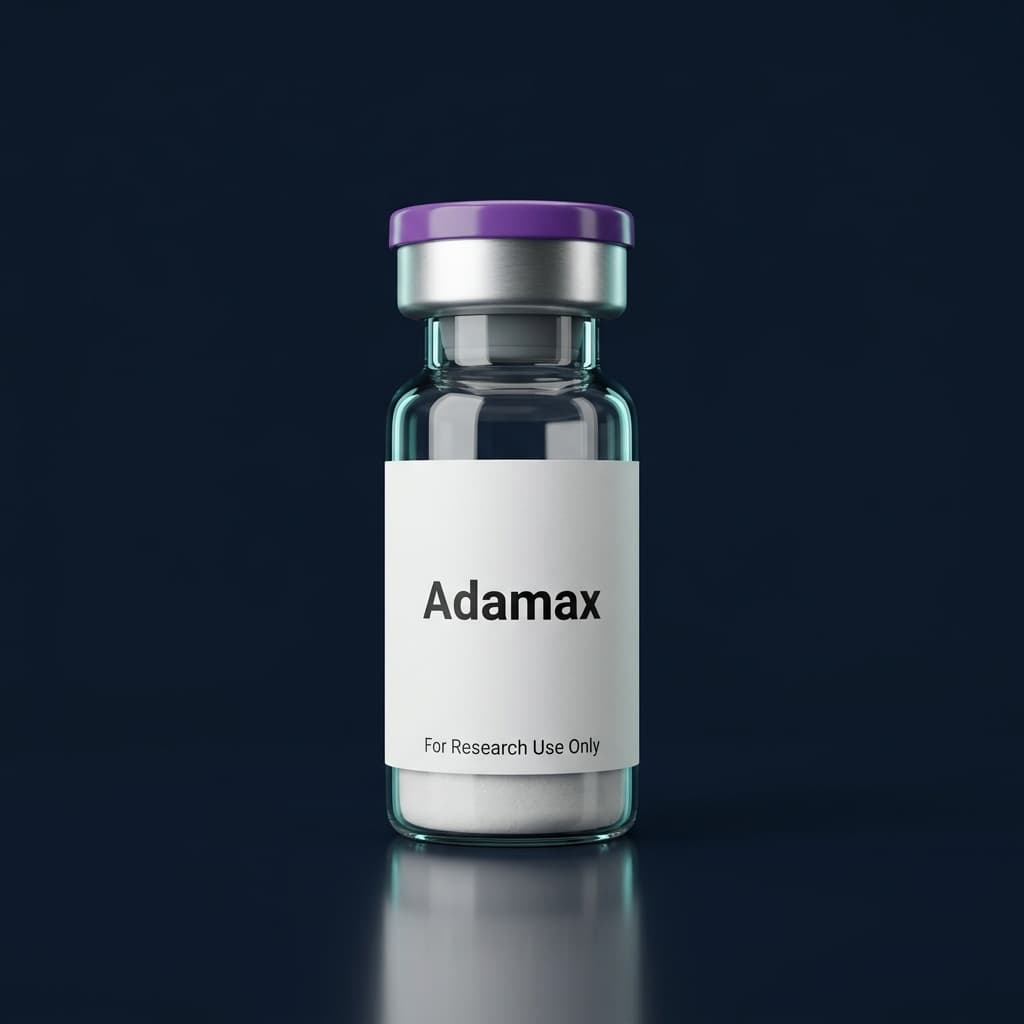
Adamax
Le laboratoire l'a identifié comme la forme d'Adamax à 984 Da, sans groupement adamantane. Notre lot de 10 mg correspond à cette forme.
Livraison gratuite pour les commandes de plus de €200
- Si un produit ne correspond pas à la spécification de son COA publié, contactez-nous avec votre numéro de lot : nous enquêtons sur la base du rapport du lot et remplaçons tout produit non conforme, sans frais pour vous.
- Contactez-nous dans les 48 heures suivant la livraison avec des photos du carton extérieur, du calage intérieur et de tous les flacons concernés, étiquettes lisibles. Les dommages de transport confirmés sont remplacés sans frais pour vous.
Le laboratoire l'a identifié comme la forme d'Adamax à 984 Da, sans groupement adamantane. Notre lot de 10 mg correspond à cette forme.
3 à 7 jours dans la plupart des pays de l'UE · 10 à 14 jours dans les pays nordiques et baltes
Livraison standard dans l'UE à partir de 4,99 € (RO) · principaux pays de l'UE (GLS) 17,99 € · pays nordiques et baltes 12,99 €–15,99 € · Expédition sous 1 à 2 jours ouvrés · Livraison gratuite au-delà de 200,00 € · aucune formalité douanière (UE) · via le réseau de transporteurs de l'UE
Encore 200,00 € pour bénéficier de la livraison gratuite au-delà de 200,00 €. En dessous, la livraison standard dans l'UE coûte 17,99 € (GLS, la plupart des pays de l'UE).
Comment fonctionnent Paysera et SEPA
- Payez : envoyez un virement SEPA manuel à l'aide de l'IBAN que nous vous communiquons par e-mail, ou, lorsque la page de paiement le propose pour votre adresse, approuvez un virement SEPA dans votre propre banque via la page hébergée de Paysera.
- Nous confirmons : Paysera nous prévient instantanément, ou nous associons le virement manuel à votre commande à son arrivée (généralement 1 jour ouvré).
- Nous expédions : les commandes confirmées sont généralement expédiées sous 1 à 2 jours ouvrés.
Les paiements par carte ne sont pas proposés actuellement. Aucun processeur de paiement par carte n'est relié à cette page de paiement.
Research-grade Adamax, 984 Da form without the adamantane group. Class-level specification ≥97%; selected lots independently tested. Lyophilized powder in sealed glass vial. For research purposes only. Not for human consumption.
| Quantité | Prix unitaire | Total | Économies |
|---|---|---|---|
| 1 unité | 49,99 € | 49,99 € | -- |
| 3+ | 47,49 € | 142,47 € | 5% de réduction |
| 5+Le plus populaire | 44,99 € | 224,95 € | 10% de réduction |
| 10+ | 42,49 € | 424,92 € | 15% de réduction |
Avis important
Ce produit est destiné uniquement à des fins de recherche. Ne convient pas à un usage humain ou vétérinaire. En procédant à l'achat, vous confirmez que ce produit sera utilisé exclusivement à des fins de recherche in vitro.
En raison d'exigences légales et réglementaires, ce produit ne peut pas être expédié vers : Italie.
Reconstitution requise
Ce peptide est expédié lyophilisé (poudre sèche) et nécessite de l'eau bactériostatique pour être reconstitué avant utilisation. L'eau BAC est vendue séparément.
Lorsque ce produit peut ne pas convenir à vos recherches
- ⚠Si vos recherches nécessitent du matériel de qualité GMP pour des applications cliniques — les peptides de qualité recherche ne sont pas destinés à un usage clinique.
- ⚠Si votre laboratoire ne dispose pas d'un stockage à froid adéquat (congélateur à -20°C) — la stabilité de ce peptide peut être compromise à des températures plus élevées.
- ⚠Si votre protocole d'étude requiert des étalons de référence approuvés par la FDA — contactez l'USP ou un fournisseur de matériel de référence certifié.
Des rapports de laboratoire sont publiés pour certains lots. Consultez chaque rapport pour connaître son résultat et la méthode indiquée. À des fins de recherche uniquement.
Consultez le rapport #241505 sur janoshik.com →
Expédition sous 1 à 2 jours ouvrés, livraison à partir de 4,99 € en Roumanie et de 12,99 € dans le reste de l'Europe
Spécification enregistrée au niveau de la classe ; rapport Janoshik indépendant sur des lots sélectionnés
À propos de Adamax
Adamax is a synthetic research peptide in the Semax family. Semax is a heptapeptide built from the ACTH(4-7) fragment extended with Pro-Gly-Pro, and Adamax is offered in more than one form under the same name: one carries an adamantane group, one does not.
This product is the 984 Da form, without the adamantane group. Janoshik identified the 10mg lot CP-2609-ADM10 as this form in report #241505.
Research use is in laboratory studies of Semax-family peptides, including comparisons between modified and unmodified analogues and studies of peptide stability.
Specifications
| Parameter | Value |
|---|---|
| Compound | Adamax, 984 Da form (no adamantane group) |
| Amount per Vial | 10mg |
| Purity | ≥97% (class-level specification) |
| Format | Lyophilized powder |
| Storage | -20°C; 2-8°C after reconstitution |
Storage
Store at -20°C before reconstitution. Refrigerate at 2-8°C after reconstitution.
Adamax is supplied for laboratory research use only. Not approved for human use. Handle in compliance with institutional biosafety guidelines.
Résumé des spécifications
À propos de Adamax
Adamax is a synthetic research peptide in the Semax family. Semax is a heptapeptide built from the ACTH(4-7) fragment extended with Pro-Gly-Pro, and Adamax is offered in more than one form under the same name: one carries an adamantane group, one does not.
This product is the 984 Da form, without the adamantane group. Janoshik identified the 10mg lot CP-2609-ADM10 as this form in report #241505.
Research use is in laboratory studies of Semax-family peptides, including comparisons between modified and unmodified analogues and studies of peptide stability.
Specifications
| Parameter | Value |
|---|---|
| Compound | Adamax, 984 Da form (no adamantane group) |
| Amount per Vial | 10mg |
| Purity | ≥97% (class-level specification) |
| Format | Lyophilized powder |
| Storage | -20°C; 2-8°C after reconstitution |
Storage
Store at -20°C before reconstitution. Refrigerate at 2-8°C after reconstitution.
Adamax is supplied for laboratory research use only. Not approved for human use. Handle in compliance with institutional biosafety guidelines.
La confiance des chercheurs
Pourquoi les chercheurs choisissent CertaPeptides
Qui teste réellement ce produit ?
Les lots sélectionnés sont vérifiés de manière indépendante par Janoshik Analytical (République tchèque) et publiés sur le portail public de Janoshik. Les autres lots sont expédiés avec la spécification de lot du fournisseur. Consultez /coa pour le mur publié.
Voir les COA →Et si je reçois le mauvais lot ?
Chaque étiquette de flacon porte un code. Recherchez-le sur notre page de vérification : elle affiche ce que CertaPeptides publie pour ce code et, pour un lot retiré, indique que le lot a été retiré et pourquoi. Si le vôtre a été retiré, ou si la recherche du code figurant sur votre étiquette ne donne rien, envoyez-nous ce code par e-mail.
Voir les COA →D'où le produit est-il expédié ?
Roumanie (UE). Nous sommes CERTALAB SRL, CUI 54169956, immatriculée à la TVA. Sameday pour la Roumanie, GLS pour la plupart des destinations de l'UE, TCE Worldwide pour les autres marchés transfrontaliers de l'UE et hors UE (Royaume-Uni, Suisse). Livraison sous 1–15 jours ouvrés selon la destination — le délai exact est indiqué lors du passage à la caisse.
Détails de l'expédition →Et en cas de problème ?
Vous disposez d'un droit de rétractation de 14 jours en vertu de l'OUG 34/2014 (droit de la consommation roumain/UE), avec possibilité de recours auprès de l'ANPC et de règlement extrajudiciaire des litiges (SAL). Contactez-nous à support@certapeptides.com.
Politique de retour →Informations sur le produit
Ce produit est destiné uniquement à des fins de recherche et de développement scientifiques. Il s'agit d'une substance chimique qui ne doit pas être utilisée comme médicament, produit thérapeutique, substance active ou ingrédient dans un quelconque produit destiné à la consommation humaine ou animale. Les chercheurs doivent manipuler ce composé conformément aux directives de biosécurité de leur établissement. À utiliser uniquement dans des environnements de laboratoire correctement équipés, avec un équipement de protection individuelle approprié.