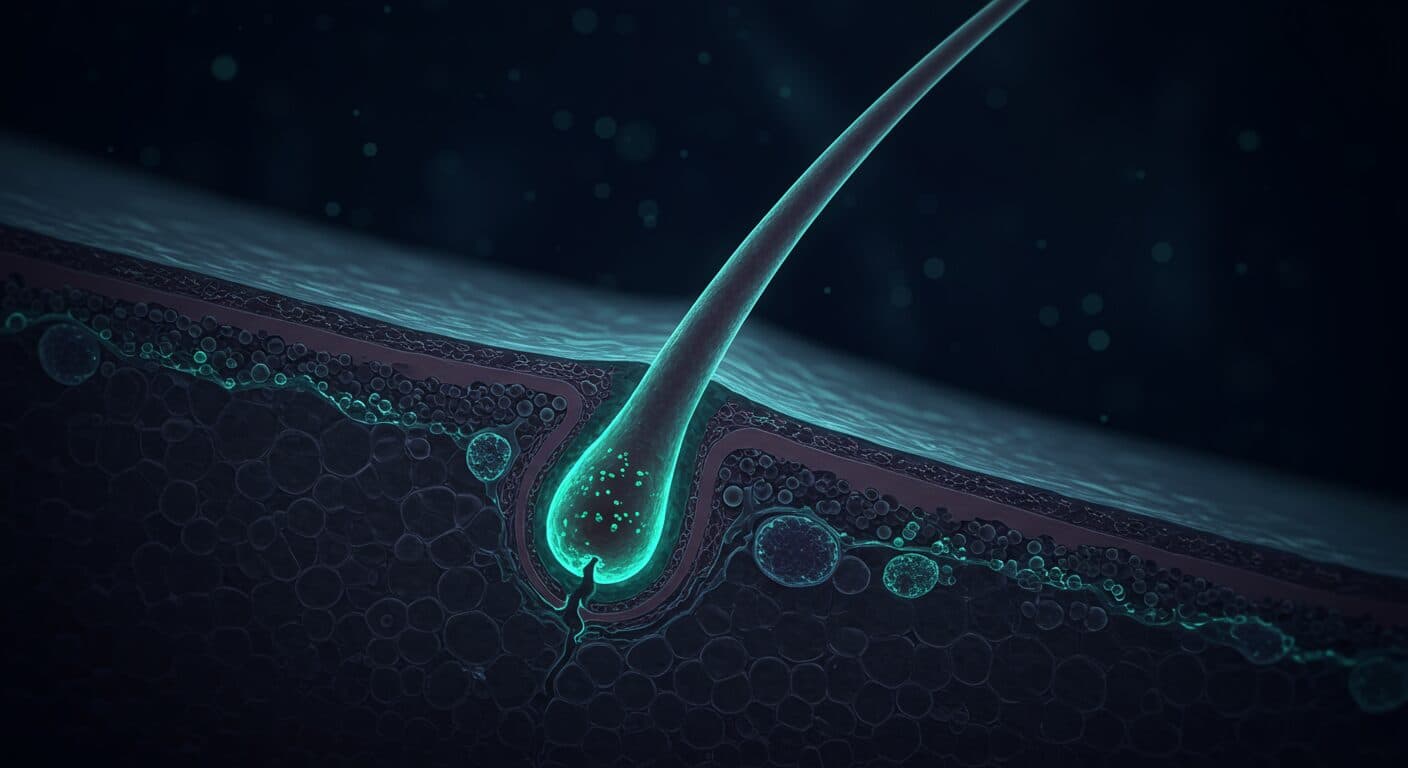
La recherche sur les follicules pileux occupe une position particulière dans la science des peptides. Elle exige une précision moléculaire — le follicule est un mini-organe structurellement complexe, avec des phases de cycle étroitement régulées — mais elle a aussi suscité un intérêt commercial important, susceptible de déformer la manière dont la science sous-jacente est communiquée. GHK-Cu ne fait pas exception. Avant de lire toute allégation concernant les peptides de cuivre et les cheveux, il est utile de savoir ce que la recherche publiée a réellement étudié, chez quelles espèces, et avec quels résultats. Cet article résume la littérature primaire sur GHK-Cu dans la biologie des follicules pileux. Toutes les constatations proviennent de travaux expérimentaux évalués par les pairs. Ce contenu est destiné à des fins éducatives et uniquement à des fins de recherche.
Le follicule pileux comme modèle de recherche
Le follicule pileux traverse trois phases : anagène (croissance active), catagène (régression) et télogène (repos). La papille dermique — un amas de cellules mésenchymateuses spécialisées à la base du follicule — agit comme le régulateur principal de ce cycle. Les cellules de la papille dermique sécrètent des facteurs de croissance (notamment IGF-1, FGF-7/KGF, VEGF et d’autres) qui maintiennent la phase anagène et régulent la transition vers la phase catagène. Les composés qui modulent l’activité des cellules de la papille dermique intéressent les chercheurs qui étudient les troubles du cycle folliculaire.
GHK-Cu est entré dans la recherche sur les follicules pileux sous cet angle. Le laboratoire de Pickart a d’abord étudié si les effets connus du composé sur l’expression du facteur de croissance des fibroblastes (observés dans des modèles de cicatrisation) s’étendaient aux cellules de la papille dermique, qui partagent une lignée fibroblastique. Pour un contexte sur le mécanisme général et la structure moléculaire de GHK-Cu, consultez notre guide de recherche complet : Peptide de cuivre GHK-Cu : le guide de recherche complet.
Les études fondatrices de Pickart sur les follicules pileux
Loren Pickart, à l’University of Washington, a commencé à étudier les effets de GHK-Cu sur les follicules pileux à la fin des années 1980, en s’appuyant sur ses travaux antérieurs sur la cicatrisation. Ses observations dans des modèles de rongeurs suggéraient que l’application topique de GHK-Cu pouvait augmenter la taille des follicules et prolonger la phase anagène.
Pickart (1990) a rapporté dans des communications scientifiques que GHK-Cu appliqué par voie topique sur la peau dorsale rasée de souris produisait des augmentations mesurables de la taille des follicules et de la densité pileuse par rapport aux témoins traités par véhicule. Le mécanisme proposé impliquait la capacité documentée de GHK-Cu à stimuler l’expression de facteurs de croissance dans les cellules fibroblastiques — si cela s’appliquait aux cellules de la papille dermique, l’effet en aval serait une signalisation anagène prolongée.
Point essentiel, les travaux de Pickart dans ce domaine ont souvent été publiés dans des brevets ou présentés lors de conférences plutôt que dans des revues évaluées par les pairs, ce qui signifie que la méthodologie a reçu moins d’examen indépendant que ses recherches sur la cicatrisation. Les chercheurs doivent en tenir compte dans leur évaluation des données sur les follicules pileux.
Les études sur le macaque à queue courte
L’étude comparative la plus rigoureuse de GHK-Cu dans la recherche sur la perte de cheveux a utilisé le macaque à queue courte (Macaca arctoides) — un primate non humain qui développe spontanément une forme d’alopécie androgénétique histologiquement similaire à la condition humaine. Cela en fait un modèle nettement plus pertinent que les études chez la souris ou le rat, qui ne développent pas spontanément d’alopécie hormonale.
Uno et Kurata (1993) ont mené une comparaison de GHK-Cu et du minoxidil dans ce modèle, en appliquant les composés par voie topique sur des zones du cuir chevelu dégarnies pendant une période de traitement définie. Leurs résultats, publiés dans le Journal of Investigative Dermatology, ont rapporté :
- Le traitement par GHK-Cu a produit un agrandissement folliculaire mesurable, quantifié par histomorphométrie de la surface de section des follicules
- L’ampleur de l’agrandissement folliculaire était comparable à celle observée avec le minoxidil pour des durées de traitement équivalentes
- Aucun des deux composés n’a restauré les nombres de cheveux terminaux aux niveaux pré-alopécie pendant la période de traitement étudiée
- Les deux composés semblaient agir par des mécanismes distincts : le minoxidil principalement comme ouvreur de canaux potassiques/vasodilatateur, GHK-Cu par une modulation présumée des facteurs de croissance
Il s’agit probablement de l’élément de preuve le plus cité concernant GHK-Cu dans la recherche capillaire. Les tailles d’échantillon étaient faibles (caractéristique des études chez les primates non humains, qui sont limitées sur le plan logistique), et l’étude n’était pas conçue pour établir une équivalence humaine. DOI: 10.1016/0022-202X(93)90516-K.
Études de culture de cellules de la papille dermique
Les études in vitro de GHK-Cu dans les cellules de la papille dermique ont examiné la production de facteurs de croissance et la prolifération cellulaire comme indicateurs indirects de l’activité folliculaire.
Kang et al. (2009), publié dans Archives of Dermatological Research (DOI: 10.1007/s00403-009-0942-x), ont étudié les effets de GHK-Cu sur des kératinocytes humains en monocouche et en culture équivalente à la peau. Ils ont rapporté une augmentation du proliferating cell nuclear antigen (PCNA), de la positivité p63, ainsi qu’une régulation à la hausse de l’intégrine α6 et β1 — les sous-unités d’intégrine se liant au collagène et à la laminine. La pertinence directe pour le cycle des follicules pileux nécessite des travaux supplémentaires dans des modèles tissulaires, mais le signal prolifératif kératinocytaire est mécaniquement pertinent pour la biologie de la gaine épithéliale externe et la régénération du compartiment épithélial du follicule.
Des travaux distincts en culture cellulaire ont examiné si GHK-Cu pouvait réguler à la hausse le facteur de croissance de l’endothélium vasculaire (VEGF) dans des préparations de papille dermique. VEGF est un facteur connu favorisant la phase anagène — les effets capillaires du minoxidil sont en partie attribués à la régulation à la hausse de VEGF par son mécanisme vasodilatateur. Si GHK-Cu stimule indépendamment VEGF dans les cellules de la papille dermique, l’efficacité comparable des deux composés dans le modèle macaque devient plus interprétable sur le plan mécanistique. Cependant, ce parallèle n’a pas été établi de manière rigoureuse dans des comparaisons in vitro directes publiées.
Comparaison au minoxidil dans les modèles de recherche
Le minoxidil a été approuvé par la FDA pour l’alopécie androgénétique sur la base d’essais cliniques contrôlés chez l’humain. GHK-Cu ne dispose d’aucun historique d’essais humains équivalent. Cette distinction est importante lors de l’interprétation des données comparatives chez les rongeurs et les primates.
Dans le modèle macaque d’Uno et Kurata (1993), la comparaison est informative au niveau mécanistique : deux composés ayant des mécanismes primaires différents (ouverture des canaux potassiques vs modulation proposée des facteurs de croissance) ont produit des résultats histologiques similaires sur la taille folliculaire. Cela présente un intérêt pour les chercheurs qui tentent de comprendre quelles voies biologiques suffisent à produire une prolongation de la phase anagène dans ce modèle.
Ce que cela n’établit pas :
- Que GHK-Cu est aussi efficace que le minoxidil chez l’humain
- Que GHK-Cu produit la même ampleur de résultat à des concentrations cliniquement pertinentes dans le cuir chevelu humain
- Que le critère d’agrandissement folliculaire utilisé dans l’étude chez le macaque est corrélé à une amélioration visible de la densité capillaire chez l’humain
Le lien FGF-7 et KGF
Un mécanisme proposé reliant GHK-Cu à la biologie des follicules pileux est la régulation à la hausse du facteur de croissance des kératinocytes (KGF, également appelé FGF-7). KGF est produit par les cellules de la papille dermique et envoie des signaux à la matrice pilaire épithéliale, où il favorise la prolifération en phase anagène. Les composés qui augmentent l’expression de KGF dans les cellules de la papille dermique font l’objet de recherches actives comme cibles potentielles pour des interventions sur le cycle folliculaire.
Les revues publiées de Pickart ont proposé que GHK-Cu stimule l’expression de KGF/FGF-7, en s’appuyant sur les effets documentés plus larges du composé sur les membres de la famille des facteurs de croissance des fibroblastes dans des modèles de cicatrisation. Le fait que cet effet ait été spécifiquement démontré dans des cellules isolées de la papille dermique avec des contrôles rigoureux doit être vérifié dans la littérature primaire avant d’être cité comme fait établi.
Ce qui n’a pas été étudié
Une évaluation honnête de la littérature sur GHK-Cu et les follicules pileux nécessite d’en reconnaître les lacunes :
- Aucun RCT humain : Il n’existe aucun essai contrôlé randomisé, publié et évalué par les pairs, de GHK-Cu pour l’alopécie androgénétique ou toute autre condition de perte de cheveux chez l’humain.
- Clarté mécanistique limitée dans les cellules spécifiques au follicule : De nombreux mécanismes publiés ont été caractérisés dans des fibroblastes de cicatrisation, et non dans des cellules de la papille dermique. Les cellules de la papille dermique ont des profils transcriptomiques distincts et peuvent répondre différemment.
- Aucune donnée dose-réponse dans les modèles de primates : L’étude chez le macaque a examiné une dose/un schéma spécifique. Il n’a pas été publié si des concentrations plus élevées ou plus faibles produisent des résultats différents.
- Effets à long terme non étudiés : Toutes les études capillaires publiées impliquent des périodes de traitement définies. Les effets d’une exposition prolongée à GHK-Cu sur la biologie folliculaire ne sont pas documentés.
Approvisionnement en GHK-Cu de qualité recherche
Pour les expériences de culture cellulaire sur les follicules pileux, les exigences de pureté de GHK-Cu reflètent celles des autres applications de recherche : pureté HPLC ≥98% avec confirmation par spectrométrie de masse du chélate de cuivre intact. Vérifiez que votre fournisseur fournit un COA confirmant à la fois la pureté et la présence de cuivre. Consultez les rapports Janoshik que CertaPeptides publie sur certapeptides.com/coa.
GHK-Cu de qualité recherche est disponible pour une utilisation en laboratoire sur certapeptides.com/shop/ghk-cu.
Points clés à retenir
- GHK-Cu est étudié dans des modèles de recherche sur les follicules pileux depuis la fin des années 1980, principalement par le laboratoire de Pickart et à travers une étude notable chez le primate non humain menée par Uno et Kurata (1993)
- Le modèle du macaque à queue courte a montré un agrandissement folliculaire avec GHK-Cu comparable au minoxidil — mais il s’agit de données de primate, pas de données humaines
- Les mécanismes proposés impliquent une modulation des facteurs de croissance des cellules de la papille dermique (KGF/FGF-7, VEGF), en s’appuyant sur l’activité établie de GHK-Cu dans les fibroblastes de cicatrisation
- Aucun essai clinique humain pour des indications de perte de cheveux n’a été publié ; toutes les données d’efficacité proviennent de modèles de rongeurs, de primates ou in vitro
- La chélation du cuivre compte : GHK seul montre des réponses atténuées par rapport à GHK-Cu dans les modèles de fibroblastes
Références
- Uno H, Kurata S. (1993). Chemical agents and peptides affect hair growth. Journal of Investigative Dermatology, 101(1 Suppl), 143S-147S. 10.1016/0022-202X(93)90516-K
- Kang YA, Choi HR, Na JI, et al. (2009). Copper–GHK increases integrin expression and p63 positivity by keratinocytes. Archives of Dermatological Research, 301(4), 301–306. DOI: 10.1007/s00403-009-0942-x
- Pickart L, Margolina A. (2018). Regenerative and protective actions of the GHK-Cu peptide in the light of the new gene data. Biomolecules, 8(2), 29. DOI: 10.3390/biom8020029
- Pickart L, Vasquez-Soltero JM, Margolina A. (2015). GHK Peptide as a Natural Modulator of Multiple Cellular Pathways in Skin Regeneration. BioMed Research International, 2015, Article 648108. DOI: 10.1155/2015/648108
- Gorouhi F, Maibach HI. (2009). Role of topical peptides in preventing or treating aged skin. International Journal of Cosmetic Science, 31(5), 327-345. DOI: 10.1111/j.1468-2494.2009.00490.x
Références
- Pickart L, Thaler MM. (1973). Tripeptide in human serum which prolongs survival of normal liver cells and stimulates growth of neoplastic liver cells. Nature New Biology, 243(124), 85–87. PMID: 4349963.
- Maquart FX, et al. (1988). Stimulation of collagen synthesis in fibroblast cultures by the tripeptide-copper complex glycyl-L-histidyl-L-lysine-Cu2+. FEBS Letters, 238(2), 343–346. PMID: 3169264.
- Pickart L, Vasquez-Soltero JM, Margolina A. (2015). GHK Peptide as a Natural Modulator of Multiple Cellular Pathways in Skin Regeneration. BioMed Research International, 2015, 648108. PMID: 26236730.
Tous les produits sont destinés uniquement à des fins de recherche. Ne convient pas à la consommation humaine.
Vérifiez avant de mener vos recherches
Les pages produit indiquent une spécification au niveau de la classe lorsqu'une telle spécification est enregistrée, et certains lots sont accompagnés d'un COA indépendant émis par un tiers.