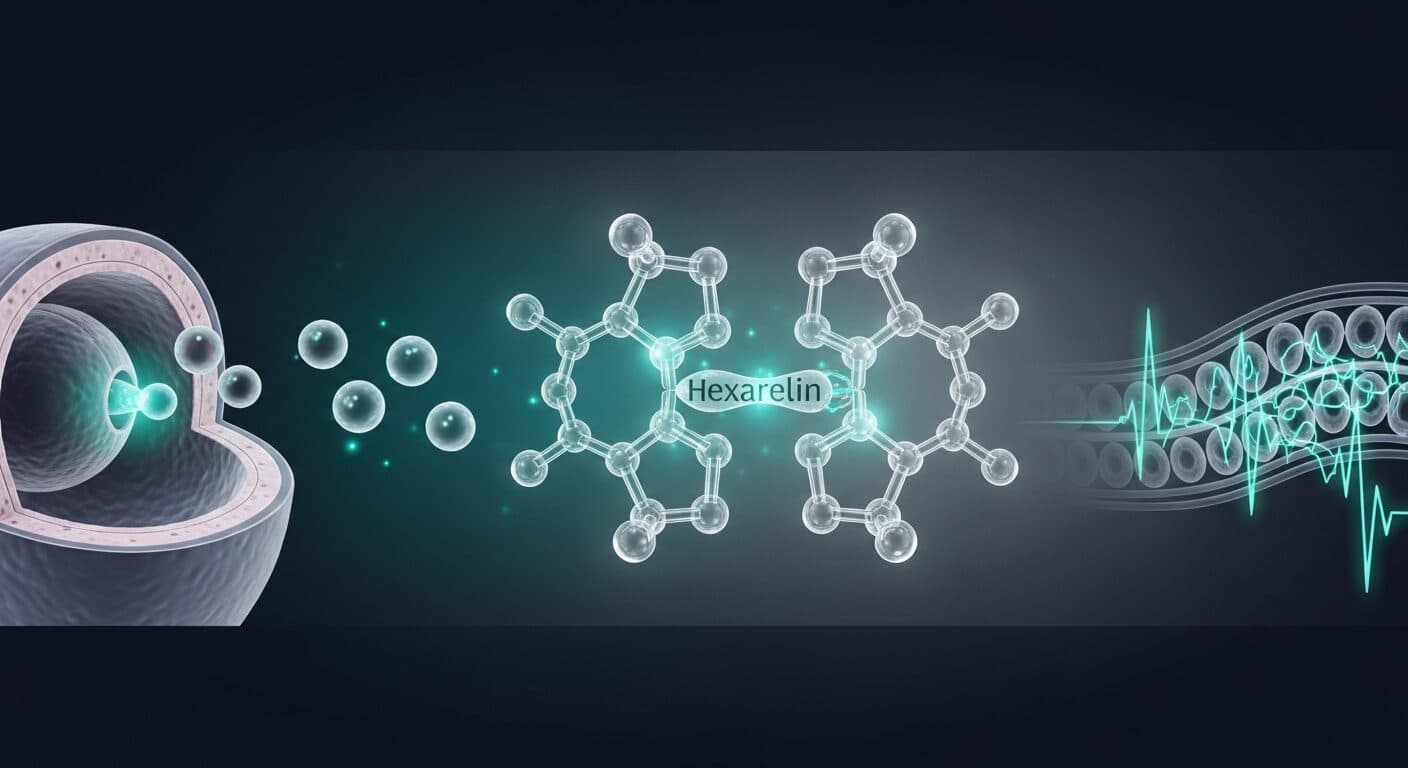
⚠️ For Research Purposes Only — This article discusses hexarelin strictly as a laboratory research compound. It is not a drug recommendation, dosage guide, or medical advice. Hexarelin is not for human consumption. It is not intended to diagnose, treat, cure, or prevent any disease. All claims below refer to published preclinical research, in vitro investigations, or peer-reviewed literature cited for scientific context only.
Introduction
Hexarelin is a synthetic hexapeptide belonging to the broader class of growth hormone-releasing peptides (GHRPs), which were developed beginning in the late 1970s as small-molecule probes of growth hormone secretion mechanisms. Along with GHRP-6, GHRP-2, and ipamorelin, hexarelin has been used extensively in research to dissect the biology of the growth hormone secretagogue receptor (GHSR-1a), the endogenous ligand of which is ghrelin, and more recently to investigate non-GHSR-mediated signaling through the scavenger receptor CD36 [1][2].
For researchers working in endocrinology, cardiovascular biology, neuroscience, or peptide pharmacology, hexarelin is a well-characterized tool compound with a substantial body of published work spanning more than two decades. Its scientific interest comes from three principal features: (1) the compound is chemically stable and potently activates GHSR-1a; (2) it exhibits cardioprotective effects in preclinical ischemia-reperfusion models that appear to be at least partly independent of growth hormone release; and (3) the peptide has binding targets beyond GHSR-1a, including a specific cardiac CD36-mediated pathway described in the research literature [1][3].
This article reviews hexarelin’s structure, mechanisms of action, and the three principal research areas in which it has been studied: ghrelin receptor signaling, cardioprotection, and neuroprotection.
Molecular Structure and Biochemistry
Hexarelin is a synthetic hexapeptide with the sequence His-D-2-methyl-Trp-Ala-Trp-D-Phe-Lys-NH2. Its structural design exemplifies the GHRP medicinal-chemistry strategy: the introduction of D-amino acids (D-2-methyl-Trp at position 2 and D-Phe at position 5) confers resistance to proteolytic degradation by aminopeptidases and endopeptidases, while the C-terminal amidation protects against C-terminal carboxypeptidases. Together, these modifications give the hexapeptide substantially greater metabolic stability than endogenous ghrelin.
Key biochemical features:
- Small size (~887 Da) makes this GHRP easy to synthesize via standard Fmoc solid-phase peptide chemistry and amenable to oral, nasal, subcutaneous, or intravenous research administration routes in preclinical protocols.
- Two tryptophan residues (one natural L-Trp, one D-2-methyl-Trp) contribute to UV absorbance at 280 nm, which is useful for HPLC quantification during research characterization.
- Basic C-terminal lysine with amide cap gives the molecule a net positive charge at physiological pH and supports interaction with negatively charged receptor surfaces.
- Chemical stability: Compared with ghrelin, the compound is more stable, is not acylated (unlike ghrelin, which requires O-octanoylation of Ser3 for GHSR-1a activity), and retains potent activity across a broader range of storage and administration conditions [1][4].
Because hexarelin does not require an acyl modification to activate GHSR-1a, it provides a useful research tool for probing receptor biology without the complications of the ghrelin O-acyltransferase (GOAT) machinery that processes endogenous ghrelin.
Mechanism of Action in Research Models
Hexarelin has two principal mechanisms described in the published research literature:
1. GHSR-1a agonism and growth hormone release. The classical mechanism: hexarelin binds the type 1a growth hormone secretagogue receptor (GHSR-1a) on anterior pituitary somatotrophs and hypothalamic neurons, activating Gq-mediated signaling, IP3-dependent calcium mobilization, and downstream GH secretion. GHSR-1a is also the endogenous ghrelin receptor, and this GHRP’s ability to mimic ghrelin’s action on this receptor has made it a widely used research tool [1][4].
In isolated rat pituitary research preparations, the peptide produces robust dose-dependent GH release with potency comparable to or exceeding that of endogenous ghrelin. Published research has used this compound to characterize GHSR-1a desensitization, signaling kinetics, and pharmacological distinctions between GHRPs and nonpeptidyl secretagogues such as MK-0677 [1][5].
2. CD36-mediated cardiac signaling. A distinctive feature of this GHRP that sets it apart from some other growth hormone releasing peptides is its ability to bind CD36, a scavenger receptor expressed in cardiomyocytes, macrophages, and other tissues. The Mao et al. 2014 review in the Journal of Geriatric Cardiology summarized the evidence that CD36 serves as a specific cardiac receptor for the hexapeptide and mediates its cardioprotective effects independently of GHSR-1a and independently of growth hormone release [1]. This dual-receptor binding profile is the mechanistic basis for the compound’s research utility in cardiovascular models.
Additional signaling threads in the hexarelin research literature include:
- Akt/glycogen synthase kinase-3β phosphorylation: In a neonatal hypoxia-ischemia rat model, treatment with the peptide increased phosphorylation of Akt and GSK-3β, correlating with reduced caspase-3 activity and decreased brain injury [7]. This pathway is widely regarded as a canonical pro-survival signaling axis.
- IL-1 signaling modulation: In rat cardiac I/R research, the compound down-regulated IL-1β expression and up-regulated IL-1Ra expression in I/R myocardium, with these effects blocked by the GHSR-1a antagonist [D-Lys3]-GHRP-6, indicating a GHSR-1a-dependent inflammatory modulation component [9].
- PTEN upregulation and Akt/mTOR suppression: In a rat coronary artery ligation-induced heart failure model, chronic treatment with this GHRP upregulated PTEN and downregulated the Akt/mTOR signaling pathway, improving left ventricular function and reducing oxidative stress [10].
- Autophagy modulation: In angiotensin II-induced hypertrophy research in H9C2 cardiomyocytes, the compound enhanced autophagy via suppression of mTOR signaling, and the protective effect was abolished by the autophagy inhibitor 3-methyladenine [11].
- Prostacyclin (PGI2) preservation: Early cardiac research reported that the hexapeptide prevented the fall in prostacyclin release in isolated perfused rat hearts subjected to I/R, providing a vascular-protective component to the cardioprotective phenotype [4].
Key Research Areas
1. Ghrelin Receptor (GHSR-1a) Research
This growth hormone releasing peptide has been a workhorse research compound for GHSR-1a biology since the receptor’s cloning and characterization in the late 1990s. Its utility derives from its chemical stability, high receptor affinity, and well-defined pharmacology. Research applications include:
- Characterization of GHSR-1a expression and distribution across the hypothalamus-pituitary complex and peripheral tissues. The observation that GHSR-1a is expressed in cardiovascular tissue led to the exploration of the peptide’s direct cardiac actions [1].
- Pharmacological dissection of receptor signaling using the compound alongside antagonists such as [D-Lys3]-GHRP-6 to distinguish GHSR-1a-dependent from GHSR-1a-independent effects [9].
- Comparative studies of GHRPs examining differences among this hexapeptide, GHRP-6, GHRP-2, ipamorelin, and the nonpeptidyl secretagogue MK-0677 in their ability to activate cardiac versus pituitary receptor pools [4][5][8].
- Feedback-regulation research using the compound to probe GH pulsatility, IGF-1 negative feedback, and the interaction of GHSR-1a signaling with GHRH and somatostatin inputs.
The 1999 clinical and experimental review by Svensson and Bengtsson summarized early human and preclinical research on this GHRP, including its effects on GH secretion, body composition in research cohorts, and diet-induced catabolism in healthy research volunteers — providing historical context for the field [5].
2. Cardioprotection Research
The cardioprotection research area is arguably where this GHRP has made its most distinctive contribution. Multiple independent research groups have reported that the compound protects cardiomyocytes and whole hearts from ischemia-reperfusion injury in preclinical models.
A foundational 1999 study from Locatelli and colleagues demonstrated that the peptide’s cardioprotective effects in hypophysectomized rats were independent of growth hormone release, establishing the GH-independent character of the cardiac phenotype [3]. This was a mechanistically important finding because it separated hexarelin’s cardiac actions from its classical somatotroph action and motivated the search for non-GHSR cardiac receptors that ultimately identified CD36 as the relevant target [1].
Subsequent cardioprotection research has reported:
- Reduced infarct size in isolated working rat hearts subjected to ischemia followed by reperfusion, with the compound producing measurable protection that was partly blocked by the protein kinase C inhibitor chelerythrine [4].
- Protection of H9c2 cardiomyocytes from doxorubicin-induced cell death via specific binding of peptidyl GHSs and inhibition of DNA fragmentation, providing a cell-line model for the peptide’s anti-apoptotic cardioprotection [8].
- Improved left ventricular function in rats with in vivo coronary ligation-induced I/R injury, with this GHRP reported to improve systolic function, reduce malondialdehyde production, and increase cardiomyocyte survival [9].
- Long-term functional benefit from a single oral dose administered 30 minutes after myocardial infarction in a mouse model, with higher ejection fraction, lower lung weight ratios, and shifts in autonomic balance reported at the chronic phase [6].
- Anti-hypertrophic effects via autophagy enhancement in Ang II-stimulated H9C2 cells [11].
- Heart failure amelioration via PTEN upregulation and Akt/mTOR pathway suppression in a rat CAL-induced HF model [10].
Together, these reports establish the compound as one of the more thoroughly characterized peptide cardioprotective research tools, with mechanistic studies spanning signaling (Akt, PKC, mTOR, PTEN), inflammation (IL-1), autophagy, and oxidative stress pathways.
3. Neuroprotection Research
A smaller but noteworthy body of research has examined the compound’s effects in the central nervous system. The 2005 Brywe et al. study examined the peptide in a neonatal hypoxia-ischemia rat model (unilateral carotid ligation plus 7.7% oxygen exposure) [7]. Intracerebroventricular administration directly after the hypoxic-ischemic insult was reported to reduce brain damage relative to vehicle, with injury reduction in cerebral cortex, hippocampus, and thalamus but not striatum [7]. The cerebroprotective effect was accompanied by reduced caspase-3 activity and increased Akt and GSK-3β phosphorylation, while ERK signaling was unaffected.
This was the first published report of central neuroprotective action for this GHRP and provides a model for researchers interested in peptide-based preconditioning or post-insult interventions in hypoxic-ischemic brain research.
Stability, Storage, and Handling in the Laboratory
This GHRP is a stable synthetic peptide that is comparatively forgiving in the laboratory setting:
- Lyophilized form: Stable at -20°C or -80°C for long-term research storage. Short-term storage at 2-8°C is acceptable for unopened vials.
- Reconstitution: Sterile water or 0.9% saline are standard research reconstitution solvents. Bacteriostatic water is also used in some research protocols. The peptide’s D-amino acid content and C-terminal amide provide robustness to a wide pH range, though neutral pH (6-8) is preferred for maximum shelf life.
- Post-reconstitution stability: The reconstituted compound is stable for several days at 2-8°C and for extended periods at -20°C when aliquoted to avoid freeze-thaw cycles.
- HPLC and MS characterization: Standard analytical QC for the research-grade peptide includes reversed-phase HPLC purity (≥95%) and mass spectrometric confirmation of the expected hexapeptide mass (~887 Da).
- Administration routes in published research: Subcutaneous, intravenous, intraperitoneal, intracerebroventricular, and oral routes have all been used in preclinical research protocols [3][6][7]. Bioavailability differs substantially across routes, and research designs should specify the route and dose-range rationale.
- Light and air sensitivity: As with most peptides containing aromatic residues, amber vials and inert-atmosphere storage improve long-term research stability.
Research Considerations and Limitations
GH-dependent vs. GH-independent effects. Because the compound’s actions at the pituitary release GH, many downstream effects (e.g., IGF-1 elevation, anabolic effects) can be mediated indirectly. Separating direct peripheral effects from GH-mediated effects requires hypophysectomized controls or matched exogenous GH comparison groups [3].
Receptor selectivity. This GHRP is not a selective GHSR-1a agonist. Its additional binding to CD36 and potentially other receptors means that experimental results require cautious mechanistic interpretation, and researchers should include GHSR-1a antagonists ([D-Lys3]-GHRP-6) or CD36-knockout controls where mechanistic specificity matters [1][9].
Species differences in cardiac receptor expression. GHSR-1a and CD36 expression patterns differ across species, and extrapolation from rodent research to other species or to human tissue should be approached with care.
Tachyphylaxis. Repeated GHRP administration can produce desensitization of the GH response in research models, so chronic-dosing experiments should include quantification of response over time.
Cortisol and prolactin effects. In some research populations, growth hormone releasing peptides including this compound have been reported to modestly elevate cortisol and prolactin along with GH. Researchers measuring GH-specific endpoints should include these hormones as controls.
Translational caveats. Most of the cardioprotection research has been conducted in rodent preclinical models, and extrapolation to human cardiovascular research requires the standard caveats about species differences in receptor biology, ischemia tolerance, and reperfusion injury mechanisms.
Frequently Asked Research Questions
Q1: How does hexarelin compare with ghrelin in research applications?
Hexarelin and ghrelin are both GHSR-1a agonists, but the former is chemically more stable and does not require the Ser3 octanoylation that is essential for ghrelin’s activity at GHSR-1a. In research applications where GHSR-1a activation needs to be probed without the confounding biology of the ghrelin-O-acyltransferase (GOAT) enzyme, this hexapeptide is often preferred. In cardiac research specifically, both compounds have been reported to protect against I/R injury, but the compound has a more thoroughly characterized CD36-mediated mechanism [1][4].
Q2: Is hexarelin selective for GHSR-1a?
No. While this GHRP is a potent GHSR-1a agonist, published research has established that it also binds CD36 in cardiac tissue, and this non-GHSR interaction mediates at least part of its cardioprotective phenotype [1]. Researchers interested in clean GHSR-1a agonism in cardiac research settings should consider complementary use of more selective agonists.
Q3: What routes of administration are used in preclinical hexarelin research?
Published rodent research has employed subcutaneous administration in cardioprotection studies [3][9], single intracerebroventricular administration in neonatal neuroprotection research [7], and oral administration in some protocols [6]. Route and exposure are determined by the research question; nothing here represents guidance for human use.
Q4: Can hexarelin be used in vitro to study cardiomyocyte biology?
Yes. H9c2 (rat cardiomyoblast) and C2C12 (mouse myoblast) cell lines have been used extensively in this research area. Published concentrations in cell culture range from nanomolar to low-micromolar, depending on the endpoint. Specific binding sites for the compound (radiolabeled tracer studies) have been characterized in these cell lines [8][11].
Q5: What is the best endpoint panel for cardioprotection research with this GHRP?
Published research typically combines functional measurements (left ventricular ejection fraction, fractional shortening, coronary perfusion pressure), biochemical markers (malondialdehyde, creatine kinase, troponin), cellular viability assays (TTC staining for infarct size, TUNEL for apoptosis), and signaling pathway readouts (Akt, GSK-3β, mTOR, PTEN phosphorylation) [4][7][9][10]. The specific combination depends on the research question and available instrumentation.
References
According to PubMed, the following peer-reviewed articles were used as primary sources for this research overview. DOI links are provided where available.
- Mao Y, Tokudome T, Kishimoto I. The cardiovascular action of hexarelin. J Geriatr Cardiol. 2014;11(3):253-8. PMID: 25278975. PMC full text
- Cao JM, Ong H, Chen C. Effects of ghrelin and synthetic GH secretagogues on the cardiovascular system. Trends Endocrinol Metab. 2006;17(1):13-8. PMID: 16309920. DOI
- Locatelli V, Rossoni G, Schweiger F, et al. Growth hormone-independent cardioprotective effects of hexarelin in the rat. Endocrinology. 1999;140(9):4024-31. PMID: 10465272. DOI
- Frascarelli S, Ghelardoni S, Ronca-Testoni S, Zucchi R. Effect of ghrelin and synthetic growth hormone secretagogues in normal and ischemic rat heart. Basic Res Cardiol. 2003;98(6):401-5. PMID: 14556085. DOI
- Svensson JA, Bengtsson B. Clinical and experimental effects of growth hormone secretagogues on various organ systems. Horm Res. 1999;51 Suppl 3:16-20. PMID: 10592439. DOI
- Mao Y, Tokudome T, Kishimoto I, et al. One dose of oral hexarelin protects chronic cardiac function after myocardial infarction. Peptides. 2014;56:156-62. PMID: 24747279. DOI
- Brywe KG, Leverin AL, Gustavsson M, et al. Growth hormone-releasing peptide hexarelin reduces neonatal brain injury and alters Akt/glycogen synthase kinase-3beta phosphorylation. Endocrinology. 2005;146(11):4665-72. PMID: 16081643. DOI
- Filigheddu N, Fubini A, Baldanzi G, et al. Hexarelin protects H9c2 cardiomyocytes from doxorubicin-induced cell death. Endocrine. 2001;14(1):113-9. PMID: 11322493. DOI
- Huang J, Li Y, Zhang J, Liu Y, Lu Q. The Growth Hormone Secretagogue Hexarelin Protects Rat Cardiomyocytes From in vivo Ischemia/Reperfusion Injury Through Interleukin-1 Signaling Pathway. Int Heart J. 2017;58(2):257-263. PMID: 28321024. DOI
- Agbo E, Liu D, Li M, et al. Modulation of PTEN by hexarelin attenuates coronary artery ligation-induced heart failure in rats. Turk J Med Sci. 2019;49(3):945-958. PMID: 31091855. DOI
- Agbo E, Li MX, Wang YQ, et al. Hexarelin protects cardiac H9C2 cells from angiotensin II-induced hypertrophy via the regulation of autophagy. Pharmazie. 2019;74(8):485-491. PMID: 31526442. DOI
Disclaimer: All products sold by CertaPeptides are intended for laboratory research use only. Not for human or veterinary use. Not for consumption. This article is provided for scientific and educational purposes and does not constitute medical advice, dosing guidance, or an endorsement of any particular use. Researchers are responsible for complying with all applicable institutional, national, and international regulations governing the acquisition, handling, and study of peptide research compounds.
Verify before you research
Every compound we list ships against a supplier batch specification, and selected lots carry an independent third-party COA.