Introduction
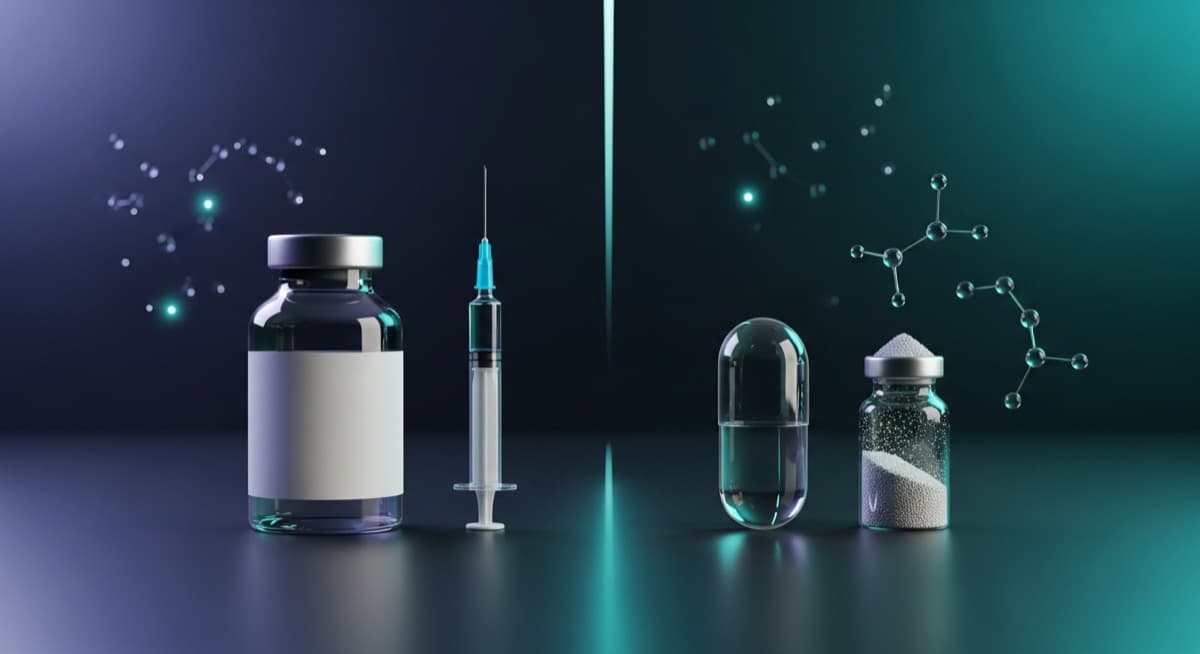
Research peptides arrive in the lab in several physical forms, and the format is a scientific choice, not just a packaging one. A lyophilized vial for injection is handled very differently from an enteric-coated capsule, a tablet built around an absorption enhancer, or a multi-compound blend mixed to a fixed ratio. Each format trades off something different: shelf stability, solubility, handling, and the biological barriers the compound has to cross once it is administered in a research model.
This guide is for researchers who want a clear, format-level picture of how injectable lyophilizates differ from oral delivery systems, and what that means at the bench. It is not a dosing guide, a clinical protocol, or medical advice. All peptides discussed here are supplied strictly for in-vitro and in-vivo preclinical research only, and handling should follow your institutional safety protocols.
We cover why lyophilization dominates injectable peptide supply, the formulation problems that make oral delivery hard, the specific oral formats now appearing in the research catalogue (tablets, capsules, enteric coatings), and the growing role of multi-compound blends. We also point to reconstitution and storage resources for injectable formats.
Lyophilized Injectable Peptides: The Standard for Injectables
What Lyophilization Does to a Peptide
Lyophilization (freeze-drying) removes water from a peptide solution under vacuum at low temperature, leaving a dry, porous cake or powder. The change is not cosmetic. In solution, a peptide is constantly exposed to hydrolytic and oxidative pathways that attack the backbone and reactive side chains; take away the water and you take away the medium those reactions need, so they slow almost to a stop.
Work on stable lyophilized protein and peptide drug products has shown that residual moisture in the finished cake is a critical quality parameter: the more water left behind, the faster the product aggregates and degrades chemically, even in the dry state. Excipients such as sucrose and trehalose are added as lyoprotectants to hold the peptide’s structure together both during freeze-drying and over long-term storage (Remmele et al., 2012).
In practice, a well-made lyophilized peptide is far more stable than the same peptide in solution. Stored dry at −20°C, it can stay analytically intact for many months. Dissolved in aqueous buffer and kept in the fridge, that window is usually days to a few weeks.
Reconstitution: Reintroducing Water
Before a lyophilized injectable peptide can be used, it has to be reconstituted: the dry powder is dissolved in a suitable sterile solvent to form a solution. The solvent choice matters for both stability and downstream use. Bacteriostatic water, sterile water with 0.9% benzyl alcohol as a preservative, is the standard solvent for most injectable research peptides. The benzyl alcohol lets a vial be accessed more than once without microbial contamination, which extends the usable life of the reconstituted batch.
Other solvents are used depending on the peptide’s physicochemical properties: sterile saline, phosphate-buffered saline, or dilute acetic acid for peptides that dissolve poorly in water. Anyone handling lyophilized injectables should work from a dedicated reconstitution guide for solvent choice, sterile handling, and storage of the made-up solution. Our Bacteriostatic Water Reconstitution Guide covers this in detail, and the companion post on Peptide Lyophilization Science explains the freeze-drying process behind the vials.
Injectable Vial Formats in the Research Catalogue
Most research peptides are supplied as lyophilized vials for reconstitution and injection in animal-model work. They include growth hormone secretagogues (Ipamorelin, CJC-1295, Tesamorelin), tissue-research peptides (BPC-157 injectable vials, TB-500), metabolic peptides (Semaglutide injectable vials, Retatrutide, Cagrilintide), and a range of structural and signalling peptides.
Multi-compound injectable blends, such as the Retatrutide + Cagrilintide Blend, are pre-formulated so two compounds can be co-administered from one reconstituted vial at a fixed ratio. That removes a step in combination-study design. The tissue research blends follow the same idea for multi-target work.
The Science of Oral Peptide Delivery
Why Oral Peptide Delivery Is Challenging
Getting a peptide to work orally has occupied pharmaceutical researchers for decades. The gastrointestinal tract is, by design, hostile to intact proteins: acidic gastric conditions, proteolytic enzymes (pepsin, trypsin, chymotrypsin, brush-border peptidases), and a physical epithelial barrier act as successive checkpoints, and most unmodified peptides do not clear them in bioactive form.
Hamman et al. (2005) set out the central barriers: enzymatic degradation in the GI lumen and at the mucosal surface, and poor permeation of the epithelium by large, hydrophilic molecules. The upshot is that oral bioavailability of unmodified peptides is usually very low, which is why injectable formats have long been the default for research peptides.
Later work has catalogued ways around these barriers: chemical modification of the peptide (cyclisation, PEGylation, lipophilic conjugation), formulation approaches (enteric coating, nanoparticle encapsulation, absorption enhancers), and dosage-form engineering (Renukuntla et al., 2013). Each one targets a specific problem, whether that is shielding the peptide from enzymes, holding off release until it reaches a friendlier part of the gut, or helping it physically cross the epithelium.
Modern Oral Peptide Formulation Strategies
Oral peptide delivery has moved on a lot since then. Tyagi et al. (2023) reviewed how systems-biology methods and dosage-form optimisation can be combined to engineer formulations that get through GI barriers, and made the point that different peptide classes need compound-specific solutions rather than one recipe for all.
Three strategies are particularly relevant to formats now available in the research peptide catalogue:
- Absorption enhancers: excipients co-formulated with the peptide that briefly increase epithelial permeability or help it cross the cell. SNAC (sodium N-(8-[2-hydroxybenzoyl] amino) caprylate) is the prototype; it was co-formulated with semaglutide to create the first orally approved GLP-1 receptor agonist.
- Enteric coating: a pH-sensitive polymer coating that keeps the dose from dissolving in the acidic stomach and releases the peptide only in the more neutral small intestine, protecting it from gastric acid and pepsin.
- Micro- and nano-encapsulation: the peptide is wrapped in polymeric, lipidic, or other carrier structures that protect it during GI transit and release it at a controlled rate at the target site.
Oral Research Peptide Formats: What Is Available and Why It Matters
Oral Tablets: The Semaglutide Model
The best-documented oral peptide format in current research use is the oral semaglutide tablet. Semaglutide, a GLP-1 receptor agonist, is a 31-amino-acid peptide carrying a fatty-acid modification that lengthens its plasma half-life. That long half-life is part of why it works as an oral candidate when many shorter-lived peptides do not.
The tablet combines semaglutide with SNAC, an absorption enhancer. Granhall et al. (2021) described what SNAC does: as the tablet erodes it creates a small buffered zone against the gastric mucosa, raises the local pH, and briefly increases epithelial permeability, so the semaglutide alongside it is absorbed mainly across the stomach lining. That is a different absorption site from most oral drugs, which are taken up in the small intestine.
Granhall et al. (2019) characterised the pharmacokinetics in both healthy subjects and people with type 2 diabetes, and found dose-proportional exposure across a wide range of single and multiple ascending doses. The overview by Andersen et al. (2021) sets out how this formulation work let a peptide move from injectable-only to an orally viable format, which matters for anyone studying GLP-1 pathway biology.
Oral semaglutide tablets in research formulations (for example 3 mg and 7 mg strengths) give an alternative to lyophilized injectable vials for in-vivo oral-administration studies. The injectable semaglutide vial and the oral tablet are different experimental variables, route of administration, absorption kinetics, and formulation excipients, and which one fits depends on the research question.
Oral Capsules and Enteric-Coated Formats
Capsule formats, especially enteric-coated ones, are a different engineering solution. An enteric coating is built to stay intact at low pH in the stomach and release its payload at the higher pH of the small intestine. That protects the peptide from gastric acid and pepsin, but it still has to survive intestinal proteases and cross the epithelium.
Several research peptides now come in encapsulated oral formats. Oral BPC-157 capsules are one example. BPC-157, a 15-amino-acid pentadecapeptide, has been studied widely in rodent models by both injection and oral gavage, so an oral research format is genuinely useful for enteric and systemic comparison studies. Our dedicated guide covers the formulation details: Oral BPC-157 Capsules: Enteric-Coated Delivery and Research Considerations.
Smaller, small-molecule-like compounds that fall under the research-peptide or peptide-adjacent label are a different picture. SLU-PP-332, a synthetic ERRα/γ agonist, comes as an oral capsule. With a lower molecular weight and a different solubility profile, a compound like SLU-PP-332 tends to have more workable oral bioavailability than a larger peptide, so the capsule is a practical delivery vehicle rather than a formulation puzzle. The SLU-PP-332 capsules in the research catalogue are an example.
KPV (Lys-Pro-Val), a tripeptide, is another case where small size and a simple structure make an oral format plausible, which is why KPV is also offered as an oral capsule.
Multi-Compound Oral Blends
Capsules also allow multi-compound blends in one unit. The Oral BPC-157 + TB-500 blend puts two tissue-research peptides in a single capsule, which saves a step for anyone comparing combined administration against single-compound controls. Blends only work if the ratio holds from batch to batch, so certificate-of-analysis documentation (see our COA verification guide) matters even more for blend products than for single compounds.
Injectable vs. Oral: Research Format Selection Considerations
Route Determines More Than Convenience
Choosing between injectable and oral format is not just about convenience. The route changes several things:
- Bioavailability and exposure profile: injectable routes (subcutaneous, intravenous, intraperitoneal) generally deliver higher and more predictable systemic exposure than oral routes for peptides, where first-pass GI and hepatic metabolism can substantially reduce bioavailability.
- Onset and duration: injectable formulations typically reach systemic circulation faster than oral formulations; absorption kinetics differ meaningfully between a subcutaneous depot and gastric or intestinal absorption.
- Research question relevance: if the question involves the compound’s effects on the gut mucosa or enteric nervous system, an oral route may be preferable to injection. If systemic exposure is the goal, injectable formats tend to give more consistent results.
- Handling complexity: lyophilized injectables require reconstitution, a suitable solvent, and sterile handling. Oral formats remove the reconstitution step, which can help in certain in-vivo model protocols.
Stability Considerations by Format
Stored correctly (sealed vials at −20°C, away from humidity and light), lyophilized injectable peptides have the best long-term stability. Once reconstituted, that window shrinks sharply. Peptides in bacteriostatic water at 2–8°C are generally considered stable for up to 28 days depending on the compound, and many researchers use them well inside that window to be safe.
Oral capsules and tablets usually store better than reconstituted solutions because they stay dry or semi-dry. The peptide inside still faces degradation during GI transit, which is exactly what the formulation is built to manage. Store oral formats as directed (usually cool, dry, dark) and respect the expiry date, since enteric coatings and other excipients can break down over time and change how the product releases.
A Well-Stocked Research Catalogue Spans Both Dimensions
A well-stocked research catalogue carries both injectable and oral formats across the same compound families where that makes sense, so researchers can pick the one that fits their design. The CertaPeptides format overview lists what is available, from lyophilized injectable vials to oral tablets, capsules, and multi-compound blends.
Selected lots are independently tested through Janoshik analytical laboratory, with COA reports to match. As a reseller of research compounds rather than a manufacturer, CertaPeptides commissions third-party testing on selected batches so researchers have purity data to work from. The COA verification guide linked above explains how to read and check those reports.
Key Takeaways
- Lyophilized injectable peptides dominate the catalogue because freeze-drying gives them strong long-term stability: take away the water and you take away the medium peptide degradation needs. Reconstitution adds the water back and starts the clock.
- Oral delivery is hard. The gut throws enzymatic, pH, and permeation barriers at a peptide that together cut the oral bioavailability of most unmodified peptides to very little.
- Modern formulation strategies (absorption enhancers like SNAC in oral semaglutide, enteric coating as in oral BPC-157 capsules, and encapsulation) each tackle a specific barrier and make oral formats workable for certain compound classes.
- Format affects more than convenience: bioavailability, exposure kinetics, and which biological compartments the compound reaches are all experimental variables.
- Multi-compound blends, injectable or oral, simplify combination studies by delivering a fixed ratio from one unit.
Frequently Asked Questions
Q: What does “lyophilized” mean for a research peptide vial?
A: Lyophilized means the peptide has been freeze-dried: water is pulled out of the peptide solution under vacuum at low temperature, leaving a dry powder or cake in a sealed vial. That improves stability for storage and shipping a great deal. Before it is used in a research protocol, the lyophilized peptide has to be reconstituted with a suitable sterile solvent.
Q: Why are most research peptides supplied as injectable vials rather than oral formats?
A: The GI tract degrades most peptides before they can be absorbed. Acidic gastric conditions, several proteolytic enzymes, and the physical barrier of the intestinal epithelium all cut the oral bioavailability of unmodified peptides sharply. Injectable routes bypass these barriers and give more predictable systemic exposure. Oral formats are viable for specific compounds where formulation engineering (enteric coating, absorption enhancers, encapsulation) or molecular characteristics (small size, structural stability) can overcome the GI barriers.
Q: What is SNAC and why is it used in oral semaglutide formulations?
A: SNAC (sodium N-[8-(2-hydroxybenzoyl) amino] caprylate) is an absorption enhancer co-formulated with semaglutide in oral tablet form. As the tablet erodes in the stomach, SNAC creates a localised buffered microenvironment that briefly increases gastric epithelial permeability, letting semaglutide absorb mainly across the gastric mucosa. Granhall et al. (2021) characterised the SNAC mechanism and its safety profile in this co-formulation context.
Q: How should I store a lyophilized research peptide vial?
A: Sealed lyophilized vials should be kept at −20°C, protected from humidity, heat, and light, and not repeatedly freeze-thawed. Once reconstituted, the conditions change: solutions in bacteriostatic water are typically held at 2–8°C and used within a defined window (commonly cited as up to 28 days, though it varies by compound). Our reconstitution guide covers storage of reconstituted peptides in detail.
Q: What is an enteric coating and why is it used for some oral peptide capsules?
A: An enteric coating is a pH-sensitive polymer film on a capsule or tablet. It is designed to resist dissolution at low pH (the acidic stomach, pH 1–3) and dissolve at higher pH (the small intestine, pH 6–7.4). That delays release until the peptide reaches the intestine, protecting it from gastric acid and pepsin, though it still has to face intestinal proteases and the epithelial absorption barrier. For research peptides like oral BPC-157, enteric coating is one way to improve GI survival of the compound.
Q: Are oral format peptides less pure or lower quality than injectable vials?
A: Purity is a function of synthesis quality and testing, not of format. Both injectable and oral formats can be made to high purity specifications, and both should be backed by analytical testing (HPLC purity, mass spectrometry identity confirmation). The format reflects the intended route and formulation strategy, not the underlying peptide quality. As with injectable formats, researchers should review the available COA documentation for oral format products.
Q: What is a multi-compound peptide blend, and how does it differ from ordering individual compounds?
A: A multi-compound blend is a pre-formulated product containing two or more peptides at a defined ratio, provided as a single injectable vial or oral capsule. Blends simplify combination-study protocols by removing the need to reconstitute and measure several compounds separately, and they hold a consistent molar ratio across a batch. The trade-off is less freedom to adjust individual compound amounts than a separate-vial approach. Common research examples include injectable blends like Retatrutide + Cagrilintide or BPC-157 + TB-500, and oral blends like Oral BPC-157 + TB-500 capsules.
Q: Can injectable and oral formats of the same peptide be used interchangeably in a research model?
A: Not without careful thought. Even when the same compound is available in both formats, the route affects absorption kinetics, bioavailability, and the biological compartments involved. An orally administered peptide is first exposed to the GI mucosa and gut-associated lymphoid tissue before it reaches systemic circulation, which an injected compound bypasses entirely. Anyone designing comparative studies should treat route of administration as an experimental variable, not a constant.
References
- Hamman JH, Enslin GM, Kotzé AF. Oral delivery of peptide drugs: barriers and developments. BioDrugs. 2005;19(3):165–177. DOI: 10.2165/00063030-200519030-00003
- Renukuntla J, Vadlapudi AD, Patel A, et al. Approaches for enhancing oral bioavailability of peptides and proteins. International Journal of Pharmaceutics. 2013;447(1–2):75–93. DOI: 10.1016/j.ijpharm.2013.02.030
- Tyagi P, Patel C, Gibson K, et al. Systems Biology and Peptide Engineering to Overcome Absorption Barriers for Oral Peptide Delivery: Dosage Form Optimization Case Study Preceding Clinical Translation. Pharmaceutics. 2023;15(10):2436. DOI: 10.3390/pharmaceutics15102436
- Granhall C, Donsmark M, Blicher TM, et al. Safety and Pharmacokinetics of Single and Multiple Ascending Doses of the Novel Oral Human GLP-1 Analogue, Oral Semaglutide, in Healthy Subjects and Subjects with Type 2 Diabetes. Clinical Pharmacokinetics. 2019;58(6):781–791. DOI: 10.1007/s40262-018-0728-4
- Granhall C, Bækdal TA, Breitschaft A, et al. Absence of QTc Prolongation with Sodium N-(8-[2-Hydroxybenzoyl] Amino) Caprylate (SNAC), an Absorption Enhancer Co-Formulated with the GLP-1 Analogue Semaglutide for Oral Administration. Diabetes Therapy. 2021;12(9):2461–2476. DOI: 10.1007/s13300-021-01106-x
- Andersen A, Knop FK, Vilsbøll T. A Pharmacological and Clinical Overview of Oral Semaglutide for the Treatment of Type 2 Diabetes. Drugs. 2021;81(9):1003–1030. DOI: 10.1007/s40265-021-01499-w
- Remmele RL, Krishnan S, Callahan WJ. Development of Stable Lyophilized Protein Drug Products. Current Pharmaceutical Biotechnology. 2012;13(3):471–496. DOI: 10.2174/138920112799361990
Disclaimer: This article is for educational and research purposes only. The information provided does not constitute medical advice, clinical guidance, or a dosing recommendation. Research peptides are intended strictly for in-vitro and in-vivo preclinical research. Always consult qualified professionals and follow all applicable institutional protocols before beginning any research program.
Verify before you research
Every compound we list ships against a supplier batch specification, and selected lots carry an independent third-party COA.