⚠️ For Research Purposes Only — This article is a technical reference for qualified laboratory researchers working with peptide reagents. It discusses formulation and stability science, not therapeutic use. Peptides referenced as examples are not approved for human or veterinary use and are supplied strictly for laboratory research.
Introduction
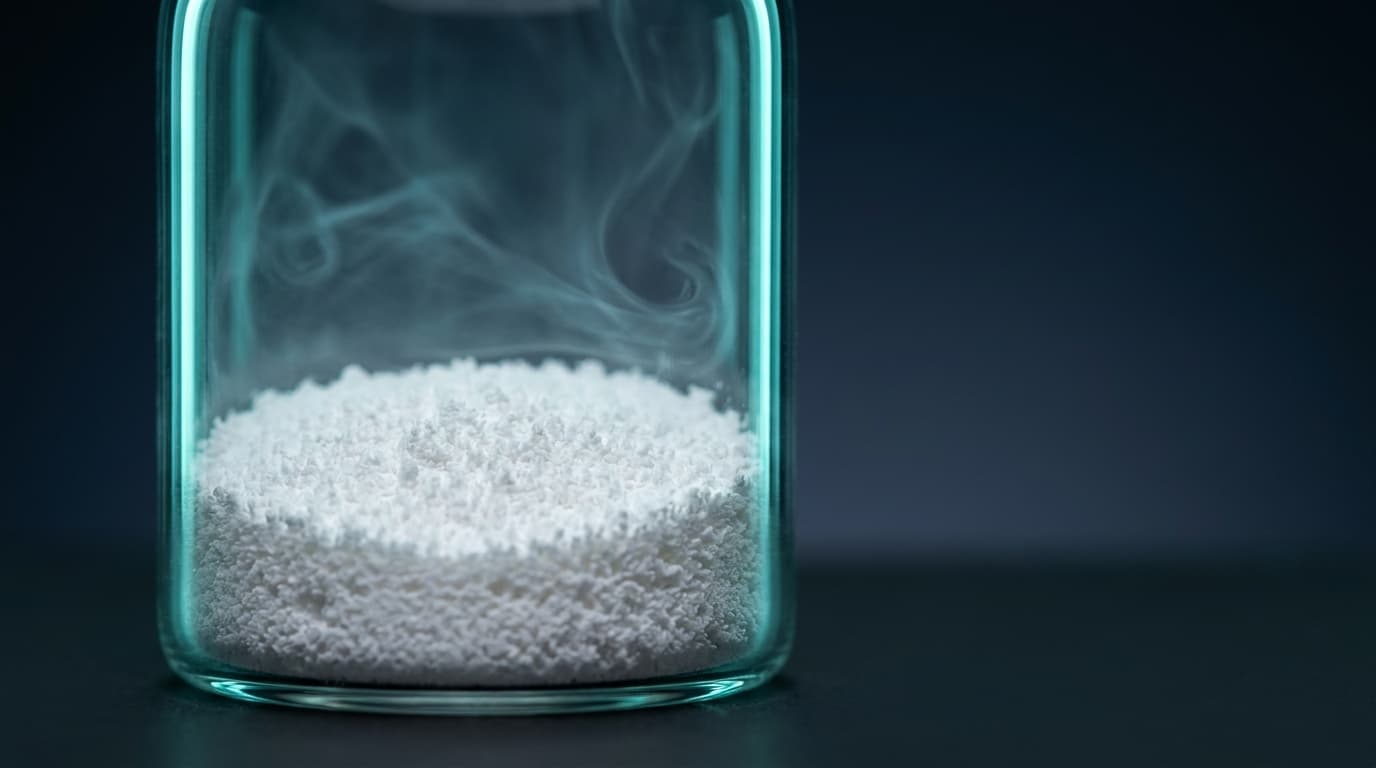
Walk into any peptide research lab and you’ll find a shelf full of small glass vials containing what looks like fluffy white residue, spun-glass thread, or a thin compact disk of solid. That solid is the whole reason the peptide inside is still usable months or years after synthesis. Lyophilization — freeze-drying — is the enabling technology of modern peptide distribution. It transforms an unstable aqueous solution into a dry, storage-stable cake that can survive shipping, cold-chain interruptions, and long-term freezer storage.
This article is a technical primer for research laboratories on how lyophilization actually works, why certain excipients are chosen, and how to interpret what you see when you open the vial. It covers:
- The thermodynamics and physics of freeze-drying
- The three stages of a standard lyophilization cycle
- Cryoprotectants and lyoprotectants: what they do and why they matter
- Cake structure, collapse temperature, and glass transitions
- Residual moisture and its relationship to stability
- Common failure modes — shrinkage, meltback, and collapse — and what they tell you
Nothing in this article is medical guidance. All discussion is in the context of research-use materials.
1. Why Lyophilize Peptides at All?
In solution, peptides are exposed to every degradation pathway their amino acid composition allows:
- Hydrolysis of peptide bonds, especially at Asp-Pro and Asp-Xaa linkages.
- Deamidation of Asn and (more slowly) Gln via succinimide intermediates.
- Oxidation of Met, Cys, Trp, Tyr, and His, accelerated by dissolved oxygen, trace metals, and light.
- Aggregation via non-covalent association, disulfide scrambling, or hydrophobic partitioning.
- Physical instability — precipitation, gelation, adsorption to surfaces.
Drying the peptide removes water, which is the solvent for most of these reactions and the kinetic enabler of molecular motion. A properly lyophilized peptide stored cold and dry can remain chemically stable for years; the same peptide in solution at 4 °C may lose significant potency within weeks.
Izutsu (2018, DOI) provides a comprehensive overview of how freeze-drying is applied to pharmaceutical formulations — peptides, proteins, and small molecules alike (PMID: 30288720). The principles map directly onto research-grade peptide manufacturing.
2. Thermodynamics: What Actually Happens in a Freeze-Dryer
Lyophilization exploits a simple phase-diagram trick. At atmospheric pressure, water transitions ice → liquid → vapor. At pressures below the triple point of water (611 Pa, or 4.58 Torr), liquid water cannot exist — ice sublimes directly to vapor. A freeze-dryer operates in this regime: the product is frozen solid, the chamber is evacuated below the triple point, and heat is applied carefully to drive sublimation without melting.
The two critical temperatures that govern every cycle:
- T′_g (glass transition of the maximally freeze-concentrated solute): The temperature below which the amorphous phase is a rigid glass. For sucrose–water systems, T′_g is approximately −32 °C; for trehalose, approximately −29 °C.
- T_c (collapse temperature): The temperature at or above which the dried matrix loses enough mechanical integrity to collapse under vacuum. T_c is typically slightly above T′_g for amorphous systems.
Primary drying must be performed with the product temperature held below T_c — otherwise the cake collapses, trapping water and destroying the porous structure that enables fast reconstitution. This single constraint drives almost every design decision in a lyophilization cycle.
3. The Three Stages of a Lyophilization Cycle
Stage 1 — Freezing
The peptide solution is cooled in a controlled ramp, typically −0.5 to −1 °C/min, down to a shelf temperature of −40 to −50 °C. As ice nucleates, solutes are concentrated into the interstitial amorphous phase. The freezing step determines ice crystal size and, therefore, the geometry of pores through which water vapor must escape in the next stage.
Key variables:
- Nucleation temperature: Spontaneous nucleation is stochastic and can occur anywhere from −8 to −18 °C, leading to batch variability. Controlled nucleation techniques (e.g., depressurization, ice fog seeding) produce more uniform cakes.
- Cooling rate: Slow cooling produces larger ice crystals (bigger pores, faster sublimation) but can concentrate solutes and damage some peptides. Fast cooling produces finer crystals and finer pores, slowing primary drying.
- Annealing: Holding the frozen product at a temperature above the glass transition (e.g., −15 °C) for 1–4 hours allows ice crystal ripening, producing larger, more uniform crystals and improving downstream drying efficiency.
Abdelwahed et al. (2006, DOI) characterized the impact of annealing on both primary and secondary drying kinetics in pharmaceutical formulations containing cryoprotectants such as sucrose and polyvinylpyrrolidone (PMID: 16904277). Their work showed that annealing can accelerate sublimation without compromising reconstituted product properties — one of the classic process-optimization findings in the field.
Stage 2 — Primary Drying (Sublimation)
Chamber pressure is reduced below the triple point of water (typically 50–200 mTorr), and shelf temperature is raised to supply latent heat of sublimation while keeping the product temperature below T_c. Ice sublimes from the surface of the frozen matrix downward and outward, leaving behind the amorphous solute phase laced with empty pores.
This is the longest stage of a typical cycle — often 20–80 hours, depending on product volume, vial geometry, and cake design. Shelf temperature is the driver; chamber pressure fine-tunes heat transfer. Product temperature is the constrained variable.
Researchers designing a cycle monitor product temperature with thermocouples in representative vials. If the product exceeds T_c, cake collapse begins and the cycle must be aborted or recovered.
Stage 3 — Secondary Drying (Desorption)
After sublimation is complete, roughly 5–20% water remains bound to the solute matrix. Secondary drying raises the shelf temperature to 20–40 °C at reduced pressure to drive off this residual bound water by desorption. Duration is typically 5–15 hours.
The endpoint of secondary drying is specified as a residual moisture target — commonly 1–3% w/w for most peptide products, though the exact target is determined by stability data for the specific molecule. Karl Fischer titration is the gold standard for residual moisture measurement in research and manufacturing.
4. Excipients: Cryoprotectants, Lyoprotectants, Bulking Agents
A lyophilized peptide formulation is almost never just peptide and water. Excipients do four main jobs:
Cryoprotectants (protection during freezing)
Sugars and polyols form hydrogen bonds that stabilize the peptide’s native conformation when water is removed. Sucrose and trehalose are the dominant cryoprotectants in peptide and protein lyophilization because:
- They are amorphous glass-formers at typical process temperatures.
- They have relatively high T′_g values (~−32 °C and ~−29 °C respectively), allowing warmer primary drying and shorter cycles.
- They form direct hydrogen bonds with peptide backbone amides, substituting for the water-bridge network that normally stabilizes peptide structure (the “water replacement hypothesis”).
- They vitrify into a high-viscosity glass that mechanically immobilizes the peptide and kinetically arrests degradation reactions (the “vitrification hypothesis”).
Trehalose is often preferred for more labile peptides because it does not contain a reducing group and cannot undergo Maillard reactions with lysine side chains. Sucrose is cheaper but can hydrolyze under acidic conditions to release reducing sugars that react with Lys and Arg.
Li et al. (1996, DOI) demonstrated in a landmark study that reducing sugars can accelerate chemical degradation of lyophilized peptides through Maillard-type reactions (PMID: 8863280). This paper is often cited as the definitive case for using non-reducing disaccharides with Lys-rich sequences.
Lyoprotectants (protection during drying and storage)
Many cryoprotectants also serve as lyoprotectants. The distinction is useful: cryoprotection addresses damage during freezing (osmotic, ice-interface), while lyoprotection addresses damage during water removal and subsequent storage. Sucrose, trehalose, and some amino acids (glycine, arginine, histidine) fall into both categories.
Bulking agents
When the peptide concentration is very low (as is common for potent research peptides at milligram scale), the solute mass is not enough to form a mechanically coherent cake. Mannitol, glycine, and sometimes lactose are added as bulking agents. Mannitol crystallizes during freezing, producing a rigid crystalline scaffold — but this can be problematic because crystalline bulking agents do not contribute to lyoprotection of the amorphous peptide phase. A common compromise is a mannitol:sucrose 3:1 or 4:1 blend: mannitol for cake structure, sucrose for lyoprotection.
Buffers and pH modifiers
Peptide stability is strongly pH-dependent. Common buffers include phosphate, acetate, histidine, and citrate. Phosphate can crystallize during freezing, causing dramatic pH shifts (up to 3 pH units) as one phosphate species crystallizes preferentially — a classic failure mode that damages pH-sensitive peptides.
Surfactants
Low-concentration polysorbate 20 or 80 (0.001–0.01% w/v) is often added to protect peptides from air–liquid interface denaturation during filling and reconstitution.
Acidifiers
Some peptides (e.g., those reconstituted in acetic acid) include acetate buffer in the lyophilized cake. Volatile acidifiers can partially evaporate during drying, shifting the final cake pH.
5. Cake Structure and What It Tells You
A properly lyophilized cake should have:
- Full volume: The cake should occupy the same volume as the pre-lyophilization fill. Shrinkage suggests collapse during drying.
- Uniform appearance: Fine-textured, typically white, evenly distributed from top to bottom of the vial.
- Mechanical integrity: The cake should not crumble when the vial is gently tapped; nor should it stick as a hard glass.
- Rapid reconstitution: Water added to a well-formed cake should produce a clear solution within seconds to minutes, depending on concentration.
Failure modes to recognize:
- Collapse: The cake has sunk to a fraction of its original volume, often with a glassy or shrunken appearance. Caused by exceeding T_c during primary drying. Reconstitution time is longer and product may be partially denatured.
- Meltback: A wet layer at the bottom of the vial, caused by reaching the melting point of the concentrated amorphous phase. The product may still reconstitute but has likely lost some stability.
- Powdering / shattering: The cake has broken apart during handling. Can indicate low residual moisture brittleness or mechanical damage.
- Discoloration: Yellow or brown tint suggests Maillard browning (reducing sugar + Lys/Arg) or oxidation.
- Fiber-like strands: Normal for some highly amorphous formulations; not necessarily a failure.
6. Residual Moisture: The Critical Spec
Residual moisture is one of the most important quality attributes of a lyophilized peptide. Too much water leaves enough molecular mobility for degradation reactions to proceed at measurable rates during storage. Too little water, paradoxically, can accelerate some oxidation and unfolding pathways in certain proteins because trace water stabilizes native conformations via the water-replacement mechanism.
Typical targets:
- Most research peptides: 1–3% w/w residual moisture.
- Highly sensitive peptides (e.g., oxidation-prone): <1% w/w.
- Larger proteins with strict conformational requirements: may target 2–4% for optimal stability.
Karl Fischer coulometric titration is the standard method; thermogravimetric analysis (TGA) is a useful cross-check.
7. Storage of Lyophilized Peptides
Once sealed under vacuum or inert gas (often nitrogen), a lyophilized peptide vial is a remarkably stable object. Best practices for research labs:
- Long-term storage: −20 °C or −80 °C in a desiccator or sealed container with silica gel. Dark storage to protect photo-sensitive residues (Trp, Tyr).
- Short-term storage: 2–8 °C is acceptable for weeks to a few months, provided humidity is controlled when the vial is opened.
- Equilibration before opening: Always allow sealed vials to reach room temperature before breaking the seal, to prevent atmospheric moisture condensing onto the cold cake.
- Desiccant: Include a desiccant sachet in storage containers, especially for repeated access.
Di Tommaso et al. (2010, DOI) reported on lyophilization of pharmaceutical formulations using sucrose and PVP as cryoprotectants, providing insight into how excipient choice affects reconstituted product quality (PMID: 20184955).
8. Practical Laboratory Considerations
When receiving a lyophilized peptide
- Inspect the vial immediately: Look for cake structure issues, discoloration, or visible moisture. Photograph any concerns.
- Let it warm to room temperature sealed: 15–30 minutes, depending on vial size. Do not open a cold vial in humid air.
- Open in a clean environment: A laminar flow hood is ideal; a clean bench with minimal disturbance is acceptable.
- Tap down: Gently tap the vial on a benchtop to ensure the cake is at the bottom before adding reconstitution solvent.
Reconstitution
- Use a sterile research-grade solvent appropriate for the peptide (sterile water, bacteriostatic water, dilute acetic acid, or a specified buffer).
- Add solvent against the vial wall, not directly onto the cake, to avoid splashing.
- Swirl gently — do not vortex hydrophobic peptides, as foaming can denature surface-active molecules.
- For slow-dissolving peptides, warming to 25–30 °C and extended gentle mixing is often sufficient without harsh agitation.
Aliquoting
Once reconstituted, a peptide is once again exposed to all the solution-phase degradation pathways. Best practice is to aliquot immediately into single-use volumes, freeze at −20 °C or −80 °C, and thaw each aliquot only once.
QC checks
For research-grade peptides where stability is critical:
- Periodic RP-HPLC purity checks on reconstituted aliquots.
- LC-MS confirmation of the main peak mass.
- Functional assays where available (e.g., receptor cAMP assay for GPCR ligands).
8a. Process Analytical Technology and Cycle Monitoring
Modern freeze-dryers incorporate process analytical technology (PAT) tools that allow researchers and manufacturers to monitor the state of the product in real time, rather than relying on predefined time-based endpoints. Key PAT methods used in peptide lyophilization include:
- Manometric temperature measurement (MTM): A brief pressure-rise test (valve closure for a few seconds) is used to estimate product temperature and sublimation rate without placing a physical sensor in the product. MTM allows model-based cycle optimization and is widely used in development labs.
- Comparative pressure measurement: Comparing readings from a Pirani gauge (sensitive to the thermal conductivity of water vapor) and a capacitance manometer (purely pressure-based) provides a sensitive indicator of sublimation endpoint. As primary drying completes, the Pirani reading converges on the capacitance manometer reading.
- Tunable diode laser absorption spectroscopy (TDLAS): Measures water vapor concentration and velocity in the duct between chamber and condenser, providing a direct real-time sublimation rate. Increasingly common in research-grade freeze-dryers.
- Wireless product temperature sensors: Miniature battery-powered thermocouples or RTDs placed in representative vials provide direct product-temperature data without physically tethered wires, enabling rotation of vials in production-scale runs.
These tools are most relevant to researchers developing new peptide formulations or validating cycles, but they also inform what researchers should expect from a well-characterized commercial lyophilization process: defined endpoints rather than arbitrary time cutoffs.
8b. Scale-Up Considerations from Lab to Production
A lyophilization cycle developed on a bench-top freeze-dryer with 50–200 vials does not always translate directly to a production-scale dryer with thousands of vials. Key scale-up variables:
- Edge effects: Vials at the edge of the shelf receive more radiative heat from chamber walls than vials in the center. Edge vials can exceed T_c while center vials are still at safe product temperature. Production runs use shelf mapping and thermal modeling to minimize this variability.
- Chamber load: Higher vial counts produce greater total sublimation mass per unit time, which can choke chamber-to-condenser transport at moderate pressures and cause local pressure gradients.
- Ice nucleation synchronization: Controlled nucleation becomes more important at scale, because stochastic nucleation at different times across thousands of vials causes a broad distribution of product histories and quality attributes.
- Shelf temperature uniformity: Shelf temperature gradients of even 1–2 °C can translate into meaningful product temperature variability and heterogeneous cake quality.
For researchers receiving peptides from commercial suppliers, understanding these scale-up challenges explains why lot-to-lot variability exists even within a single manufacturer. Requesting a lot-specific COA for each batch is the best way to verify that each lot meets the expected specifications.
9. Frequently Asked Research Questions
Q1: Why does my reconstituted peptide look slightly cloudy?
Common causes: (a) incomplete dissolution of hydrophobic peptides — try gentle warming and extended mixing; (b) aggregation during long-term storage of the solution — consider using a fresh aliquot; (c) particulates from the vial closure or syringe filter — filter through a 0.22 µm low-protein-binding filter before quantitative assays; (d) precipitation due to pH shift — check the pH of the solvent against the peptide’s isoelectric point.
Q2: How do I tell if a lyophilized cake has collapsed?
A collapsed cake has visibly shrunk relative to the fill volume, often with a glassy, uneven, or sunken appearance. Reconstitution time is typically longer, and the reconstituted solution may appear cloudier than normal. If you suspect collapse, run an HPLC purity check and, where the certificate of analysis (COA) reports a purity figure, compare the two.
Q3: Can I relyophilize a peptide I’ve already reconstituted?
In principle yes, but in practice this is not recommended without stability data. The peptide has been exposed to hydrolytic conditions and possibly freeze–thaw stress. Relyophilization can concentrate any degradation products and produces a cake of unknown quality. For most research purposes, it is better to aliquot reconstituted peptide and freeze, using each aliquot once.
Q4: Why does my peptide cake sometimes look like a donut with a depression in the middle?
This is often a “shelf effect” where the center of the vial warms faster than the edges during drying, causing uneven sublimation. It is usually cosmetic rather than a stability problem, but if accompanied by discoloration or slow reconstitution, it warrants a closer look.
Q5: What’s the difference between a “cake” and a “powder” in lyophilized products?
A cake is a structurally coherent porous solid that occupies the full fill volume. A powder is loose, free-flowing particulate. Most pharmaceutical-grade lyophilized products aim for a cake structure because it signals a properly executed cycle and good formulation. Some research peptides are deliberately lyophilized to a powder form in tubes for ease of weighing; this is acceptable but provides less visual information about process quality.
References
- Izutsu, K. (2018). Applications of Freezing and Freeze-Drying in Pharmaceutical Formulations. Advances in Experimental Medicine and Biology, 1081, 371–383. DOI: 10.1007/978-981-13-1244-1_20 (PMID: 30288720)
- Li, S., Patapoff, T. W., Overcashier, D., Hsu, C., Nguyen, T. H., & Borchardt, R. T. (1996). Effects of reducing sugars on the chemical stability of human relaxin in the lyophilized state. Journal of Pharmaceutical Sciences, 85(8), 873–877. DOI: 10.1021/js950456s (PMID: 8863280)
- Abdelwahed, W., Degobert, G., & Fessi, H. (2006). Freeze-drying of nanocapsules: impact of annealing on the drying process. International Journal of Pharmaceutics, 324(1), 74–82. DOI: 10.1016/j.ijpharm.2006.06.047 (PMID: 16904277)
- Di Tommaso, C., Como, C., Gurny, R., & Möller, M. (2010). Investigations on the lyophilisation of MPEG-hexPLA micelle based pharmaceutical formulations. European Journal of Pharmaceutical Sciences, 40(1), 38–47. DOI: 10.1016/j.ejps.2010.02.006 (PMID: 20184955)
- Wang, W. (2000). Lyophilization and development of solid protein pharmaceuticals. International Journal of Pharmaceutics, 203(1–2), 1–60. DOI: 10.1016/S0378-5173(00)00423-3 (PMID: 10967427)
- Pikal, M. J. (1985). Use of laboratory data in freeze drying process design: heat and mass transfer coefficients and the computer simulation of freeze drying. Journal of Parenteral Science and Technology, 39(3), 115–139. (PMID: 3839016)
- Carpenter, J. F., Pikal, M. J., Chang, B. S., & Randolph, T. W. (1997). Rational design of stable lyophilized protein formulations: some practical advice. Pharmaceutical Research, 14(8), 969–975. DOI: 10.1023/A:1012180707283 (PMID: 9279875)
- Franks, F. (1998). Freeze-drying of bioproducts: putting principles into practice. European Journal of Pharmaceutics and Biopharmaceutics, 45(3), 221–229. DOI: 10.1016/S0939-6411(98)00004-6 (PMID: 9653626)
Citations retrieved from PubMed. Please consult the original sources for full methodological detail.
Not for human consumption. For laboratory research only.
Disclaimer: All products sold by CertaPeptides are intended for laboratory research use only. Not for human or veterinary use. Not for consumption. This article discusses formulation and stability science in a research context only. Researchers are responsible for complying with all applicable laws, institutional policies, and ethical guidelines governing the handling of research peptides.
Researcher Q&A
These questions come from researchers evaluating freeze-dried peptide formats and visually inspecting received material in lab settings. Answers reflect the published formulation-science literature and general pharmaceutical QA practice, and are for research-use-only contexts. CertaPeptides compiled this appendix from the questions our support team fields most often.
Q: Why is lyophilised peptide powder sometimes more expensive than a ready-made reconstituted solution, and is one format better for research use?
A: The price inversion is real and has a specific explanation in unit-operation cost.
Lyophilization (freeze-drying) is a defined pharmaceutical unit operation and it is not cheap. The Carpenter and Randolph laboratory work on rational design of stable lyophilised protein formulations (Carpenter 2002, PMID 11987749) lays out the requirements: an appropriate cryoprotectant such as trehalose or sucrose, controlled freezing to avoid phase separation, primary drying below the formulation’s collapse temperature, and secondary drying to bring residual moisture low enough — typically below 1 to 2% — for long-term stability. A proper lyophilization cycle can run 48 to 72 hours per batch in a pharmaceutical-grade lyophilizer. Ready-made solutions skip that entire process: the vial is filled, stoppered, and sealed.
The reasons to choose lyophilised format anyway are substantive. First, stability. A well-lyophilised peptide can remain stable for years at -20 °C, and often for months at 4 °C, compared with weeks to months for a solution. The Arrhenius kinetics of peptide hydrolysis strongly favour removal of water. Second, shipping tolerance. A dry cake survives several days at ambient temperature without meaningful degradation, which is an important factor for international shipping where transit times and thermal excursions are variable. Third, flexibility: the researcher controls reconstitution volume and therefore concentration, which supports different experimental protocols without reformulation.
On quality specifically, the powder itself is not inherently “better” than the solution — both start from the same synthesised peptide. The difference is that powder reaches the researcher in good condition more frequently, and the lyophilization failure modes (collapsed cake, elevated residual moisture, aggregation on rehydration) are visually inspectable by the researcher in a way that thermal damage to a solution is not.
For most research workflows the lyophilised format represents better value in stability and shipping tolerance, notwithstanding the higher unit price.
Q: What does a proper visual QA checklist for a received copper-containing peptide such as GHK-Cu look like?
A: GHK-Cu is a useful case because its visual state is unusually diagnostic — the colour is the chemistry, not cosmetic.
On colour: lyophilised GHK-Cu should present as a distinct blue or blue-violet powder. That colour arises from the Cu(II) ion coordinated by the glycyl-histidyl-lysine tripeptide. A cake that appears pale or white suggests underloading on copper, a different compound, or loss of complex integrity. Intense dark blue is normal, and slight colour variation between vials in the same batch is also normal.
On cake structure: a proper lyophilisation cake should be uniform, slightly porous, and fill most of the vial volume. A collapsed cake — shrunken, glassy, or resinous in appearance — indicates that primary drying ran above the collapse temperature. The peptide is typically still bioactive, but the formulation is cosmetically off and residual moisture may be higher than specification.
On reconstitution behaviour: GHK-Cu dissolves quickly in bacteriostatic water into a clear blue solution with a colour roughly comparable to dilute copper sulfate. Cloudy solutions, visible particulate, or brown coloration are all abnormal. Brown specifically suggests Cu(II) reduction or peptide degradation.
On vial and stopper condition: discoloured or oxidised stoppers, loose crimp seals, or visible moisture inside a sealed vial all indicate a fill-finish problem that should prompt replacement.
GHK-Cu is one of the few research peptides for which visual assessment is a meaningful quality signal rather than cosmetic inference. When the cake appears pale and the reconstituted solution does not develop the deep blue colour characteristic of the intact Cu-tripeptide complex, the batch should be treated as suspect and the vendor contacted for replacement.
Verify before you research
Product pages show a class-level specification where one is on record, and selected lots carry an independent third-party COA.