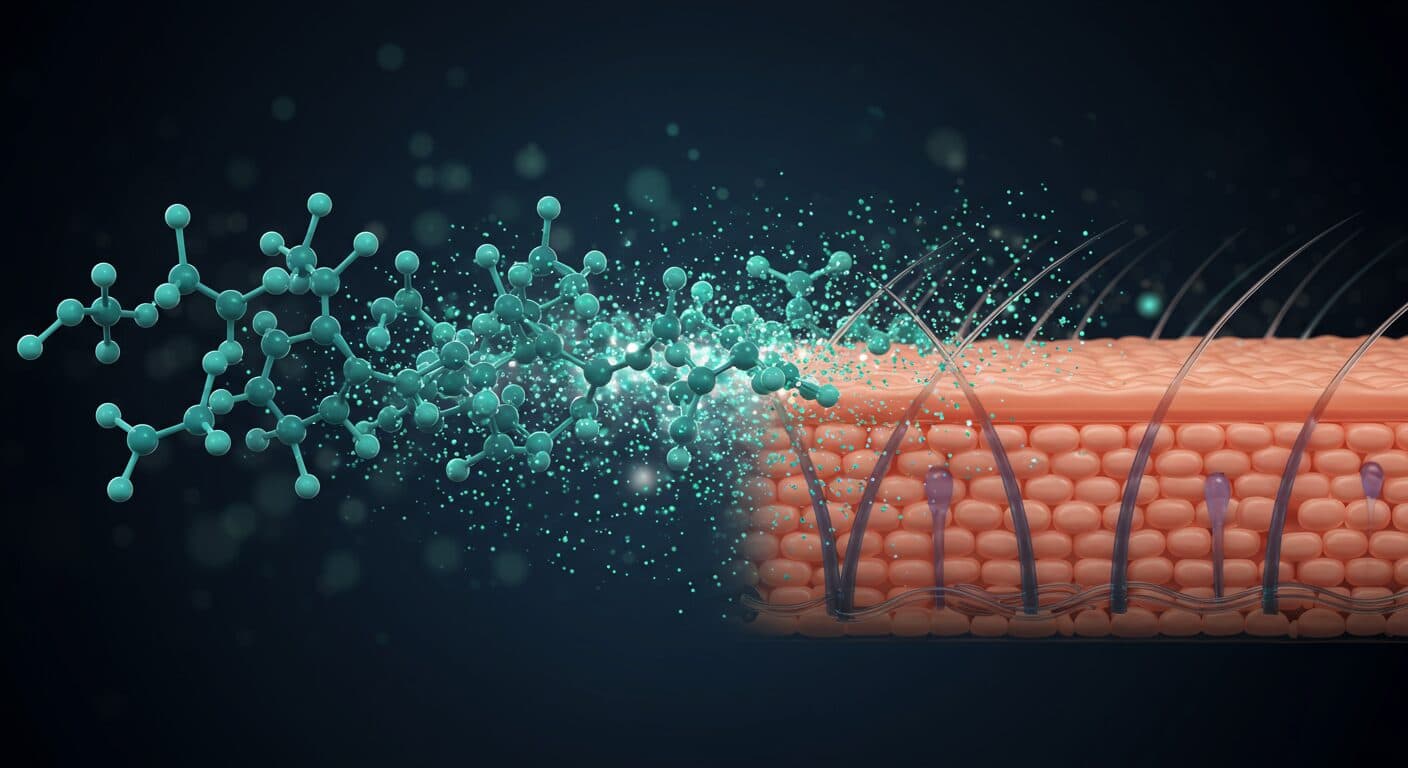
GHK-Cu occupies an unusual position in the cosmetic science literature. It began as a biochemistry research compound — Pickart’s 1973 plasma tripeptide with hepatocyte-stimulating activity — and over the following three decades migrated into high-end skincare formulations, where it is now one of the most recognized “active” peptide ingredients. This migration from Petri dish to product is worth examining carefully, because the translation involved both genuine scientific progress and several interpretive leaps that researchers should be aware of. This post examines the published research on GHK-Cu in skin cell and topical studies, and the significant difference between cosmetic-grade and research-grade material. This content is for educational and research purposes only.
The Research Lineage: Where the Cosmetic Claims Come From
The case for GHK-Cu in skin research rests on three pillars: fibroblast culture studies, rodent skin models, and a small number of clinical formulation studies. Each pillar has a different evidential weight, and conflating them produces overstatements.
For the full mechanistic context and complete research overview, see: GHK-Cu Copper Peptide: The Complete Research Guide.
Pillar 1: Fibroblast Culture Studies
The most mechanistically rigorous GHK-Cu data for skin applications comes from human dermal fibroblast cultures. Maquart et al. (1988) (PMID: 3169264) used radiolabeled precursor incorporation to show dose-dependent increases in collagen synthesis in response to GHK-Cu at nanomolar concentrations in cultured human skin fibroblasts — the foundational in vitro finding the cosmetic literature has built on since.
Kang et al. (2009) (DOI: 10.1007/s00403-009-0942-x) extended this picture by showing that Copper–GHK upregulates integrin α6 and β1 in human keratinocytes — the collagen- and laminin-binding integrin subunits that mediate attachment to the basement membrane — alongside increased PCNA and p63 positivity in monolayer and skin-equivalent cultures. Integrins are not merely adhesion molecules; they are mechanosensors that translate extracellular matrix composition into intracellular signaling. This keratinocyte-proliferative and adhesion-regulatory response complements the fibroblast/collagen arc of GHK-Cu research covered elsewhere in this cluster.
These cell culture findings are methodologically sound and reproducible. But cell culture fibroblasts are not the same as fibroblasts in intact skin tissue, which is surrounded by a complex extracellular matrix, innervated, vascularized, and interacting with epidermal cells above and subcutaneous tissue below.
Pillar 2: Rodent Skin Models
In vivo skin studies in rodents take the cell culture data one step closer to tissue-level biology. Pickart’s wound healing work (reviewed in our dedicated post: GHK-Cu Wound Healing: 30+ Years of Rodent Research) used full-thickness excisional wounds as the primary model. Histological sections of healing tissue showed denser collagen organization and earlier re-epithelialization in GHK-Cu-treated animals.
For cosmetic research applications, unwounded rodent skin models are more directly relevant. Some studies have examined dermal thickness and collagen content in aged rodent skin treated with topical GHK-Cu formulations, with reported increases in dermal thickness and Type I collagen immunostaining. The specific studies and their methodological quality vary — researchers should examine each primary paper before drawing conclusions.
Pillar 3: Clinical Formulation Studies
The most clinically proximate evidence for GHK-Cu in skin research comes from Fitzpatrick and Rostan (2003) (DOI: 10.1080/14764170310000817), a double-blind, vehicle-controlled trial of a topical formulation applied to facial skin. Published in Dermatologic Surgery, the study enrolled 67 subjects per group and assessed outcomes at 12 weeks.
The reported findings:
- Improved skin laxity scores in the GHK-Cu group vs. vehicle
- Reduced fine line depth by profilometric measurement
- Improved mottled hyperpigmentation scoring
- No significant adverse events attributable to GHK-Cu
Before citing this study, researchers should note:
- The formulation contained multiple active ingredients, not purified GHK-Cu alone. Attribution of effects specifically to GHK-Cu versus other components cannot be made from this design.
- Industry funding was involved in the study’s conduct.
- Sample size was modest for a cosmetic clinical trial. Larger, independently funded replication studies have not been published.
Gorouhi and Maibach (2009) (DOI: 10.1111/j.1468-2494.2009.00490.x), in their comprehensive review of topical peptides, classified GHK-Cu as a “signal peptide” and concluded that while mechanistic support is strong, the clinical evidence requires larger, better-controlled trials before definitive efficacy conclusions can be drawn.
Topical Absorption: The Penetration Question
A question that recurs throughout the cosmetic GHK-Cu literature is whether topically applied GHK-Cu actually penetrates the stratum corneum to reach viable epidermal and dermal cells. The stratum corneum is an effective barrier against most hydrophilic molecules, and GHK-Cu, while small (MW ~340 Da), is highly water-soluble — a property that generally predicts poor passive penetration through the lipophilic stratum corneum barrier.
Published skin permeation studies using excised human skin in Franz diffusion cells have shown limited but measurable penetration of GHK-Cu into the viable epidermis, with substantially less reaching the dermis where fibroblasts reside. This means that the fibroblast culture data, which used GHK-Cu in direct contact with cells, may overestimate the relevant concentration that fibroblasts experience after topical application of a conventional formulation.
Cosmetic formulation research has explored several approaches to improve penetration: carrier systems (liposomes, nanoparticles), chemical penetration enhancers, and iontophoresis for medical device applications.
Why Cosmetic-Grade Does Not Equal Research-Grade
Cosmetic-grade GHK-Cu
- Purity specification: typically ≥90-95% HPLC; some manufacturers specify lower or do not specify at all
- Batch documentation: COA may be provided but is often internal/supplier-issued rather than third-party
- Stabilization: often formulated with preservatives, carriers, and excipients optimized for skin product stability
- Regulatory framework: governed by cosmetic regulations, which do not require efficacy proof or safety testing at the same level as pharmaceutical ingredients
Research-grade GHK-Cu
- Purity: ≥98% HPLC, confirmed by third-party independent testing
- Documentation: Full COA including mass spectrometry confirmation of molecular identity, HPLC chromatogram with peak area percentage, and typically endotoxin testing for in vivo research applications
- No excipients beyond the salt form (typically acetate or trifluoroacetate counterion)
- Lot-specific traceability: each production lot has its own COA, allowing researchers to document exactly what material was used in a published experiment
For published research, using cosmetic-grade material introduces uncertainty about what was actually tested. View CertaPeptides’ third-party COA documentation at certapeptides.com/coa.
The Transition from Pickart’s Biomedical Research to Cosmetic Products
Loren Pickart, after his foundational academic work at the University of Washington, founded a company (Skin Biology) to commercialize GHK-Cu-based products. The transition from academic researcher to commercial operator means that some of the publications relevant to GHK-Cu’s cosmetic applications come from or are funded by a commercial stakeholder. This is common in applied biochemistry, but it is a factor in how independently the cosmetic efficacy claims have been validated.
The broader cosmetic peptide industry adopted GHK-Cu as a template for the “signal peptide” category in the late 1990s and 2000s. Other commercial signal peptides (Matrixyl/palmitoyl pentapeptide, Leuphasyl, etc.) were developed partly in response to GHK-Cu’s commercial success. The cosmetic peptide market’s growth was driven by consumer demand and marketing more than by clinical evidence, which is why the distinction between mechanistic research and clinical efficacy evidence remains important.
Current Research Applications in Rodent Skin Models
For researchers studying GHK-Cu in skin-related rodent models, the most relevant contemporary applications include:
- Photoaged skin models: UV-irradiated rodent dorsal skin as a proxy for photoaged human skin, assessing GHK-Cu effects on dermal collagen density and antioxidant enzyme activity
- Dermal fibrosis models: Bleomycin-induced dermal fibrosis in mice, where GHK-Cu’s proposed MMP modulation may be relevant to scar remodeling
- Wound healing with diabetic or aged animal models: As discussed in our wound healing post, these models combine the healing endpoint with physiologically impaired baseline conditions
- Cell culture mechanistic studies: Human keratinocyte and fibroblast co-culture systems examining GHK-Cu effects on epidermal-dermal signaling
Sourcing Research-Grade GHK-Cu for Skin Studies
For skin model research, ≥98% HPLC purity is the standard. For in vivo rodent studies, endotoxin testing is particularly important — LPS contamination at low levels can induce inflammatory responses in rodent skin that confound wound healing and fibrosis outcomes. Confirm LAL endotoxin levels are within acceptable limits for your model before use.
Research-grade GHK-Cu for laboratory use is available at certapeptides.com/shop/ghk-cu.
Key Takeaways
- GHK-Cu’s cosmetic research foundation rests on strong fibroblast cell culture data (Maquart et al. 1993, Kang et al. 2009), limited but positive clinical formulation data (Fitzpatrick and Rostan 2003), and rodent skin models — each with different evidential weight
- Topical penetration is a genuine limitation: GHK-Cu’s high polarity limits passive skin penetration; the fibroblast culture data may overestimate achievable dermal concentrations from topical application
- Cosmetic-grade and research-grade GHK-Cu have different purity specifications, documentation standards, and regulatory frameworks — they are not interchangeable for experimental use
- The commercial transition of GHK-Cu from academic research to skincare products involved a conflict of interest dynamic that researchers should factor into their critical appraisal of the cosmetic evidence base
- The strongest evidence for GHK-Cu in skin biology remains from in vitro fibroblast studies; human clinical evidence requires larger, independently funded, better-controlled trials
References
- Fitzpatrick RE, Rostan EF. (2003). Reversal of photodamage with topical growth factors: a pilot study. Journal of Cosmetic and Laser Therapy, 5(1), 25–34. DOI: 10.1080/14764170310000817
- Kang YA, Choi HR, Na JI, et al. (2009). Copper–GHK increases integrin expression and p63 positivity by keratinocytes. Archives of Dermatological Research, 301(4), 301–306. DOI: 10.1007/s00403-009-0942-x
- Gorouhi F, Maibach HI. (2009). Role of topical peptides in preventing or treating aged skin. International Journal of Cosmetic Science, 31(5), 327-345. DOI: 10.1111/j.1468-2494.2009.00490.x
- Pickart L, Margolina A. (2018). Regenerative and protective actions of the GHK-Cu peptide in the light of the new gene data. Biomolecules, 8(2), 29. DOI: 10.3390/biom8020029
- Pickart L, Vasquez-Soltero JM, Margolina A. (2015). GHK Peptide as a Natural Modulator of Multiple Cellular Pathways in Skin Regeneration. BioMed Research International, 2015, Article 648108. DOI: 10.1155/2015/648108
References
- Pickart L, Thaler MM. (1973). Tripeptide in human serum which prolongs survival of normal liver cells and stimulates growth of neoplastic liver cells. Nature New Biology, 243(124), 85–87. PMID: 4349963.
- Maquart FX, et al. (1988). Stimulation of collagen synthesis in fibroblast cultures by the tripeptide-copper complex glycyl-L-histidyl-L-lysine-Cu2+. FEBS Letters, 238(2), 343–346. PMID: 3169264.
- Pickart L, Vasquez-Soltero JM, Margolina A. (2015). GHK Peptide as a Natural Modulator of Multiple Cellular Pathways in Skin Regeneration. BioMed Research International, 2015, 648108. PMID: 26236730.
All products are intended for research purposes only. Not for human consumption.