Introduction: why pharmacokinetics matter more than mechanism alone
When evaluating GLP-1 class peptides for research, most attention goes to their receptor binding profiles and downstream signaling. But a peptide’s pharmacokinetic (PK) profile, how long it circulates, how it resists degradation, and how it distributes through tissues, often determines research outcomes more than mechanism alone.
Native GLP-1 has a plasma half-life of approximately 2 minutes. Semaglutide lasts roughly 7 days. That difference is not a minor tweak, it represents a fundamental re-engineering of the molecule’s interaction with the body’s clearance systems. Understanding how these modifications work at the molecular level matters when designing rigorous research protocols.
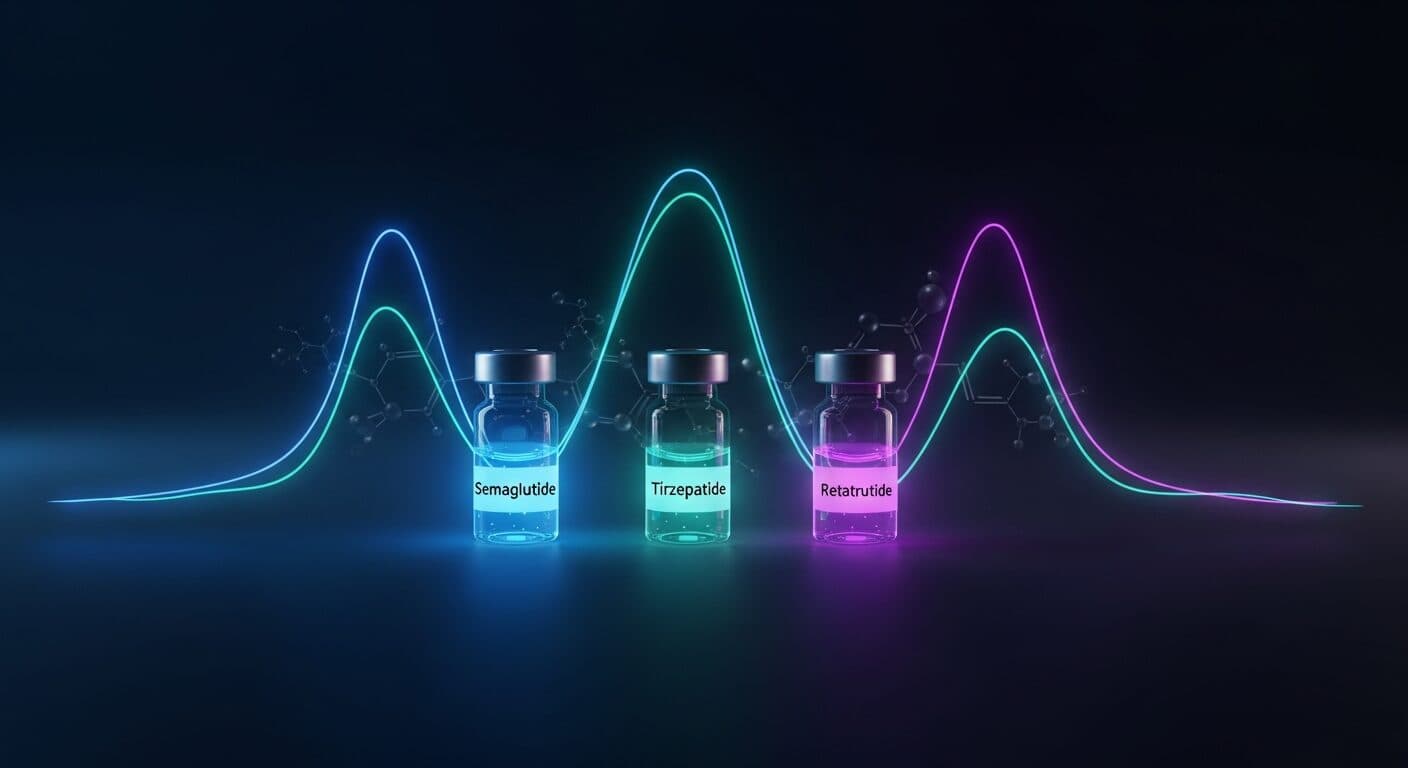
This article examines the pharmacokinetic profiles of three GLP-1 class research peptides — semaglutide, tirzepatide, and retatrutide — with a focus on the molecular modifications that make each one unique.
All peptides discussed are for laboratory research purposes only and are not intended for human use.
The native GLP-1 problem
Glucagon-like peptide-1 (GLP-1) is a 30-amino acid incretin hormone secreted by intestinal L-cells in response to nutrient ingestion. It plays a central role in glucose homeostasis through multiple mechanisms: stimulating insulin secretion, suppressing glucagon release, slowing gastric emptying, and modulating appetite-related signaling in the central nervous system.
However, native GLP-1 faces three critical pharmacokinetic barriers that severely limit its research utility:
DPP-4 degradation
Dipeptidyl peptidase-4 (DPP-4) cleaves native GLP-1 at the alanine-2 position within minutes of secretion. This enzymatic degradation is the primary reason for the peptide’s approximately 2-minute plasma half-life. The cleavage product, GLP-1(9-36), has minimal receptor binding activity (Deacon et al., 1995).
Renal clearance
Even intact GLP-1 molecules that escape DPP-4 are rapidly cleared by the kidneys. The peptide’s small molecular weight (approximately 3,300 Da) falls well below the glomerular filtration threshold, allowing efficient renal elimination.
Short receptor occupancy
The combined effect of rapid degradation and clearance means native GLP-1 occupies its target receptor for only seconds to minutes, far too brief for sustained downstream signaling in research models requiring extended observation periods.
These limitations drove the development of modified GLP-1 analogs with engineered pharmacokinetic properties. Each of the three peptides discussed below solves these problems through different molecular strategies.
Semaglutide: C-18 fatty acid acylation
Molecular modifications
Semaglutide is a 31-amino acid GLP-1 receptor agonist with three key modifications that extend its half-life from 2 minutes to approximately 7 days, a 5,000-fold increase:
1. Aib8 substitution: The native alanine at position 8 is replaced with alpha-aminoisobutyric acid (Aib), which sterically blocks DPP-4 from accessing its cleavage site. This single substitution dramatically reduces enzymatic degradation (Lau et al., 2015).
2. C-18 fatty diacid chain: A C-18 octadecanedioic fatty acid is attached at lysine-26 via a mini-PEG linker. This modification is the primary driver of semaglutide’s extended half-life.
3. Arg34 substitution: Lysine at position 34 is replaced with arginine to prevent unwanted acylation at that site.
How albumin binding extends half-life
The C-18 fatty acid chain confers strong, reversible binding to serum albumin (approximately 99.9% bound). This albumin association provides three pharmacokinetic advantages:
- Protection from DPP-4: The albumin-bound complex is too large and sterically hindered for DPP-4 to access the cleavage site
- Reduced renal clearance: Albumin (66.5 kDa) is well above the glomerular filtration threshold, preventing renal elimination of the bound peptide
- Depot effect: The equilibrium between bound and free semaglutide creates a slow-release depot, maintaining steady-state plasma concentrations over days
Semaglutide’s terminal half-life in humans is approximately 165 hours (approximately 7 days).
Tirzepatide: C-20 fatty diacid with dual agonism
Molecular modifications
Tirzepatide is a 39-amino acid peptide that represents a different engineering approach. Rather than modifying native GLP-1, it is based on the GIP (glucose-dependent insulinotropic polypeptide) sequence with engineered GLP-1 receptor cross-reactivity. Its key modifications include:
1. GIP-based backbone: The primary sequence derives from native GIP, providing full GIP receptor agonism. Strategic amino acid substitutions at specific positions enable cross-binding to GLP-1 receptors with approximately 5-fold lower affinity than native GLP-1 (Coskun et al., 2018).
2. C-20 eicosanedioic fatty diacid: A 20-carbon fatty diacid chain (two carbons longer than semaglutide’s C-18) is attached at lysine-20 via a linker. This longer acyl chain provides enhanced albumin binding affinity.
3. Aib2 substitution: Similar to semaglutide’s DPP-4 resistance strategy, the position-2 alanine is replaced with Aib to prevent enzymatic cleavage.
Pharmacokinetic profile
Tirzepatide achieves a terminal half-life of approximately 5 days (approximately 116 hours). While shorter than semaglutide’s 7-day half-life, tirzepatide’s dual receptor engagement means the net biological effect per injection may differ in research models. The dual GIP/GLP-1 activation produces complementary downstream signaling through both receptor pathways simultaneously (Willard et al., 2020).
The C-20 fatty diacid chain provides approximately 99.5% albumin binding. The slightly lower binding fraction compared to semaglutide (99.9%) results in a marginally higher free fraction, which may contribute to the different PK profile despite the longer acyl chain.
Retatrutide: triple agonism with acylated half-life extension
Molecular modifications
Retatrutide is the newest entrant in this class, engineered as a triple agonist targeting GIP, GLP-1, and glucagon receptors simultaneously. Its molecular architecture combines elements from both predecessors:
1. GIP-based backbone with triple receptor activity: Like tirzepatide, retatrutide uses a GIP-derived primary sequence but is further engineered to activate the glucagon receptor (GCGR) in addition to GIP-R and GLP-1R (Coskun et al., 2022).
2. Fatty acid acylation: An acyl chain provides albumin binding for half-life extension, following the same pharmacokinetic strategy as semaglutide and tirzepatide.
3. Optimized receptor balance: The relative potencies at each receptor are carefully tuned. Preclinical data suggests full GIP agonism, moderate GLP-1 agonism, and attenuated glucagon agonism, creating a specific signaling profile distinct from either single or dual agonists.
Pharmacokinetic profile
Retatrutide has a multi-day half-life comparable to semaglutide’s.
The addition of glucagon receptor agonism introduces a pharmacodynamic dimension not present in semaglutide or tirzepatide. Glucagon’s primary effects on hepatic glucose output and lipid oxidation create a metabolic signaling profile that differs qualitatively from incretin-only approaches.
Comparative pharmacokinetic table
| Parameter | Semaglutide | Tirzepatide | Retatrutide |
|---|---|---|---|
| Amino acids | 31 | 39 | 39 |
| Receptor targets | GLP-1R only | GIP-R + GLP-1R | GIP-R + GLP-1R + GCGR |
| Primary sequence basis | GLP-1 | GIP | GIP |
| Acyl chain | C-18 fatty diacid | C-20 fatty diacid | Fatty acid (acylated) |
| DPP-4 resistance | Aib8 substitution | Aib2 substitution | Engineered resistance |
| Half-life | ~7 days (165 h) | ~5 days (116 h) | ~6-7 days (weekly dosing) |
| Albumin binding | ~99.9% | ~99.5% | High (acylation-mediated) |
| Molecular weight | ~4,114 Da | ~4,810 Da | ~4,500 Da (est.) |
| Phase of development | Approved (research analog) | Approved (research analog) | Phase 3 clinical trials |
How PK differences affect research protocol design
Steady-state accumulation
Peptides with longer half-lives accumulate to higher steady-state concentrations over repeated dosing. Semaglutide, with its 7-day half-life, takes roughly four to five half-lives to reach steady state. Tirzepatide, with a shorter 5-day half-life, reaches steady state slightly faster. Researchers designing multi-week studies must account for this accumulation phase when evaluating time-to-effect data.
Washout periods
The general pharmacological guideline is that 5 half-lives are required for near-complete elimination. For semaglutide, this means approximately 35 days of washout; for tirzepatide, approximately 25 days. Cross-over study designs must incorporate adequate washout periods to avoid carryover effects.
Reconstitution and handling
All three peptides are supplied as lyophilized powders requiring reconstitution before use. For solvent selection guidance, see our reconstitution guide.
Key takeaways
- Native GLP-1 is pharmacokinetically impractical for research (2-minute half-life) — all three analogs solve this through fatty acid acylation and DPP-4-resistant modifications
- Semaglutide uses a C-18 fatty diacid on a GLP-1 backbone for single-receptor, 7-day half-life
- Tirzepatide uses a C-20 fatty diacid on a GIP backbone with engineered GLP-1R cross-reactivity for dual agonism, 5-day half-life
- Retatrutide adds glucagon receptor agonism to the dual agonist formula, creating a triple receptor profile with weekly dosing
- Albumin binding is the shared mechanism driving extended half-lives — the acyl chain length and structure determine binding affinity and free fraction
- Pharmacokinetic modelling must account for accumulation kinetics and washout periods
Frequently asked questions
Q: Why does native GLP-1 have such a short half-life?
A: Native GLP-1 is rapidly degraded by the enzyme DPP-4, which cleaves the peptide at position 2 within minutes of secretion. Combined with rapid renal clearance due to its small molecular weight (approximately 3,300 Da), the resulting plasma half-life is only about 2 minutes. This is a normal physiological design, GLP-1 acts as a local paracrine signal, not a sustained circulating hormone.
Q: How does fatty acid acylation extend peptide half-life?
A: Attaching a fatty acid chain (C-18 or C-20) to the peptide enables reversible binding to serum albumin, a large protein (66.5 kDa) that circulates with a half-life of approximately 19 days. While bound to albumin, the peptide is protected from both DPP-4 degradation and renal filtration. The equilibrium between bound and free peptide creates a slow-release effect that maintains plasma concentrations over days.
Q: Why does tirzepatide have a shorter half-life than semaglutide despite having a longer acyl chain?
A: The relationship between acyl chain length and half-life is not strictly linear. Tirzepatide’s C-20 chain provides strong albumin binding, but its GIP-based backbone and different amino acid sequence may affect overall molecular stability, receptor-mediated internalization rate, and tissue distribution differently than semaglutide’s GLP-1-based structure. The net half-life reflects all these factors combined.
Q: What is the advantage of triple agonism over single or dual agonism?
A: Each additional receptor target introduces a distinct signaling pathway. GLP-1R drives incretin effects and appetite signaling. GIP-R adds complementary nutrient-sensing and adipose tissue signaling. GCGR (glucagon receptor) introduces hepatic glucose mobilization and lipid oxidation pathways. The hypothesis is that activating all three produces metabolic effects that are qualitatively different from, not simply additive to, single or dual agonist approaches.
Q: How should researchers account for accumulation when designing studies?
A: For weekly-dosed peptides with 5-7 day half-lives, steady state is reached after approximately 4-5 administrations. Studies measuring acute effects should distinguish between single-dose PK and steady-state PK data. For cross-over designs, a washout period of at least 5 half-lives (25-35 days) is recommended to avoid carryover confounds.
Q: Can these peptides be reconstituted with the same solvents?
A: Yes, all three are supplied as lyophilized powders. They are generally stable and tolerant of standard aqueous solvents. Store reconstituted solutions at 2-8°C and use within 28 days. See our reconstitution guide for detailed solvent recommendations.
References
- Deacon CF, Johnsen AH, Holst JJ. “Degradation of glucagon-like peptide-1 by human plasma in vitro yields an N-terminally truncated peptide that is a major endogenous metabolite in vivo.” The Journal of Clinical Endocrinology & Metabolism. 1995;80(3):952-957. DOI: 10.1210/jcem.80.3.7883856 | PMID: 7883856
- Lau J, Bloch P, Schaffer L, et al. “Discovery of the Once-Weekly Glucagon-Like Peptide-1 (GLP-1) Analogue Semaglutide.” Journal of Medicinal Chemistry. 2015;58(18):7370-7380. DOI: 10.1021/acs.jmedchem.5b00726 | PMID: 26308095
- Coskun T, Sloop KW, Loghin C, et al. “LY3298176, a novel dual GIP and GLP-1 receptor agonist for the treatment of type 2 diabetes mellitus: From discovery to clinical proof of concept.” Molecular Metabolism. 2018;18:3-14. DOI: 10.1016/j.molmet.2018.09.009 | PMID: 30473097
- Willard FS, Douros JD, Gabe MBN, et al. “Tirzepatide is an imbalanced and biased dual GIP and GLP-1 receptor agonist.” JCI Insight. 2020;5(17):e140532. DOI: 10.1172/jci.insight.140532 | PMID: 32730231
- Jastreboff AM, Kaplan LM, Frias JP, et al. “Triple-Hormone-Receptor Agonist Retatrutide for Obesity – A Phase 2 Trial.” New England Journal of Medicine. 2023;389(6):514-526. DOI: 10.1056/NEJMoa2301972 | PMID: 37366315
- Coskun T, Urva S, Roell WC, et al. “LY3437943, a novel triple glucagon, GIP, and GLP-1 receptor agonist for glycemic control and weight loss: From discovery to clinical proof of concept.” Cell Metabolism. 2022;34(9):1234-1247.e9. DOI: 10.1016/j.cmet.2022.07.013 | PMID: 35985340
Disclaimer
This article is for educational and research purposes only. The information provided does not constitute medical advice, dosing recommendations, or treatment guidance. Semaglutide, tirzepatide, and retatrutide are research peptides sold by CertaPeptides strictly for laboratory use and are not intended for human consumption. Always consult qualified professionals before beginning any research protocol.
Verify before you research
Product pages show a class-level specification where one is on record, and selected lots carry an independent third-party COA.