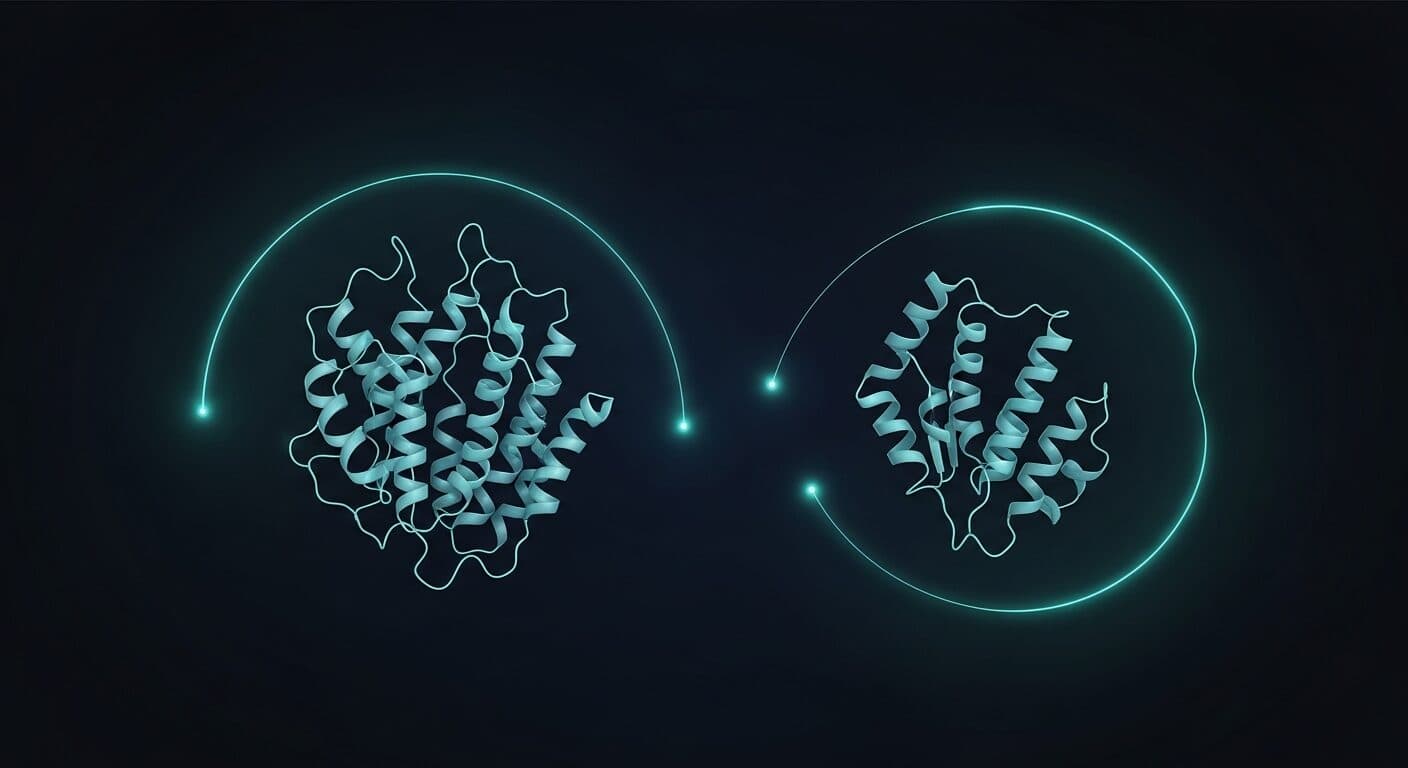
Most of the peptide industry gets this wrong. Vendors list “Thymosin Beta-4 (TB-500)”, forums use the names interchangeably, and Reddit threads cite thymosin beta-4 studies to support TB-500 claims. What usually gets lost is that the name “TB-500” is used for two different molecules.
Depending on the supplier, “TB-500” is either full-length thymosin beta-4 or a much shorter synthetic fragment of it. The distinction matters for research validity, and researchers who don’t understand it risk misinterpreting published literature.
Why this distinction matters
When a researcher reads a PubMed study on “thymosin beta-4 accelerates wound healing” and then orders TB-500 from a supplier assuming they’re getting the same thing, that assumption needs checking. The study used a 43-amino-acid protein. Some suppliers ship that same protein as TB-500; others ship a short fragment, which is a different molecule with potentially different biological activity.
This isn’t pedantic nomenclature. It’s a research validity issue. If your results don’t replicate a published finding, one possible explanation is that you were using a different molecule than the one studied — even though both get called “TB-500” or “thymosin beta-4” casually.
What is Thymosin Beta-4?
Thymosin beta-4 (Tβ4) is a naturally occurring 43-amino acid protein with a molecular weight of approximately 4,963 Da. Allan Goldstein’s group published its full amino acid sequence in 1981 and described it as one of several peptides in thymosin fraction 5, an extract of calf thymus (Low et al., PNAS, 1981, PMID: 6940133). That work built on the thymosin research Goldstein and colleagues began in the 1960s (Goldstein et al., PNAS, 1966, PMID: 5230175).
Tβ4 is one of the most abundant intracellular peptides in mammals. It’s expressed in virtually every cell type except red blood cells. Its primary known function is sequestering monomeric G-actin, which regulates actin polymerization — the process by which cells build their internal cytoskeleton for migration, division, and shape changes.
The full sequence: Ac-SDKPDMAEIEKFDKSKLKKTETQEKNPLPSKETIEQEKQAGES
Beyond actin regulation, published research has documented Tβ4’s involvement in wound healing, angiogenesis, anti-inflammatory signaling, and cardiac tissue repair. Malinda et al. showed that Tβ4 accelerated dermal wound healing in rats, with faster re-epithelialization and more collagen deposition and angiogenesis; in vitro, it also stimulated keratinocyte migration (Malinda et al., J Invest Dermatol, 1999, PMID: 10469335). Bock-Marquette et al. demonstrated that, after coronary artery ligation in mice, Tβ4 increased the activity of ILK and of the survival kinase Akt in the heart, enhanced early myocyte survival and improved cardiac function (Bock-Marquette et al., Nature, 2004, PMID: 15565145).
What is TB-500?
TB-500 is a research trade name used for two different compounds. Some suppliers sell synthetic full-length Tβ4 under it. Others sell a short synthetic fragment built around LKKTETQ, the actin-binding segment (amino acids 17-23), usually as Ac-LKKTETQ.
The key facts about the fragment form:
- Length: 7 amino acids for Ac-LKKTETQ; the exact fragment varies by product
- Molecular weight: Far smaller than full Tβ4 (about 890 Da for Ac-LKKTETQ vs about 4,963 Da)
- Design rationale: Isolate the actin-binding active site at lower synthesis cost and potentially better stability
- Market name: TB-500 is a trade/research name, not a formal scientific designation, and it is also used for full-length Tβ4
Fragment versions exist because synthesizing the full 43-amino-acid Tβ4 is expensive and technically demanding. A shorter fragment targeting the functional domain offered a more practical research compound at a fraction of the cost.
Structural comparison
| Property | Thymosin Beta-4 (Tβ4) | TB-500 sold as a fragment (e.g. Ac-LKKTETQ) |
|---|---|---|
| Amino Acid Count | 43 | 7 for Ac-LKKTETQ (varies by product) |
| Molecular Weight | ~4,963 Da | ~890 Da (Ac-LKKTETQ) |
| Source | Endogenous (produced in nearly all cell types) | Synthetic fragment |
| Active Domain | Contains full actin-binding + all other functional regions | Contains actin-binding domain only |
| Actin Binding | Yes (LKKTETQ region, aa 17-23) | Yes (this IS the LKKTETQ region) |
| Other Functions | Anti-inflammatory, angiogenic, cell migration, hair follicle stem cell activation | Actin-related functions only (other domains absent) |
| Stability | Less stable (larger protein, more degradation sites) | More stable (shorter, fewer cleavage sites) |
| Synthesis Cost | High (43-aa solid-phase synthesis) | Low-moderate (shorter chain) |
| Published PubMed Studies | Hundreds (as “thymosin beta-4”) | Very few (specifically as the synthetic fragment) |
| WADA Status | Full Tβ4 is on the prohibited list (S2 Peptide Hormones) | WADA lists thymosin-β4 and its derivatives, such as TB-500, under S2; check the current list |
Do they have the same research applications?
The overlap exists, but it’s not complete.
Both Tβ4 and TB-500 can bind G-actin through the LKKTETQ sequence. This means the actin-related functions — cell migration, cytoskeletal reorganization, and some aspects of wound repair — are potentially shared. The fragment form was designed to retain this activity.
But Tβ4 is a 43-amino-acid protein with multiple functional domains beyond actin binding. The N-terminal region (Ac-SDKP tetrapeptide) has independent anti-inflammatory and anti-fibrotic properties. Regions outside the actin-binding domain contribute to angiogenic signaling and gene expression regulation. When you use a fragment product instead of full Tβ4, you’re getting the actin-binding sequence without these additional functional regions.
An analogy: imagine a Swiss Army knife (full Tβ4) versus just the blade (a fragment product). The blade does cutting — that’s the core function. But the full tool does cutting, screwing, can-opening, and more. Whether the other tools matter depends on what you’re trying to do.
For wound healing research specifically: Philp et al. found that LKKTETQ, a seven-amino-acid synthetic peptide that duplicates the actin-binding domain, promoted dermal repair in aged mice about as well as full-length Tβ4 (Philp et al., Wound Repair Regen, 2003, PMID: 12581423). The N-terminal Ac-SDKP site (amino acids 1-4) is linked to different effects: it generally blocks inflammation and reduces fibrosis (Sosne et al., FASEB J, 2010, PMID: 20179146). A fragment product would miss that contribution.
What the published literature actually uses
This is where the confusion does the most damage.
Search PubMed for “thymosin beta-4 wound healing” and you get dozens of papers. Search for “TB-500” and you get almost nothing in the peer-reviewed literature. The vast majority of published research used the full-length Tβ4 protein, not a TB-500 fragment.
When someone on Reddit says “TB-500 has been shown to accelerate wound healing in multiple studies” — what they usually mean is “thymosin beta-4 was shown to accelerate wound healing, and I’m assuming TB-500 does the same thing.” That assumption may or may not be valid. For a fragment product, the published evidence doesn’t directly support it, because the studies used full-length Tβ4.
The landmark cardiac studies by Bock-Marquette et al. (2004) and the dermal wound healing work by Malinda et al. (1999) — both used full-length Tβ4. The hair follicle stem cell activation paper by Philp et al. (2004, PMID: 14657002) — also full Tβ4. The angiogenesis studies — full Tβ4.
This doesn’t mean fragment products are ineffective. It means the evidence base for the fragment specifically is much thinner than most people realize. Researchers should be precise about which molecule they’re using and which molecule was used in the studies they’re citing.
Why some suppliers sell a fragment as TB-500
Practical and economic reasons explain why fragment versions exist:
Cost: Synthesizing a 43-amino-acid peptide via solid-phase peptide synthesis (SPPS) is significantly more expensive than a short fragment. Each coupling step has a yield less than 100%, and errors compound with chain length. A 43-mer requires more cycles, more reagents, and has a lower overall synthesis yield.
Stability: Shorter peptides are generally more stable in solution and during storage. The full Tβ4 protein has more sites susceptible to proteolytic cleavage and oxidation.
Market convention: “TB-500” became the standard research name in the commercial peptide space. Once the name was established, it stuck — even though it’s not a formal scientific name and products sold under it range from a short fragment to full-length Tβ4.
COA verification: This is where quality testing really matters. A Certificate of Analysis for TB-500 should show which molecule is being sold. The expected molecular weight is about 4,963 Da for full-length Tβ4 and about 890 Da for the Ac-LKKTETQ fragment; a measured mass that matches one of them identifies the product. Mass spectrometry is the usual way to take that measurement. CertaPeptides’ TB-500 is supplied as the full-length 43-amino-acid sequence (about 4,963 Da), not a shortened fragment; the TB-500 product page shows any independent report we have published for it.
Frequently asked questions
Is TB-500 a fragment of thymosin beta-4?
It depends on the product. The name is used both for a synthetic fragment built around the actin-binding sequence LKKTETQ (approximately amino acids 17-23), which lacks the other functional domains of Tβ4, and for full-length Tβ4 (43 amino acids, about 4,963 Da). CertaPeptides’ TB-500 is full-length Tβ4, not the fragment: Janoshik reports #155233 and #212152 identify it as TB4. A measured mass on the COA is how you tell them apart.
Can you substitute TB-500 for thymosin beta-4 in research?
Only if the TB-500 is full-length Tβ4. If a published study used full-length Tβ4, substituting a fragment product changes the experimental variable: the fragment retains the actin-binding activity but lacks the N-terminal Ac-SDKP domain and other regions that contribute to Tβ4’s full biological profile. For research reproducing published Tβ4 studies, this distinction matters for data interpretation.
Which one has more published research?
Full-length thymosin beta-4 has dramatically more published research — hundreds of PubMed-indexed studies spanning wound healing, cardiac repair, angiogenesis, and inflammation. TB-500 as a specific synthetic fragment has very few dedicated studies in the peer-reviewed literature. Most “TB-500 research” discussions actually reference Tβ4 studies.
When this distinction may not apply to your research
- If your research specifically focuses on actin polymerization dynamics, TB-500 and Tβ4 both contain the relevant binding domain and may produce similar results in that narrow context.
- WADA’s prohibited list (S2) covers thymosin-β4 and its derivatives, such as TB-500. Researchers working in sports science or anti-doping contexts should check the current list.
- What is sold as TB-500 varies between suppliers, from a 7-residue fragment to full-length Tβ4. If the exact molecule matters for your research, confirm the sequence and molecular weight on the COA.
Related reading: BPC-157 research guide | TB-500 vs BPC-157 comparison | How to read a COA | HPLC and mass spectrometry explained
References
- Goldstein AL, et al. “Preparation, assay, and partial purification of a thymic lymphocytopoietic factor (thymosin).” Proc Natl Acad Sci U S A. 1966;56(3):1010-1017. PMID: 5230175
- Low TL, et al. “Complete amino acid sequence of bovine thymosin beta 4: a thymic hormone that induces terminal deoxynucleotidyl transferase activity in thymocyte populations.” Proc Natl Acad Sci U S A. 1981;78(2):1162-1166. PMID: 6940133
- Malinda KM, et al. “Thymosin beta4 accelerates wound healing.” J Invest Dermatol. 1999;113(3):364-368. PMID: 10469335
- Bock-Marquette I, et al. “Thymosin beta4 activates integrin-linked kinase and promotes cardiac cell migration, survival and cardiac repair.” Nature. 2004;432(7016):466-472. PMID: 15565145
- Philp D, et al. “Thymosin beta 4 increases hair growth by activation of hair follicle stem cells.” FASEB J. 2004;18(2):385-387. PMID: 14657002
- Philp D, et al. “Thymosin beta 4 and a synthetic peptide containing its actin-binding domain promote dermal wound repair in db/db diabetic mice and in aged mice.” Wound Repair Regen. 2003;11(1):19-24. PMID: 12581423
- Sosne G, et al. “Biological activities of thymosin beta4 defined by active sites in short peptide sequences.” FASEB J. 2010;24(7):2144-2151. PMID: 20179146
- Goldstein AL, et al. “Thymosin β4: a multi-functional regenerative peptide. Basic properties and clinical applications.” Expert Opin Biol Ther. 2012;12(1):37-51. PMID: 22074294
All compounds discussed are for laboratory and educational research purposes only. Not for human consumption.
Verify before you research
Product pages show a class-level specification where one is on record, and selected lots carry an independent third-party COA.