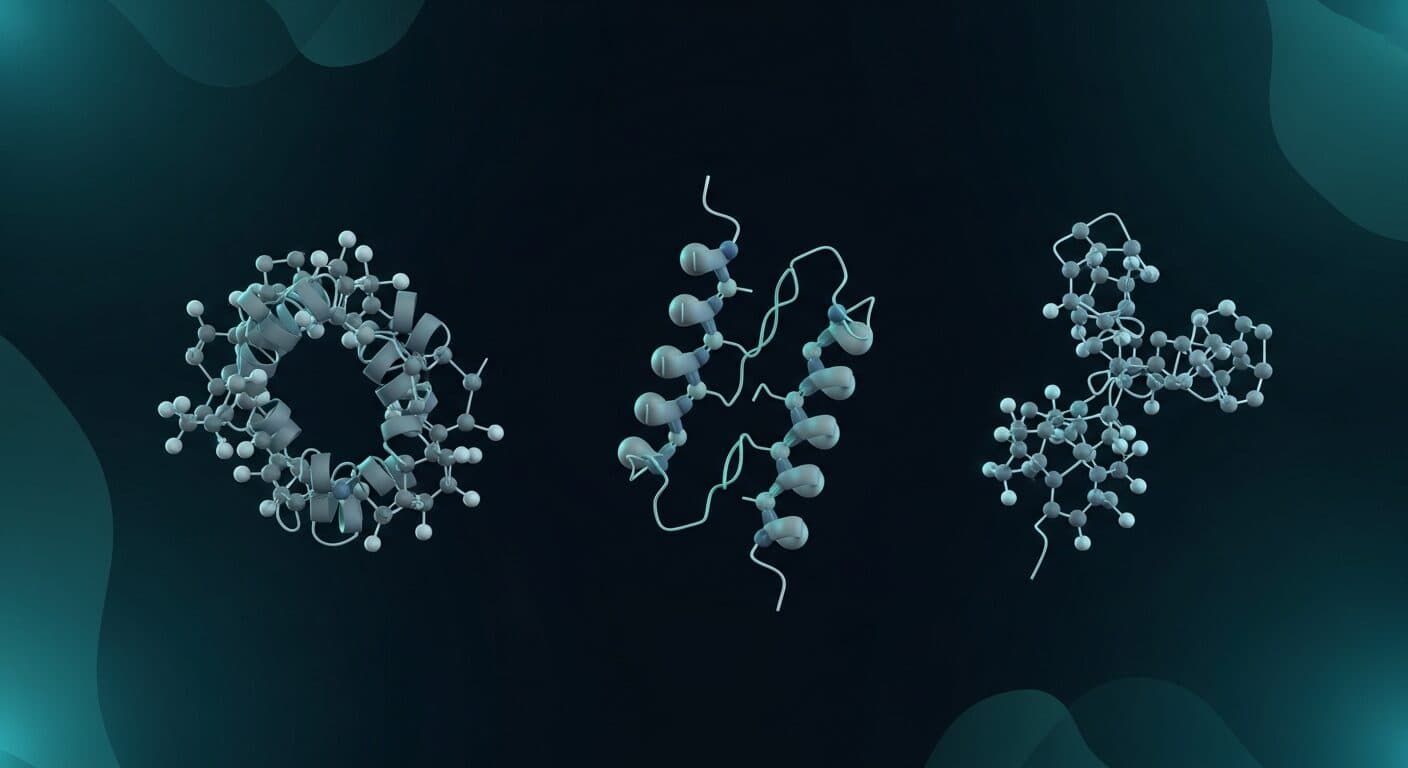
The GLP-1 receptor agonist space has gone from one major compound to three in less than a decade. Semaglutide proved the concept. Tirzepatide added a second receptor. Retatrutide brought in a third. Each expansion changed what researchers could study — and the differences between them matter more than most summaries let on.
This is the comparison piece that doesn’t exist yet: a head-to-head look at all three, covering receptor pharmacology, pharmacokinetics, clinical efficacy data, side effects, and what each one is actually useful for in a research context. No marketing spin, just the published data.
Receptor profiles: single, dual, and triple agonism
The core difference between these three compounds is how many receptors they activate. This isn’t a minor technical detail — it fundamentally changes the pharmacological profile.
| Property | Semaglutide | Tirzepatide | Retatrutide |
|---|---|---|---|
| Receptor Targets | GLP-1R only | GLP-1R + GIPR | GLP-1R + GIPR + GCGR |
| Classification | Single agonist | Dual agonist (“twincretin”) | Triple agonist |
| GLP-1R Activity | Full agonist | Partial agonist (~5x GLP-1 bias) | Full agonist |
| GIPR Activity | None | Full agonist | Full agonist |
| GCGR Activity | None | None | Full agonist |
| Molecular Type | Modified GLP-1 analog | Synthetic GIP/GLP-1 hybrid | Synthetic triple hybrid |
Semaglutide works entirely through GLP-1 receptor activation. It slows gastric emptying, enhances glucose-dependent insulin secretion, and suppresses glucagon release. This is the mechanism that drove the weight loss revolution.
Tirzepatide adds GIP receptor agonism on top of GLP-1. GIP (glucose-dependent insulinotropic polypeptide) has its own set of metabolic effects — it enhances beta-cell function and appears to have independent effects on adipose tissue. The GIP component is what makes tirzepatide a “twincretin” and may explain why it outperformed semaglutide in head-to-head studies.
Retatrutide brings in a third receptor: the glucagon receptor (GCGR). Glucagon agonism increases energy expenditure and hepatic lipid oxidation. This is counterintuitive — glucagon raises blood glucose — but in the context of simultaneous GLP-1 activation, the metabolic effects can complement each other. The glucagon component is the reason researchers are particularly interested in retatrutide for hepatic steatosis (fatty liver) applications.
Pharmacokinetic comparison
All three compounds achieved once-weekly dosing through different molecular engineering strategies. The pharmacokinetic details matter for research protocol design.
| Parameter | Semaglutide | Tirzepatide | Retatrutide |
|---|---|---|---|
| Half-Life | ~168 hours (7 days) | ~120 hours (5 days) | ~144 hours (6 days) |
| Dosing Frequency | Once weekly | Once weekly | Once weekly |
| Half-Life Extension | C-18 fatty acid acylation → albumin binding | C-20 fatty acid → albumin binding | Fatty acid acylation → albumin binding |
| Time to Peak | 24-72 hours post-dose | 8-72 hours post-dose | 24-60 hours post-dose |
| Steady State | 4-5 weeks | 4 weeks | ~4 weeks (estimated) |
| Molecular Weight | ~4,114 Da | ~4,810 Da | ~4,500 Da (estimated) |
| Route | SubQ (also oral formulation) | SubQ only | SubQ only |
All three use fatty acid acylation to bind serum albumin, which shields them from rapid renal clearance. Semaglutide’s 7-day half-life is the longest — achieved through an 18-carbon fatty acid chain attached via a linker to the peptide backbone. Tirzepatide uses a similar strategy with a C-20 fatty acid. Retatrutide’s half-life sits between the two at approximately 6 days based on Phase 2 data (Jastreboff et al., 2023, PMID: 37385275).
Worth noting: semaglutide is the only one with an approved oral formulation. Oral bioavailability is low (~1%) but the SNAC absorption enhancer makes it viable. Neither tirzepatide nor retatrutide have oral formulations, though oral tirzepatide is in clinical development.
Clinical efficacy: what the trials actually show
Let’s be direct about something: you cannot directly compare results across different clinical trials. Patient populations, inclusion criteria, baseline characteristics, and study durations all differ. That said, the data tells a clear directional story.
| Trial | Compound | Top Dose | Duration | Mean Weight Loss | Citation |
|---|---|---|---|---|---|
| STEP 1 | Semaglutide | 2.4 mg/week | 68 weeks | -14.9% | Wilding et al., NEJM 2021 (PMID: 33567185) |
| SURMOUNT-1 | Tirzepatide | 15 mg/week | 72 weeks | -22.5% | Jastreboff et al., NEJM 2022 (PMID: 35658024) |
| Phase 2 | Retatrutide | 12 mg/week | 48 weeks | -24.2% | Jastreboff et al., NEJM 2023 (PMID: 37385275) |
| TRIUMPH-4 (Phase 3) | Retatrutide | 12 mg/week | 48 weeks | -23.7% | developer press release, 2025 |
The pattern is directional: each additional receptor target appears to add efficacy. Semaglutide’s 14.9% with single agonism. Tirzepatide’s 22.5% with dual agonism. Retatrutide’s 24.2% with triple agonism. But remember the cross-trial caveat — these populations and durations weren’t identical.
The SURMOUNT-5 trial provided the first direct head-to-head: tirzepatide (15 mg) produced greater weight reduction than semaglutide (2.4 mg) over 72 weeks in the same study population. That comparison is the cleanest data point we have. No similar head-to-head exists yet for retatrutide vs either compound.
The glucagon receptor component in retatrutide is particularly interesting for metabolic research beyond weight. Phase 2 data showed significant reductions in liver fat (up to 82% relative reduction), which neither semaglutide nor tirzepatide achieved to the same degree. This has implications for MASLD/MASH research specifically.
Side effect profiles
GI side effects are the dominant class across all three. This is expected — GLP-1 receptor activation directly slows gastric emptying.
| Side Effect | Semaglutide | Tirzepatide | Retatrutide |
|---|---|---|---|
| Nausea | 44% (STEP 1) | 31% (SURMOUNT-1) | 46% (Phase 2, 12 mg) |
| Diarrhea | 30% | 23% | 25% |
| Vomiting | 24% | 12% | 22% |
| Constipation | 24% | 12% | 10% |
| Injection site reaction | 3.2% | 4.8% | 4.6% |
| Discontinuation (GI) | 7% | 6.6% | 6% (12 mg) |
A few observations from the data. Tirzepatide had notably lower nausea rates despite similar or better efficacy — the GIP component may buffer the GLP-1 GI effects, though this isn’t fully understood. Retatrutide’s nausea rates were higher, possibly related to glucagon receptor activation adding another GI dimension. All three are dose-dependent: lower starting doses with staged tier progression per cited protocol significantly reduce side effect severity.
The discontinuation rates due to GI adverse events are actually similar across all three (6-7%), which suggests that while the initial side effects vary, long-term tolerability is comparable.
Regulatory status (2026)
| Compound | FDA Status | Approved Brands | Research Availability |
|---|---|---|---|
| Semaglutide | FDA-approved (2017/2021) | branded clinical semaglutide | Widely available as research compound |
| Tirzepatide | FDA-approved (2022) | branded clinical tirzepatide | Available as research compound |
| Retatrutide | Phase 3 clinical trials | None yet (developer pipeline) | Available as research compound |
Semaglutide has the longest track record and the largest safety database. Tirzepatide received approval more recently but already has robust post-marketing data. Retatrutide is still in Phase 3 — the TRIUMPH program includes four pivotal trials — and remains investigational.
The 2026 FDA peptide reclassification expanded access to compounded versions of semaglutide and tirzepatide for research settings, though this primarily affects the US market. EU researchers have different regulatory pathways for accessing research-grade compounds.
Research availability and cost
From a practical research standpoint, all three are available as research-grade compounds from qualified suppliers. Pricing follows a predictable pattern based on market maturity and synthesis complexity.
Semaglutide is the most affordable — it’s been available longest and has the most established synthesis pathways. Tirzepatide costs moderately more, reflecting its more complex dual-agonist structure. Retatrutide commands the highest research pricing due to its newer status, more complex triple-agonist synthesis, and lower production volumes.
Storage requirements are similar across all three: lyophilized powder at -20°C for long-term storage, 2-8°C once reconstituted, use within 28 days post-reconstitution. All three should be reconstituted with bacteriostatic water for multi-use research protocols.
CertaPeptides carries all three compounds with batch-specific COAs and dual HPLC + mass spectrometry verification — see the individual product pages for semaglutide, tirzepatide, and retatrutide.
Which one for your research?
The honest answer: it depends entirely on the research question.
If you’re studying GLP-1 receptor pharmacology specifically, semaglutide is the cleanest tool — single-receptor agonism with no confounding GIP or glucagon effects. It’s also the most cost-effective and has the largest body of published reference data to compare against.
If you’re studying incretin synergy or dual-agonist mechanisms, tirzepatide is the relevant compound. The GIP/GLP-1 interaction is one of the more interesting questions in metabolic research right now, and tirzepatide is the only approved dual agonist.
If you’re studying hepatic lipid metabolism, energy expenditure, or multi-receptor metabolic integration, retatrutide’s glucagon receptor component makes it uniquely relevant. The liver fat reduction data from Phase 2 trials is something neither semaglutide nor tirzepatide can match.
If you’re doing comparative studies, having access to all three allows controlled comparisons of single vs dual vs triple agonism using compounds with similar pharmacokinetic profiles (all once-weekly, all albumin-bound). This is actually a rare opportunity in metabolic research.
There’s no “best” compound — there’s the right compound for the right research question. The GLP-1 space is going to split into distinct research tracks, and understanding which track your work falls into determines which compound you need.
Frequently asked questions
Is retatrutide more effective than semaglutide?
The Phase 2 and Phase 3 data for retatrutide showed numerically greater mean weight reduction (23-24%) compared to semaglutide’s Phase 3 data (14.9% at the highest dose). However, these are cross-trial comparisons with different study designs and patient populations. No direct head-to-head trial exists between semaglutide and retatrutide. What we can say is that adding receptor targets appears to add efficacy based on available data — but this must be weighed against the differences in study design.
Can tirzepatide and semaglutide be directly compared?
Yes — the SURMOUNT-5 trial directly compared tirzepatide 15 mg to semaglutide 2.4 mg in the same patient population. Tirzepatide demonstrated statistically superior weight reduction. This is the strongest evidence for the dual-agonist advantage over single GLP-1R agonism, though it represents only one dose comparison.
Which GLP-1 agonist has the fewest side effects?
Tirzepatide had lower nausea rates (31%) compared to semaglutide (44%) and retatrutide (46%) in their respective trials, despite similar or better efficacy. The GIP receptor component may buffer GLP-1-mediated GI effects, though this mechanism isn’t fully characterized. Discontinuation rates due to side effects were similar across all three (6-7%), suggesting comparable long-term tolerability.
Related reading: For deeper dives into each compound individually, see our semaglutide research guide, tirzepatide research guide, retatrutide research guide, and our analysis of GLP-1 pharmacokinetics and molecular modifications. Use our reconstitution calculator for dosing math.
When this comparison may not suit your research
- If your research question is specifically about oral peptide delivery, only semaglutide has an approved oral formulation — tirzepatide and retatrutide are injection-only.
- Cross-trial efficacy comparisons have inherent limitations. For the strongest comparative evidence, the SURMOUNT-5 head-to-head (tirzepatide vs semaglutide) is the only direct comparison available.
- Retatrutide is still in Phase 3 clinical trials. Long-term safety data is more limited compared to semaglutide (approved since 2017) and tirzepatide (approved since 2022).
References
- Wilding JPH, Batterham RL, Calanna S, et al. “Once-Weekly Semaglutide in Adults with Overweight or Obesity.” N Engl J Med. 2021;384(11):989-1002. PMID: 33567185
- Jastreboff AM, Aronne LJ, Ahmad NN, et al. “Tirzepatide Once Weekly for the Treatment of Obesity.” N Engl J Med. 2022;387(4):327-340. PMID: 35658024
- Jastreboff AM, Kaplan LM, Frías JP, et al. “Triple-Hormone-Receptor Agonist Retatrutide for Obesity — A Phase 2 Trial.” N Engl J Med. 2023;389(6):514-526. PMID: 37385275
- Frías JP, Davies MJ, Rosenstock J, et al. “Tirzepatide versus Semaglutide Once Weekly in Patients with Type 2 Diabetes.” N Engl J Med. 2021;385(6):503-515. PMID: 34170647
- Samms RJ, Coghlan MP, Sloop KW. “How May GIP Enhance the Therapeutic Efficacy of GLP-1?” Trends Endocrinol Metab. 2020;31(6):410-421. PMID: 32396843
All compounds discussed are for laboratory and educational research purposes only. Not for human consumption. Consult applicable regulations in your jurisdiction.