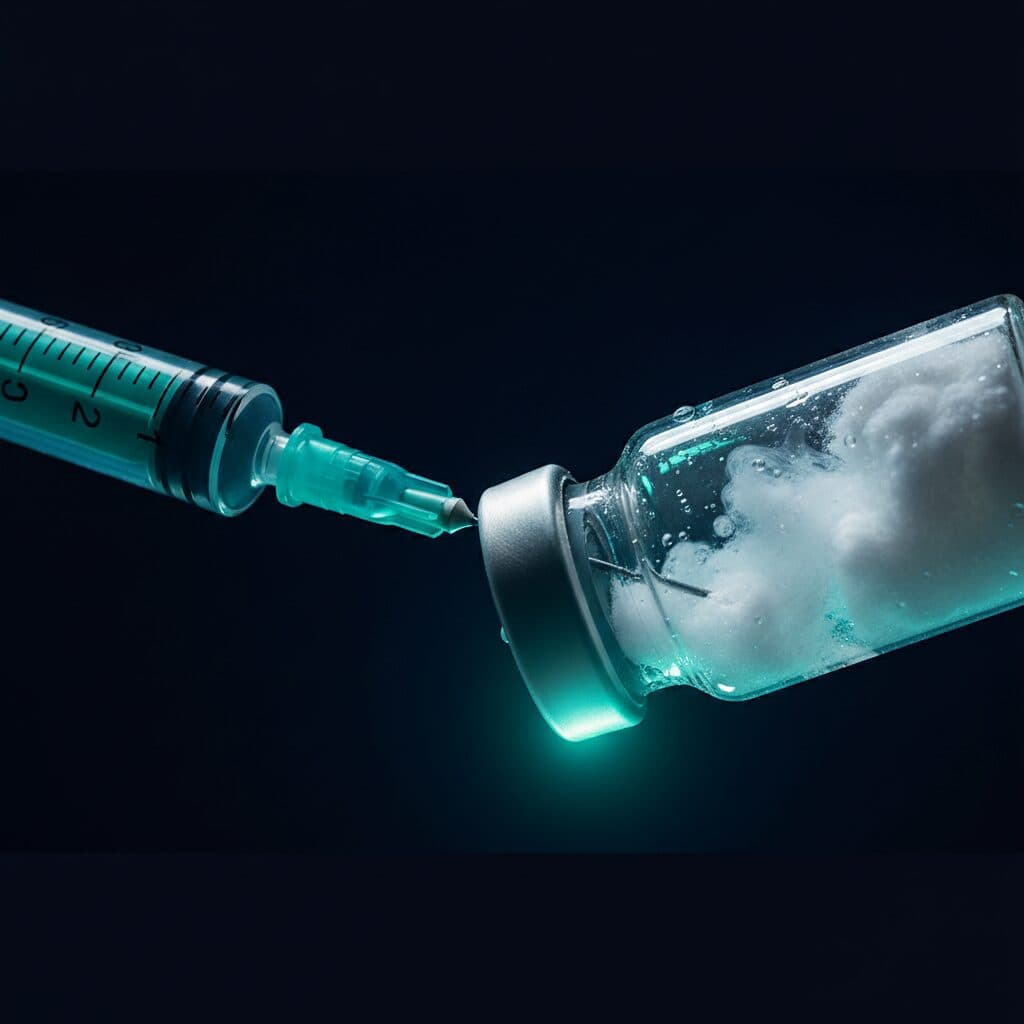
How to reconstitute peptides correctly is the first quality-control checkpoint in any preclinical peptide workflow. The arithmetic is simple, but small deviations at this step propagate through every downstream measurement. This guide walks laboratory researchers through a six-step reconstitution protocol for lyophilized research peptides, pairs it with a free CertaPeptides Reconstitution Calculator, and provides a reference table of typical bacteriostatic water volumes for ten common research peptides. All procedures described here are for research purposes only.
TL;DR: Use bacteriostatic water (0.9% benzyl alcohol), never sterile saline. Calculate purity-adjusted volume with the formula [mass (mg) x purity%] / target concentration (mg/ml). Inject the solvent slowly down the vial wall. Swirl, do not vortex. Label immediately. Store at 2 to 8 degrees C for working stocks (up to 28 days) or aliquot and freeze at -20 degrees C for archival. Preclinical, in vitro, and animal-model use only.
Common reconstitution errors that invalidate preclinical research data include using sterile water instead of bacteriostatic water (microbial contamination within 24 hours of first puncture), vortex mixing (which introduces air bubbles and can denature peptide bonds through shear stress), and skipping purity correction in concentration calculations. This protocol addresses each of these systematically and is suitable for in vitro assays and animal-model research workflows.
What You Will Need
Before starting, gather all materials at your workstation. Having everything within reach minimises handling time and reduces contamination risk during the procedure. Work in a clean laboratory environment, ideally adjacent to a HEPA-filtered laminar flow hood if your facility has one.
- Lyophilized peptide vial – the freeze-dried lyophilisate in its sealed, sterile vial as received from the supplier.
- Bacteriostatic water (BW) – 0.9% benzyl alcohol in water for injection. Not regular sterile water, not saline.
- Precision syringes – 1 ml capacity with 27 to 30 gauge needle for low-dead-volume measurement. Insulin-style syringes are standard in research workflows.
- Alcohol swabs – 70% isopropyl alcohol pads for disinfecting rubber septa.
- Sterile storage vials – amber glass preferred for light protection if transferring the reconstituted solution into aliquots.
- Permanent marker or label tape – for immediate post-reconstitution labelling with peptide name, concentration, and reconstitution date.
- Certificate of Analysis (COA) – to confirm actual peptide mass and HPLC purity percentage before calculating volume.
Step-by-Step Reconstitution Protocol
Step 1 – Calculate Your Target Concentration
Before touching the vial, do the maths. The basic reconstitution formula is Volume of BW (ml) = Peptide mass (mg) / Target concentration (mg/ml). The purity-adjusted version, which is mandatory for precise preclinical research, is Volume (ml) = [Peptide mass (mg) x Purity%] / Target concentration (mg/ml). Skipping the purity correction introduces a systematic concentration error into every downstream assay, typically in the 2 to 7% range depending on peptide grade.
Worked example. A 5 mg vial of BPC-157 at 99.1% HPLC purity, target concentration 1 mg/ml. Adjusted mass = 5 x 0.991 = 4.955 mg. Volume needed = 4.955 ml of bacteriostatic water. Round to 5 ml for practical draw and record the actual concentration as 0.991 mg/ml on the label. Any assay using this stock should reference the as-reconstituted concentration, not the nominal 1 mg/ml.
Rather than computing this by hand every time, use the calculator below. Enter your vial mass, COA purity, and target concentration and it outputs the exact bacteriostatic water volume. Bookmark it – it eliminates a major source of protocol drift across repeated experiments.
Free tool:
Open the CertaPeptides Reconstitution Calculator
Vial mass + purity + target concentration in, exact bacteriostatic water volume out. Preclinical research reference.
Step 2 – Prepare the Work Area
Wipe your work surface thoroughly with a fresh 70% isopropyl alcohol swab. Allow it to dry completely (approximately 60 seconds) before placing any materials on the surface. Residual alcohol that contacts the peptide or solvent can degrade the compound and introduce an uncontrolled variable into your research.
If working in a shared lab, a clean paper towel or sterile drape under your materials provides an additional contamination barrier. Wash hands and, if available, put on nitrile gloves. The goal is to minimise the time the vial septa are exposed to open air during needle insertion. Laminar flow is ideal but not mandatory for small-scale research reconstitutions.
Step 3 – Draw Bacteriostatic Water
Swab the rubber septum of the bacteriostatic water vial with a fresh alcohol pad. Allow 30 to 60 seconds for the alcohol to evaporate. Insert your syringe needle at a slight angle through the centre of the septum – this reduces coring of the rubber. Invert the BW vial, draw back the plunger slowly to your calculated volume, then withdraw the needle. Check the syringe barrel for air bubbles; if present, flick gently and push the bubbles out before proceeding.
Use the volume you calculated in Step 1. If the calculator outputs 2.0 ml, draw 2.0 ml. If your syringe only holds 1 ml, divide into two draws – this is preferable to a larger gauge syringe that introduces more dead-volume error. Consistency of measurement method matters across experimental batches, so document which syringe type you used in your protocol notes.
Step 4 – Introduce Solvent Slowly Along the Vial Wall
Swab the rubber septum of your lyophilized peptide vial with a fresh alcohol swab and allow it to dry. Insert the needle slowly through the septum and angle the tip so it points at the inner glass wall, not straight down into the peptide cake. Depress the plunger very slowly, allowing the bacteriostatic water to run down the vial wall and gradually contact the lyophilisate from the bottom up.
Do not direct the stream onto the peptide cake. High-velocity liquid impact can fragment the lyophilized structure and generate foam. Foam denotes air-water interface contact with the peptide, which accelerates oxidation and can denature fragile residues, particularly in peptides containing methionine, cysteine, or tryptophan (Manning et al., Pharm Res 2010, PMID 20143256). The wall-directed slow injection technique takes an extra 20 to 30 seconds but meaningfully preserves peptide integrity. Once all the BW is in, withdraw the needle and dispose of the syringe in a sharps container.
Step 5 – Gently Swirl Until Clear
Do not vortex. Do not shake. Place the vial between your palms and roll it slowly back and forth, or swirl it gently in small circles. The lyophilisate will begin to hydrate and dissolve. Most peptides go fully clear within 2 to 5 minutes of gentle agitation. Some amphipathic or long-chain peptides (for example TB-500 at 44 amino acids) may appear slightly opalescent – this is normal for that class and does not in itself indicate degradation.
If the peptide has not dissolved after 10 minutes of gentle rolling, do not force it. Set it aside at room temperature for an additional 10 to 15 minutes. Heating to accelerate dissolution is not recommended – even body-temperature warming is sufficient to accelerate degradation in sensitive peptides (Wang, Int J Pharm 1999, PMID 10460913). If a visible precipitate remains after 30 minutes, consult your COA and verify the correct solvent was specified for that specific compound.
Step 6 – Label and Store Immediately
Once fully dissolved, label the vial before doing anything else. Write or affix: peptide name, concentration (mg/ml), date of reconstitution, and calculated expiry (typically 4 weeks from reconstitution date when stored at 2 to 8 degrees C with bacteriostatic water). Place in refrigerator within minutes – do not leave at room temperature once reconstituted. Cold-chain handling from this point onward is the single biggest determinant of multi-week stability.
If you are aliquoting into separate storage vials for longer-term archival, transfer immediately using a fresh syringe and sterile technique. Each aliquot vial gets the same label. Transfer quickly to minimise cumulative air exposure. For storage beyond 4 weeks, freeze single-use aliquots at -18 to -20 degrees C (see the storage section below). For comprehensive guidance on long-term storage conditions, see the peptide storage guide.
Reconstitution Volume Reference Table
The table below provides typical bacteriostatic water volumes for ten peptides in common vial sizes. These are starting-point references based on typical preclinical research concentration ranges – always use the CertaPeptides Reconstitution Calculator to compute exact volume from your specific vial mass and COA purity data. All values are for laboratory research reference only.
| Peptide | Common Vial Size | Recommended Bac Water | Final Concentration |
|---|---|---|---|
| BPC-157 | 5 mg | 5 ml | 1 mg/ml (1,000 mcg/ml) |
| TB-500 (Thymosin Beta-4) | 5 mg | 2 ml | 2.5 mg/ml (2,500 mcg/ml) |
| GHK-Cu | 50 mg | 10 ml | 5 mg/ml (5,000 mcg/ml) |
| Semaglutide | 2 mg | 2 ml | 1 mg/ml (1,000 mcg/ml) |
| Tirzepatide | 5 mg | 2 ml | 2.5 mg/ml (2,500 mcg/ml) |
| Retatrutide | 2 mg | 2 ml | 1 mg/ml (1,000 mcg/ml) |
| Ipamorelin | 2 mg | 2 ml | 1 mg/ml (1,000 mcg/ml) |
| CJC-1295 (no DAC) | 2 mg | 2 ml | 1 mg/ml (1,000 mcg/ml) |
| Epitalon | 10 mg | 5 ml | 2 mg/ml (2,000 mcg/ml) |
| Selank | 5 mg | 5 ml | 1 mg/ml (1,000 mcg/ml) |
Preclinical research reference only. Concentration selection depends on experimental design, assay sensitivity, and storage volume constraints. Consult your specific research protocol before reconstituting.
Why Bacteriostatic Water, Not Sterile Water
Both bacteriostatic water (BW) and sterile water for injection (SWFI) are sterile at the time of manufacture. The difference is what happens after the vial is first punctured. Sterile water contains no preservative – once the septum is breached, the clock starts. Any microorganism introduced through the needle or from ambient air can begin multiplying immediately. For single-use applications where the entire vial is consumed in one session, SWFI is technically acceptable. For multi-use research vials, it is not practical.
Bacteriostatic water contains 0.9% benzyl alcohol, a broad-spectrum bacteriostatic preservative that inhibits bacterial and fungal proliferation through membrane disruption (Manning et al., Pharm Res 2010, PMID 20143256). This extends the safe usable period of the reconstituted solution to approximately 28 days when stored at 2 to 8 degrees C, compared to 24 hours or less for SWFI. Because most research peptide vials are consumed over multiple sessions across days or weeks, bacteriostatic water is the standard solvent for research-use reconstitution. For a full breakdown of solvent selection criteria, solubility by peptide class, and shelf-life data, see the complete bacteriostatic water guide.
Common Reconstitution Mistakes
Systematic awareness of these six errors will protect preclinical data integrity and reduce sample waste:
- Vortex or vigorous shaking. Creates foam, introduces air-water interfaces that accelerate oxidation, and generates shear stress that can fragment peptide bonds. Always use gentle swirling only.
- Using sterile water or saline for multi-use vials. Sterile water has no antimicrobial protection; saline (0.9% NaCl) can cause precipitation or aggregation in charged or amphipathic peptides. Use bacteriostatic water for research peptides requiring multi-use storage.
- Injecting directly onto the lyophilized cake. High-impact liquid contact breaks up the fragile porous lyophilisate structure and promotes foaming. Always direct the needle at the vial wall.
- Skipping purity correction. A peptide labelled as 5 mg at 95% purity contains 4.75 mg of active compound. Ignoring HPLC purity introduces a systematic error into every experimental result. Always pull purity from your COA and apply it in the formula.
- Storing at room temperature after reconstitution. Reconstituted peptides degrade rapidly at ambient temperatures. Most lose significant potency within hours at 20 to 25 degrees C. Move to refrigerator (2 to 8 degrees C) within minutes of reconstitution.
- Freeze-thaw cycling the same aliquot. Repeated freeze-thaw cycles cause ice-crystal damage and progressive peptide degradation. If long-term storage is required, divide into single-use aliquots before the first freeze. See the full list of peptide reconstitution mistakes with impact data for each.
Storage After Reconstitution
Once reconstituted, a peptide solution is significantly more fragile than its lyophilized precursor. Three factors drive degradation: temperature, light, and contamination (Wang, Int J Pharm 1999, PMID 10460913). Managing all three extends usable shelf life and preserves experimental consistency across multi-week protocols.
Temperature. Store at 2 to 8 degrees C for active working stocks with bacteriostatic water, maximum 28 days. For longer-term archival, freeze at -18 to -20 degrees C in single-use aliquots. Do not store in a frost-free freezer (temperature cycling during defrost cycles degrades peptides). Freeze-thaw limit: one cycle. Pre-aliquot before first freezing.
Light. UV radiation and even prolonged exposure to visible fluorescent light can break peptide bonds, particularly in aromatic residue-containing compounds (tryptophan, phenylalanine, tyrosine). Store in amber glass vials or wrap clear vials in aluminium foil. Never leave peptide solutions on a bench in a lit lab for extended periods.
Contamination. Swab septa with alcohol before every needle insertion, even if the vial has been in the refrigerator. Use a fresh syringe for each withdrawal. If the solution develops visible cloudiness, colour change, or particulate matter that was not present at reconstitution, discard – do not use in experiments (Bogdanowich-Knipp et al., peptide solvent stability review, PMID 10424348). For a complete evidence-based storage protocol covering all peptide classes, refer to the peptide storage guide.
Frequently Asked Questions
What water do I use to reconstitute peptides?
Bacteriostatic water (BW) is the standard for research peptides. It contains 0.9% benzyl alcohol as a preservative, which inhibits microbial growth and extends the shelf life of the reconstituted solution to approximately 28 days at 2 to 8 degrees C. Sterile water for injection is acceptable for single-use applications but offers no antimicrobial protection for multi-use vials. Do not use tap water, distilled water from a non-sterile source, or regular saline.
How long does reconstituted peptide last in the fridge?
Reconstituted with bacteriostatic water and stored at 2 to 8 degrees C: approximately 28 days for most peptides. Reconstituted with sterile water: 24 hours maximum. Frozen at -18 to -20 degrees C in single-use aliquots: 3 to 6 months for most peptides, though some are stable for up to 12 months. These are general laboratory guidelines – stability varies by peptide sequence, concentration, and storage conditions. Always note the reconstitution date on the label.
What concentration should I reconstitute to?
Concentration depends entirely on your experimental protocol, the assay’s detection sensitivity, and the volume available for each research application. Higher concentrations require smaller volumes per use (useful when limiting volume per animal-model dosing in preclinical work) but reduce total sample volume. Use the CertaPeptides Reconstitution Calculator to model different concentration options against your vial size and research requirements. The reference table above lists commonly used starting concentrations for ten major research peptides.
Can I use regular saline for reconstitution?
Saline (0.9% NaCl solution) is generally not recommended for peptide reconstitution. The sodium chloride can cause precipitation or aggregation in charged or amphipathic peptides. Saline also offers no antimicrobial protection for multi-use storage. While some specific peptide protocols cite isotonic saline for particular applications, bacteriostatic water is the default choice for research peptide reconstitution due to its compatibility with the widest range of compounds and its preservative properties.
Do I need to filter reconstituted peptide solutions?
Filtration is not required for most preclinical research applications if sterile technique is followed during reconstitution and storage. If your protocol requires endotoxin-limited or particulate-free solutions (for example, certain in vivo animal model studies with strict injection-volume controls), a 0.22 micron sterile PES or PVDF syringe filter is commonly used. PTFE filters should be avoided for most peptides because of non-specific binding that can reduce effective concentration. Always validate filter recovery with a small pilot volume before filtering a full stock.
All content above is provided for laboratory research purposes only. These materials are not for human consumption, medical diagnosis, or treatment. Researchers should follow their institution’s biosafety and compound-handling SOPs.
Verify before you research
Every compound we list ships against a supplier batch specification, and selected lots carry an independent third-party COA.