⚠️ For Research Purposes Only — This article is a scientific reference for qualified laboratory researchers. Semaglutide, tirzepatide, and retatrutide are discussed here strictly as subjects of incretin-axis research. Nothing in this article is medical advice, a dosing recommendation, or an endorsement of any use outside controlled preclinical or experimental contexts. These are not products for human consumption when supplied as research reagents.
Introduction
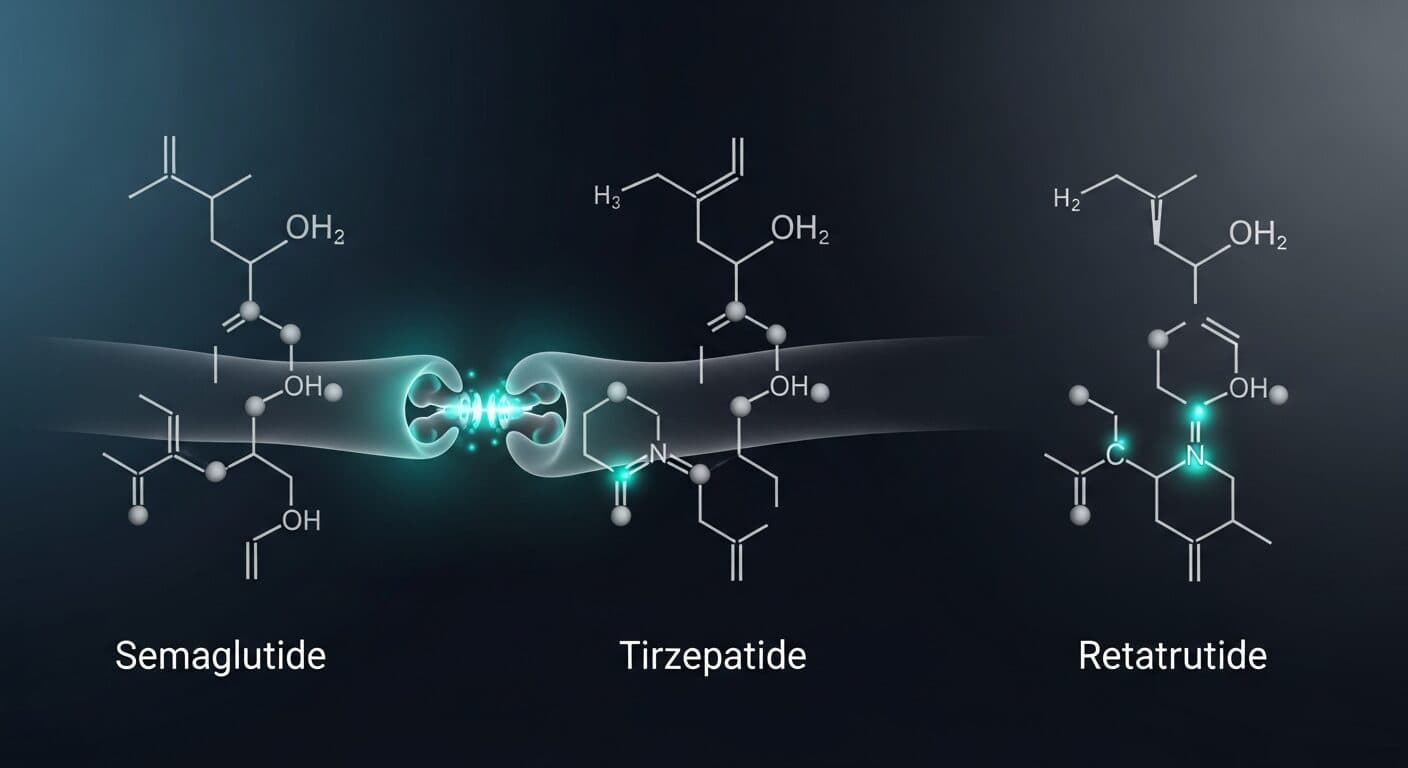
The incretin axis — the GLP-1, GIP, and glucagon signaling system — has become the most intensively studied endocrine pathway of the last decade. Three peptides dominate the current research landscape: semaglutide, a long-acting GLP-1 receptor mono-agonist; tirzepatide, a dual GIP/GLP-1 co-agonist; and retatrutide, an investigational triple GIP/GLP-1/glucagon receptor agonist.
For research laboratories studying incretin biology, metabolic physiology, receptor pharmacology, or peptide chemistry, these three molecules represent a logical progression from single-receptor targeting toward multi-receptor orchestration of the enteroinsular and energy-balance axes.
This article is a rigorous comparative primer — not a clinical guide. It covers:
- The three incretin/counter-regulatory receptors involved (GLP-1R, GIPR, GCGR)
- Structural design principles behind each peptide
- A side-by-side comparison table
- Reported pharmacokinetic parameters from published research
- Differences in downstream signaling and preclinical observations
- Practical considerations for researchers working with these peptides in vitro
All references are drawn from PubMed-indexed literature.
1. The Receptor Landscape
Three class B (secretin-family) G protein-coupled receptors define this comparative space:
- GLP-1R (Glucagon-Like Peptide-1 Receptor) — expressed on pancreatic β-cells, α-cells, brain neurons (including AP/NTS hindbrain, hypothalamus), gut enteric neurons, and peripheral tissues. Signals via Gα_s, raising cAMP. Drives glucose-dependent insulin secretion, suppresses glucagon at hyperglycemic set points, slows gastric emptying, and reduces food intake through central circuits.
- GIPR (Glucose-Dependent Insulinotropic Polypeptide Receptor) — expressed on pancreatic β-cells and α-cells, adipocytes, bone, and CNS regions. Also Gα_s coupled. Contributes to postprandial insulin secretion and adipose tissue lipid handling. The role of GIP receptor agonism vs. antagonism in obesity research remains an active debate.
- GCGR (Glucagon Receptor) — expressed predominantly in hepatocytes. Signals through Gα_s to increase hepatic glucose output (glycogenolysis and gluconeogenesis), and contributes to increased energy expenditure and hepatic lipid oxidation. In balanced multi-receptor agonists, GCGR activity is leveraged for increased energy expenditure while GLP-1R activity offsets the counter-regulatory rise in glucose.
Semaglutide engages only GLP-1R. Tirzepatide engages GLP-1R and GIPR. Retatrutide engages all three. Each successive molecule was designed with increasingly complex pharmacology.
2. Semaglutide — The Long-Acting GLP-1 Mono-Agonist
Semaglutide is a 31-residue analog of native GLP-1(7-37) with three critical modifications engineered for extended plasma residence:
- Ala8 → Aib (α-aminoisobutyric acid): Prevents cleavage by dipeptidyl peptidase-4 (DPP-4), which normally cleaves GLP-1 within minutes.
- Lys34 → Arg: Eliminates an attachment site, directing the fatty acid linker to position 26.
- Lys26 attached to a C-18 diacid via a γGlu–2×OEG spacer: This fatty-acid side chain enables high-affinity, reversible binding to serum albumin.
The result is a peptide with a plasma half-life of approximately 165–184 hours (~7 days) in preclinical and experimental pharmacokinetic studies — suitable for weekly dosing paradigms. Semaglutide’s mechanism in research models centers on delayed gastric emptying, reduced caloric intake via hindbrain and hypothalamic circuits, and glucose-dependent enhancement of insulin secretion.
Davies et al. (2021, DOI) published a Phase 3 STEP 2 trial of semaglutide in adults with overweight or obesity and type 2 diabetes, demonstrating substantial weight changes versus placebo. Wilding et al. (2022, DOI) reported on weight regain and cardiometabolic changes after withdrawal in the STEP 1 extension, providing insight into the reversibility of observed effects. These are clinical studies cited here to contextualize the research pharmacology; they are not endorsements for any use outside controlled research.
3. Tirzepatide — The Dual GIP/GLP-1 Co-Agonist
Tirzepatide is a 39-residue synthetic peptide built on a modified GIP backbone engineered to also engage GLP-1R. The design philosophy differs from semaglutide in two important ways:
- Unbalanced dual agonism: Tirzepatide is intentionally biased toward GIPR over GLP-1R in potency, reflecting the hypothesis that GIPR co-activation adds beneficial metabolic effects beyond GLP-1R alone.
- C20 fatty diacid modification at Lys20 with a γGlu–2×AEEA spacer: Similar to semaglutide in principle (albumin binding for extended half-life) but at a different position and with slightly different linker chemistry.
Reported plasma half-life in experimental pharmacokinetic studies is approximately 117 hours (~5 days), supporting weekly dosing in research protocols.
Jastreboff et al. (2022, DOI) reported the Phase 3 SURMOUNT-1 trial of tirzepatide in adults with obesity, establishing the magnitude of weight changes observed with GIP/GLP-1 dual agonism relative to placebo. This is cited to map the research pharmacology — researchers studying the molecule in preclinical contexts use these data to benchmark mechanistic findings.
An interesting mechanistic question that remains active in the research community concerns GIPR pharmacology: is tirzepatide’s GIPR activity functionally agonistic, biased, or even desensitizing? Some biochemical studies suggest that sustained GIPR activation leads to receptor internalization and functional desensitization, complicating the simple “dual agonist” framing. This is an active area of investigation in peptide research labs.
4. Retatrutide — The Triple GIP/GLP-1/Glucagon Agonist
Retatrutide (developmental designation LY3437943) is a 39-residue synthetic peptide designed to activate all three receptors: GLP-1R, GIPR, and GCGR. Its discovery and first characterization were reported by Coskun et al. (2022) in Cell Metabolism:
Coskun T, et al. LY3437943, a novel triple glucagon, GIP, and GLP-1 receptor agonist for glycemic control and weight loss: From discovery to clinical proof of concept. Cell Metab. 2022;34(9):1234–1247. DOI: 10.1016/j.cmet.2022.07.013 (PMID: 35985340)
Key findings reported by the originator research group:
- In vitro: Retatrutide shows balanced activity at GCGR and GLP-1R, with higher potency at GIPR.
- In obese mouse models: Body weight reduction was augmented by GCGR-mediated increases in energy expenditure on top of GIPR- and GLP-1R-driven reductions in caloric intake.
- Pharmacokinetics: The profile supported once-weekly dosing, with weight changes persisting up to day 43 after a single dose in the initial Phase 1 single-ascending-dose study.
Jastreboff et al. (2023, DOI) subsequently reported a Phase 2 trial of retatrutide, characterizing its pharmacology across a range of doses and durations in adults with obesity. This is included as a research citation only — not a recommendation.
The rationale for the third receptor (GCGR) is elegant: glucagon receptor activation increases hepatic glucose output and raises energy expenditure. Alone, this would worsen glycemic profiles; however, when paired with GLP-1R activation — which drives glucose-dependent insulin secretion — the counter-regulatory rise is offset while the energy-expenditure benefit is retained. It is a textbook example of designing complementary pharmacology into a single molecule.
Madsbad and Holst (2025, DOI) reviewed the pipeline of GLP-1RA development and place retatrutide in the broader context of multi-receptor incretin research (PMID: 40022548).
5. Side-by-Side Comparison Table
| Parameter | Semaglutide | Tirzepatide | Retatrutide |
|---|---|---|---|
| Receptor targets | GLP-1R | GLP-1R + GIPR | GLP-1R + GIPR + GCGR |
| Agonism profile | Mono-agonist | Dual (GIP-biased) | Triple (balanced GCGR/GLP-1R, higher GIPR) |
| Backbone origin | GLP-1(7-37) analog | GIP-based chimera | Novel chimeric design |
| Length (amino acids) | 31 | 39 | 39 |
| DPP-4 protection | Aib at position 2 (Ala8 → Aib) | Aib substitutions | Aib substitutions |
| Half-life extension strategy | C18 diacid at Lys26, γGlu–2×OEG spacer | C20 diacid at Lys20, γGlu–2×AEEA spacer | C20 diacid, optimized linker |
| Reported plasma t½ | ~165–184 h (~7 days) | ~117 h (~5 days) | ~6 days (weekly dosing supported) |
| Primary research mechanisms | Gastric emptying delay, satiety, glucose-dependent insulinotropic | Dual incretin effect + adipose tissue GIPR effects | Dual incretin + GCGR-driven energy expenditure |
| Current research phase (key reference) | Marketed GLP-1RA class standard; numerous STEP trials | SURMOUNT trial program | Phase 2 (Jastreboff 2023); ongoing Phase 3 program |
| Key preclinical discovery paper | Multiple; Novo Nordisk program | Coskun et al., 2018 (prior Cell Metab) | Coskun et al., 2022 (DOI) |
| Discovery research group | Novo Nordisk | the drug sponsor | the drug sponsor |
Note on half-lives: Reported values vary across studies depending on analytical method (LC-MS/MS vs. immunoassay), species, and dose. The values above reflect commonly cited ranges from published PK research. Any half-life claim in a research manuscript should cite the specific primary source.
6. Structural Design Principles — What the Chemists Actually Did
All three molecules share a family of design tricks:
- DPP-4 resistance at position 2: Native GLP-1 and GIP are both rapidly cleaved by DPP-4 at their Ala2 residue. Substitution with Aib (α-aminoisobutyric acid) eliminates this cleavage.
- Lysine fatty-acid side chain for albumin binding: A C18 or C20 diacid chain attached via a flexible γGlu–spacer–Lys side chain. The diacid tail partitions into albumin’s fatty-acid binding sites, reducing free fraction and extending elimination.
- Chimeric sequence design for multi-receptor engagement: For tirzepatide and retatrutide, sequence positions known to determine GLP-1R, GIPR, or GCGR selectivity are grafted together, and candidates are screened by competitive binding and cAMP assays at each receptor.
- Optimized spacer chemistry (OEG, AEEA): The ethylene glycol or amino-ethoxy-acetic acid spacers position the fatty acid away from the peptide backbone to preserve receptor engagement while allowing albumin binding.
Melson et al. (2024, DOI) provide a contemporary review of the broader incretin pipeline (PMID: 38302593), and Locatelli et al. (2024, DOI) address how these pharmacologies interact with body composition research (PMID: 38687506).
7. In Vitro Research Considerations
cAMP assays
GLP-1R, GIPR, and GCGR are all Gα_s-coupled, so cAMP is the canonical functional readout. Homogeneous time-resolved fluorescence (HTRF) cAMP assays in HEK293 or CHO cells heterologously expressing each receptor are the standard format for characterizing EC₅₀ and Emax at each target.
When profiling multi-agonists, researchers should:
- Run all three receptors in parallel on the same day with the same reference standard (usually native GLP-1, GIP, or glucagon).
- Normalize to the native ligand’s Emax to calculate relative efficacy.
- Report both EC₅₀ and relative intrinsic activity, since the two can dissociate for biased agonists.
β-arrestin recruitment and internalization
Sustained receptor engagement by albumin-bound, long-acting peptides creates pharmacological profiles different from native incretins. β-arrestin recruitment assays (e.g., PathHunter) and internalization assays (BRET, immunofluorescence) are increasingly important for characterizing biased and desensitizing profiles at GIPR in particular.
Binding studies
Equilibrium binding with radiolabeled tracers (³H or ¹²⁵I) or SPR (surface plasmon resonance) with extracellular domain constructs gives Kd values. For fatty-acid-modified peptides, binding assays performed in the presence and absence of physiological albumin concentrations (35–50 g/L HSA) reveal how much free peptide is actually available.
8. Practical Laboratory Considerations
Reconstitution
All three peptides are supplied lyophilized. Suggested research-use reconstitution approach:
- Semaglutide: Reconstitute in bacteriostatic water or sterile research-grade water at 1–5 mg/mL. Good solubility; minimal aggregation at neutral pH.
- Tirzepatide: Similar approach. The larger molecule (molecular weight ~4.8 kDa) may require gentle swirling rather than vortex mixing to avoid foaming and potential aggregation at the air–liquid interface.
- Retatrutide: Similar. As with other fatty-acid-modified incretin analogs, avoid high shear forces.
Storage
- Lyophilized powder: −20 °C or −80 °C, desiccated, dark.
- Reconstituted stock: 2–8 °C for short-term use (days to weeks, depending on concentration); −20 °C for longer-term storage as single-use aliquots. Repeated freeze–thaw should be minimized.
Analytical confirmation
Before any quantitative experiment, confirm identity and purity by:
- RP-HPLC: Typical main peak >95% for research-grade material; >98% for material used in quantitative PK work.
- LC-MS: Confirm the monoisotopic mass matches the theoretical sequence including the fatty acid modification.
- Amino acid analysis (if available): Gold standard for absolute peptide content.
Controls
When comparing semaglutide, tirzepatide, and retatrutide in the same experimental paradigm, always include:
- Native GLP-1(7-36)-NH₂ and/or native GIP(1-42) as reference agonists.
- Vehicle control matched to the reconstitution buffer.
- A receptor-selective antagonist (e.g., exendin(9-39) for GLP-1R) where available, to confirm pharmacology.
8a. Comparative Research Observations Across the Three Molecules
Placing the three molecules side by side allows researchers to appreciate the engineering progression from mono- to multi-receptor targeting. Several comparative observations are worth making explicit:
- Potency at GLP-1R: All three molecules are full or near-full agonists at GLP-1R with EC₅₀ values in the low picomolar to nanomolar range. Relative potency at GLP-1R alone does not distinguish them in a way that explains their differential metabolic profiles in preclinical models.
- Receptor coverage is the differentiator: The key mechanistic difference is which receptors are engaged — semaglutide (GLP-1R only), tirzepatide (GLP-1R + GIPR), retatrutide (all three). The addition of each new receptor brings new pharmacological effects that are not achievable by dose escalation of a mono-agonist alone.
- Half-life strategies converge: All three molecules use albumin binding via fatty-acid side chains as their primary half-life extension strategy. The choice of C18 vs C20 diacid, spacer chemistry, and attachment position are design details, not fundamental differences.
- Structural similarity with functional divergence: Tirzepatide and retatrutide share the same 39-residue length and similar backbone architecture but differ in the residues that encode receptor selectivity. This makes them useful research tools for mapping which sequence positions control engagement of each receptor.
- In vitro assay panels: The minimum useful panel for characterizing any molecule in this class is parallel cAMP assays at all three receptors, run with reference native ligands on the same day. Without this panel, claims about “balance” or “bias” cannot be meaningfully compared across laboratories.
Open research questions
Despite extensive study, several active questions remain in this field:
- What is the optimal balance between GLP-1R, GIPR, and GCGR activity? Retatrutide’s balance was chosen based on preclinical phenotype; other ratios may produce different outcomes.
- Is GIPR agonism or functional antagonism more beneficial in a multi-receptor context? The GIPR paradox remains unresolved.
- How do these molecules compare on β-arrestin signaling and receptor trafficking? Biased signaling profiles may explain some of the pharmacological differences not captured by cAMP assays alone.
- What is the structural basis for the observed pharmacology? Cryo-EM and X-ray structures of each receptor in complex with these agonists are now being reported and will inform the next generation of analogs.
9. Frequently Asked Research Questions
Q1: Why is retatrutide called a “triple agonist” if its activity at the three receptors isn’t equal?
“Triple agonist” refers to engagement of three receptors as a pharmacologically meaningful functional agonist at each — not to identical intrinsic activities. Coskun et al. (2022) reported balanced GCGR/GLP-1R activity with higher GIPR potency. The “balance” is tuned by design to achieve a specific metabolic phenotype in preclinical models.
Q2: Which peptide has the longest half-life in published research?
Semaglutide has the longest reported half-life (~7 days) among the three in standard pharmacokinetic studies, followed by retatrutide and tirzepatide (both ~5–6 days). All three support weekly dosing in research protocols. Half-life numbers vary across studies and species; always cite the specific primary source.
Q3: Can I use the same in vitro assay to compare all three?
You can use a panel of three cAMP assays — GLP-1R, GIPR, GCGR — run in parallel on the same day with the same peptide preparations and reference standards. This generates directly comparable EC₅₀ and Emax values. Running the assays on different days introduces variability that can obscure genuine pharmacological differences.
Q4: How should I think about GIPR agonism vs. antagonism in research?
This is one of the most interesting open questions in incretin research. Some groups report that sustained GIPR agonism leads to receptor desensitization that is functionally similar to antagonism in vivo. Other groups maintain that tonic GIPR activation is genuinely beneficial. Both hypotheses have experimental support. The “GIPR paradox” is an active area of peptide pharmacology research.
Q5: Why does tirzepatide have 39 residues but semaglutide only 31?
They are built on different backbones. Semaglutide is a modified GLP-1(7-37) analog and follows the native GLP-1 length. Tirzepatide is a GIP-based chimera, and native GIP is a 42-residue peptide — tirzepatide uses a truncated/modified version of that longer backbone to which GLP-1R-engaging elements have been grafted. Retatrutide uses a similar length and design logic.
References
- Coskun, T., Urva, S., Roell, W. C., et al. (2022). LY3437943, a novel triple glucagon, GIP, and GLP-1 receptor agonist for glycemic control and weight loss: From discovery to clinical proof of concept. Cell Metabolism, 34(9), 1234–1247.e9. DOI: 10.1016/j.cmet.2022.07.013 (PMID: 35985340)
- Jastreboff, A. M., Kaplan, L. M., Frías, J. P., et al. (2023). Triple-Hormone-Receptor Agonist Retatrutide for Obesity — A Phase 2 Trial. New England Journal of Medicine, 389(6), 514–526. DOI: 10.1056/NEJMoa2301972 (PMID: 37366315)
- Jastreboff, A. M., Aronne, L. J., Ahmad, N. N., et al. (2022). Tirzepatide Once Weekly for the Treatment of Obesity. New England Journal of Medicine, 387(3), 205–216. DOI: 10.1056/NEJMoa2206038 (PMID: 35658024)
- Davies, M., Færch, L., Jeppesen, O. K., et al. (2021). Semaglutide 2.4 mg once a week in adults with overweight or obesity, and type 2 diabetes (STEP 2): a randomised, double-blind, double-dummy, placebo-controlled, phase 3 trial. The Lancet, 397(10278), 971–984. DOI: 10.1016/S0140-6736(21)00213-0 (PMID: 33667417)
- Wilding, J. P. H., Batterham, R. L., Davies, M., et al. (2022). Weight regain and cardiometabolic effects after withdrawal of semaglutide: The STEP 1 trial extension. Diabetes, Obesity and Metabolism, 24(8), 1553–1564. DOI: 10.1111/dom.14725 (PMID: 35441470)
- Melson, E., Ashraf, U., Papamargaritis, D., & Davies, M. J. (2024). What is the pipeline for future medications for obesity? International Journal of Obesity, 48(4), 433–451. DOI: 10.1038/s41366-024-01473-y (PMID: 38302593)
- Madsbad, S., & Holst, J. J. (2025). The promise of glucagon-like peptide 1 receptor agonists (GLP-1RA) for the treatment of obesity: a look at phase 2 and 3 pipelines. Expert Opinion on Investigational Drugs. DOI: 10.1080/13543784.2025.2472408 (PMID: 40022548)
- Locatelli, J. C., Costa, J. G., Haynes, A., et al. (2024). Incretin-Based Weight Loss Pharmacotherapy: Can Resistance Exercise Optimize Changes in Body Composition? Diabetes Care, 47(6), 1079–1095. DOI: 10.2337/dci23-0100 (PMID: 38687506)
Citations retrieved from PubMed. Please consult the original sources for full methodological detail.
Not for human consumption. For laboratory research only.
Disclaimer: All products sold by CertaPeptides are intended for laboratory research use only. Not for human or veterinary use. Not for consumption. Nothing in this article is medical advice, and no claims of safety, efficacy, diagnosis, treatment, prevention, or cure are made for semaglutide, tirzepatide, retatrutide, or any related compound. The compounds are discussed here only as subjects of published preclinical and experimental research. Researchers are responsible for complying with all applicable laws, institutional policies, and ethical guidelines governing the handling of research peptides.
Researcher Q&A
This question comes from researchers designing protocols that combine GLP-1-class compounds such as retatrutide with GH-axis and mitochondrial peptides. The answer reflects the published preclinical and clinical literature, is for research-use-only contexts, and includes no dosing guidance. CertaPeptides compiled this appendix from the questions our support team fields most often.
Q: How do retatrutide, tesamorelin, and MOTS-c interact mechanistically when used together in a research protocol?
A: These three compounds are mechanistically non-overlapping, which is an advantage in that they do not compete at the same receptor, and a complication in that each operates on a different signalling timescale. That mismatch is the central issue for any researcher evaluating a combined protocol.
Retatrutide is a triple agonist at the GLP-1, GIP, and glucagon receptors with pharmacokinetics designed for weekly administration. The signal is fast: appetite and glycaemic effects are measurable within days, and body-composition changes appear over weeks. The glucagon arm distinguishes retatrutide from tirzepatide and underlies both the enhanced lipolytic signal observed in clinical work and the heat-generation and catabolic-adjacent side effects some subjects report.
Tesamorelin is a DPP-IV-stabilised GHRH analog that drives endogenous pulsatile GH release via the pituitary. The signal is slow: the visceral adipose tissue reduction that grounds its HIV-lipodystrophy approval appears over 12 to 26 weeks in the trial data. It is dosed daily, typically in the evening to align with the physiological GH pulse. The first week of a protocol is not expected to produce a perceptible effect.
MOTS-c is a mitochondrial-derived peptide encoded within the 12S rRNA. It activates AMPK and produces metabolic and exercise-capacity changes in rodent models over weeks-to-months timescales, with fasting glucose and insulin sensitivity as the canonical readouts.
Three implications follow for researchers running the three in parallel. First, the timescales are genuinely mismatched — retatrutide acts in days, tesamorelin in months, MOTS-c somewhere between — so attributing any observed effect to a specific compound in a concurrent protocol is not possible; this is the classic N-of-1 confounding problem. Second, tesamorelin and GLP-1-class compounds have documented interactions around insulin sensitivity: the tesamorelin-driven IGF-1 rise can nudge insulin resistance mildly in one direction, while GLP-1 agonism pushes the other. This is not a contraindication, but fasting glucose and HbA1c are relevant monitoring endpoints when baseline data are available. Third, MOTS-c contributes the least observable signal in the short term, so in a protocol structured to actually discriminate compound effects, staging MOTS-c later is often the higher-information choice.
Staged introduction with defined observation windows generally yields more interpretable research data than simultaneous multi-compound introduction.