Tyrimų klasės junginys. Tik laboratoriniam naudojimui. Neskirtas žmonių ar gyvūnų naudojimui, nurijimui ar injekcijai. Jokie medicininiai teiginiai nėra pateikiami ar numanomi.
Tiekėjo partijos specifikacija · ≥97% (recombinant peptide fragment, by HPLC)
Endocrine and Hormone Research PeptidesSKU: CP-TER10
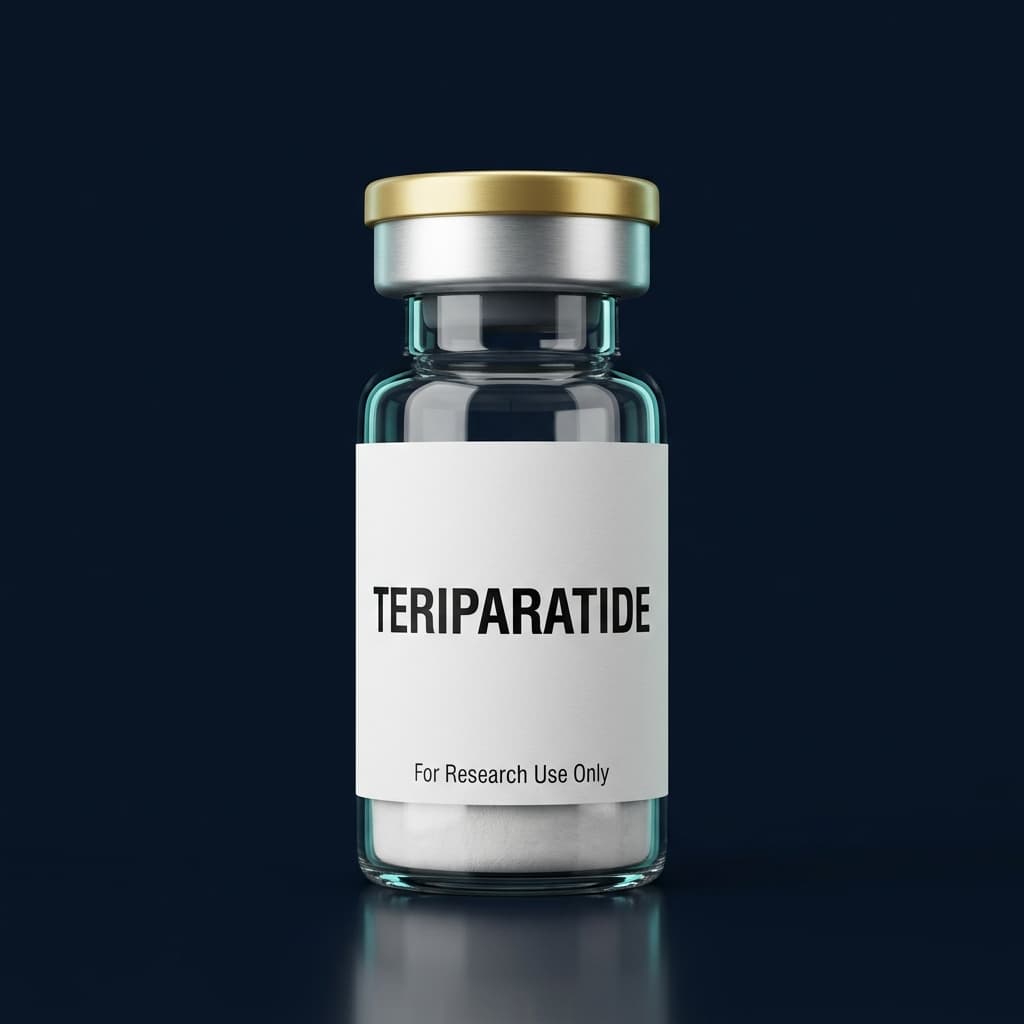
Teriparatide 10mg
≥97% (recombinant peptide fragment, by HPLC)
Susijęs PeptidesDB įrašas (tas pats savininkas)
peptidesdb.org
/p/teriparatide
119,99 €Yra sandėlyje
Sandėlyje liko tik 10 — užsakykite netrukus
Pristatoma į EU per 3-7 darbo dienos
Nemokamas pristatymas viršijus €200 · jokių muitinės dokumentų (ES) · su EU carrier network
1
Iš viso: 119,99 €
Nemokamas siuntimas užsakymams virš €200
Research-grade Teriparatide. 99.4% avg purity, HPLC & MS verified. Lyophilized powder in sealed glass vial. For laboratory research use only. Not for human consumption.
Kainos pagal kiekįTaikoma automatiškai atsiskaitant
| Kiekis | Kaina už vienetą | Iš viso | Sutaupymas |
|---|---|---|---|
| 1 unit | 119,99 € | 119,99 € | -- |
| 3+ | 113,99 € | 341,97 € | 5% nuolaida |
| 5+Populiariausia | 107,99 € | 539,96 € | 10% nuolaida |
| 10+ | 101,99 € | 1 019,91 € | 15% nuolaida |
Svarbi pastaba
Šis produktas skirtas tik laboratoriniam ir tyrimų naudojimui. Ne vartoti žmonėms ar veterinarinei paskirčiai. Pirkdami patvirtinate, kad šis produktas bus naudojamas išimtinai in vitro tyrimų tikslais.
Reikia atskiedimo
Šis peptidas siunčiamas liofilizuotas (sausi milteliai) ir prieš naudojimą jį reikia atskiesti bakteriostatiniu vandeniu. Bakteriostatinis (BAC) vanduo parduodamas atskirai.
Kada šis produktas gali netikti Jūsų tyrimui
- ⚠Jei Jūsų tyrimui reikalinga GMP klasės medžiaga klinikiniam taikymui — tyrimų klasės peptidai nėra skirti klinikiniam naudojimui.
- ⚠Jei Jūsų laboratorija neturi tinkamų šalto saugojimo sąlygų (-20°C šaldiklio) — šio peptido stabilumas aukštesnėje temperatūroje gali sumažėti.
- ⚠Jei Jūsų tyrimo protokolui reikalingi FDA patvirtinti pamatiniai standartai — kreipkitės į USP arba sertifikuotos pamatinės medžiagos tiekėją.
Grynumas HPLC
99,4 % vidutinis HPLC grynumas mūsų paskelbtose laboratorinėse ataskaitose
Tirta trečiosios šalies
Janoshik ataskaita skelbiama, kai tampa prieinama
Greitas siuntimas
Išsiuntimas per 24 val., siuntimas visoje ES nuo €4.99
Tirta trečiosios šalies
Tiekėjo partijos specifikacija kiekvienam produktui; nepriklausoma Janoshik ataskaita atrinktoms partijoms
Paskutinį kartą peržiūrėta: 2026-08-03
Apie Teriparatide 10mg
About Teriparatide 10mg
What is Teriparatide?
Teriparatide is the 1-34 N-terminal fragment of parathyroid hormone — 34 amino acids that contain the full receptor-binding domain required for PTH1R (parathyroid hormone receptor 1) activation. The intact PTH molecule is 84 amino acids, but the first 34 are sufficient for complete biological activity at the receptor. Teriparatide is FDA-approved as Forteo for osteoporosis, and it's mechanistically distinct from every other osteoporosis agent in one critical way: it builds new bone rather than simply preventing bone loss.
The central research interest in teriparatide is the PTH administration paradox. Continuous PTH exposure — as in primary hyperparathyroidism — causes net bone resorption and calcium mobilization. But intermittent teriparatide dosing stimulates bone formation over resorption, resulting in increased bone density and improved bone architecture. The mechanism involves activation of canonical Wnt/beta-catenin signaling in osteoblasts, suppression of sclerostin (an osteocyte-derived Wnt inhibitor), and promotion of osteoblast differentiation and survival while transiently increasing RANKL-mediated osteoclast activity. Understanding exactly how the temporal pattern of PTH1R stimulation determines whether anabolic or catabolic pathways dominate is an active area of bone biology research, and teriparatide is the primary pharmacological tool for these studies.
Mechanism of Action
FAQ
Why does intermittent PTH build bone while continuous PTH breaks it down?
The paradox lies in the kinetics of receptor signaling and downstream gene expression. PTH1R is a GPCR that activates both cAMP/PKA and IP3/calcium pathways. Brief, pulsatile activation (as with once-daily teriparatide dosing) preferentially engages the cAMP pathway and activates Wnt signaling — pathways that promote osteoblast differentiation, survival, and bone formation. Sustained receptor activation (continuous exposure, as in hyperparathyroidism) downregulates cAMP signaling and shifts toward RANKL upregulation in osteoblasts, which recruits and activates osteoclasts (bone-resorbing cells) at a rate that exceeds formation. The same receptor, the same ligand — but timing determines whether net effect is anabolic or catabolic. This is one of the most instructive examples in pharmacology of how temporal dosing patterns fundamentally alter physiological outcomes.
What bone cell types does teriparatide act on?
PTH1R is expressed on osteoblasts (bone-forming cells) and osteocytes (the embedded mature bone cells that coordinate bone remodeling), but not meaningfully on osteoclasts (bone-resorbing cells). Teriparatide's direct effects are on osteoblast lineage cells. In osteoblasts, intermittent PTH1R activation drives Wnt/beta-catenin signaling and suppresses apoptosis, increasing their number and activity. In osteocytes, it suppresses sclerostin expression — sclerostin normally inhibits Wnt signaling in osteoblasts, so reducing it amplifies the anabolic effect. The indirect effects on osteoclasts (via RANKL/OPG changes in osteoblasts) produce a transient increase in resorption that's outweighed by the larger formation response under intermittent dosing conditions.
Research Overview
Specifications
Molecular weight~4,118 Da
SequencePTH residues 1-34 (34 amino acids)
Presentation10mg lyophilized
Purity≥98% HPLC
CAS52232-67-4
Storage
Store at -20°C. Reconstitute in sterile PBS or 0.9% saline; stable at 4°C for 2-3 weeks after reconstitution. The 1-34 fragment is more stable than full-length PTH but benefits from the same cold, light-protected storage conditions applied to other medium-size peptides.
Quality
HPLC purity analysis, mass spec identity confirmation, endotoxin testing on every batch. COA ships with every order. EU-based QC under CERTALAB S.R.L.
Product Specifications
- Purity: 99.4% avg (HPLC verified)
- Form: Lyophilized powder
- SKU: CP-TER10
Certificate of Analysis available for every batch. View COAs →
For research purposes only. Not for human consumption.
Specifikacijų santrauka
FormaLiofilizuoti milteliai
Laikymas-20\u00B0C
Apie Teriparatide 10mg
About Teriparatide 10mg
What is Teriparatide?
Teriparatide is the 1-34 N-terminal fragment of parathyroid hormone — 34 amino acids that contain the full receptor-binding domain required for PTH1R (parathyroid hormone receptor 1) activation. The intact PTH molecule is 84 amino acids, but the first 34 are sufficient for complete biological activity at the receptor. Teriparatide is FDA-approved as Forteo for osteoporosis, and it's mechanistically distinct from every other osteoporosis agent in one critical way: it builds new bone rather than simply preventing bone loss.
The central research interest in teriparatide is the PTH administration paradox. Continuous PTH exposure — as in primary hyperparathyroidism — causes net bone resorption and calcium mobilization. But intermittent teriparatide dosing stimulates bone formation over resorption, resulting in increased bone density and improved bone architecture. The mechanism involves activation of canonical Wnt/beta-catenin signaling in osteoblasts, suppression of sclerostin (an osteocyte-derived Wnt inhibitor), and promotion of osteoblast differentiation and survival while transiently increasing RANKL-mediated osteoclast activity. Understanding exactly how the temporal pattern of PTH1R stimulation determines whether anabolic or catabolic pathways dominate is an active area of bone biology research, and teriparatide is the primary pharmacological tool for these studies.
Mechanism of Action
FAQ
Why does intermittent PTH build bone while continuous PTH breaks it down?
The paradox lies in the kinetics of receptor signaling and downstream gene expression. PTH1R is a GPCR that activates both cAMP/PKA and IP3/calcium pathways. Brief, pulsatile activation (as with once-daily teriparatide dosing) preferentially engages the cAMP pathway and activates Wnt signaling — pathways that promote osteoblast differentiation, survival, and bone formation. Sustained receptor activation (continuous exposure, as in hyperparathyroidism) downregulates cAMP signaling and shifts toward RANKL upregulation in osteoblasts, which recruits and activates osteoclasts (bone-resorbing cells) at a rate that exceeds formation. The same receptor, the same ligand — but timing determines whether net effect is anabolic or catabolic. This is one of the most instructive examples in pharmacology of how temporal dosing patterns fundamentally alter physiological outcomes.
What bone cell types does teriparatide act on?
PTH1R is expressed on osteoblasts (bone-forming cells) and osteocytes (the embedded mature bone cells that coordinate bone remodeling), but not meaningfully on osteoclasts (bone-resorbing cells). Teriparatide's direct effects are on osteoblast lineage cells. In osteoblasts, intermittent PTH1R activation drives Wnt/beta-catenin signaling and suppresses apoptosis, increasing their number and activity. In osteocytes, it suppresses sclerostin expression — sclerostin normally inhibits Wnt signaling in osteoblasts, so reducing it amplifies the anabolic effect. The indirect effects on osteoclasts (via RANKL/OPG changes in osteoblasts) produce a transient increase in resorption that's outweighed by the larger formation response under intermittent dosing conditions.
Research Overview
Specifications
Molecular weight~4,118 Da
SequencePTH residues 1-34 (34 amino acids)
Presentation10mg lyophilized
Purity≥98% HPLC
CAS52232-67-4
Storage
Store at -20°C. Reconstitute in sterile PBS or 0.9% saline; stable at 4°C for 2-3 weeks after reconstitution. The 1-34 fragment is more stable than full-length PTH but benefits from the same cold, light-protected storage conditions applied to other medium-size peptides.
Quality
HPLC purity analysis, mass spec identity confirmation, endotoxin testing on every batch. COA ships with every order. EU-based QC under CERTALAB S.R.L.
Product Specifications
- Purity: 99.4% avg (HPLC verified)
- Form: Lyophilized powder
- SKU: CP-TER10
Certificate of Analysis available for every batch. View COAs →
For research purposes only. Not for human consumption.
Tyrėjų pasitikėjimas
Kodėl tyrėjai renkasi CertaPeptides
Kas iš tikrųjų tai tiria?
Atrinktas serijas nepriklausomai patikrina Janoshik Analytical (Čekija), o rezultatai skelbiami viešame Janoshik portale. Kitos serijos siunčiamos su tiekėjo partijos specifikacija. Paskelbtų rezultatų sieną žr. /coa.
Peržiūrėti COA →Kas, jei gausiu ne tą partiją?
Kiekvienoje buteliuko etiketėje yra serijos numeris, susietas su konkrečiu analizės sertifikatu. Jei partija neatitinka specifikacijos, jos nesiunčiame – ir taškas.
Peržiūrėti COA →Iš kur siunčiama?
Iš Rumunijos (ES). Esame CERTALAB SRL, CUI 54169956, registruoti PVM mokėtoju. Sameday Rumunijoje, GLS daugumai ES krypčių, TCE Worldwide likusioms tarpvalstybinėms ES ir ne ES rinkoms (JK, Šveicarijai, Islandijai, Izraeliui, Serbijai). Pristatymas 1–15 darbo dienų priklausomai nuo krypties – tikslus terminas rodomas atsiskaitymo metu.
Siuntimo informacija →Kas, jei kils problema?
Turite 14 dienų teisę atsisakyti sutarties pagal OUG 34/2014 (Rumunijos/ES vartotojų teisės aktus), su galimybe kreiptis į ANPC/ODR. Susisiekite su mumis adresu support@certapeptides.com.
Grąžinimo politika →Produkto informacija
Šis produktas skirtas tik moksliniams tyrimams ir plėtrai. Tai cheminė medžiaga, kurios negalima naudoti kaip vaisto, vaistinio preparato, veikliosios medžiagos ar sudedamosios dalies jokiame produkte, skirtame žmonėms ar gyvūnams vartoti. Tyrėjai privalo tvarkyti šį junginį laikydamiesi savo institucijos biosaugos gairių. Naudokite tik tinkamai įrengtose laboratorijose su atitinkamomis asmeninėmis apsaugos priemonėmis.
Dažniausiai užduodami klausimai
Tyrimų biblioteka
Susiję tyrimų straipsniai
Dažnai tiriami kartu
Teriparatide 10mg119,99 €
1