Composto di grado ricerca. Solo per uso di laboratorio. Non destinato all'uso umano o animale, all'ingestione o all'iniezione. Non viene formulata né implicata alcuna affermazione di natura medica.
Specifica di lotto del fornitore · ≥97% (recombinant peptide fragment, by HPLC)
Endocrine and Hormone Research PeptidesSKU: CP-TER10
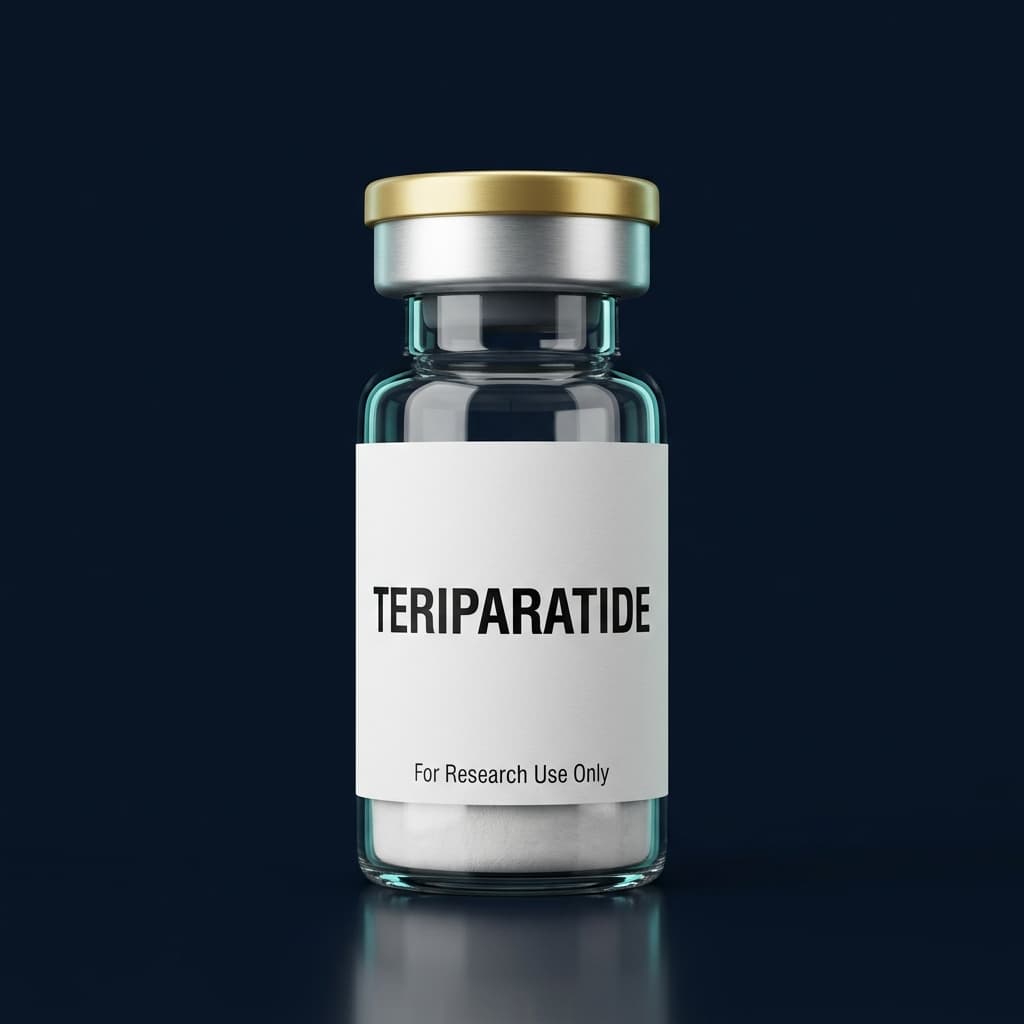
Teriparatide 10mg
≥97% (recombinant peptide fragment, by HPLC)
Voce PeptidesDB correlata (stesso proprietario)
peptidesdb.org
/p/teriparatide
119,99 €Disponibile
Solo 10 rimasti in stock — ordini presto
Consegna in EU in 3-7 giorni lavorativi
Spedizione gratuita oltre €200 · nessuna pratica doganale (UE) · tramite EU carrier network
1
Totale: 119,99 €
Spedizione gratuita sugli ordini superiori a €200
Research-grade Teriparatide. 99.4% avg purity, HPLC & MS verified. Lyophilized powder in sealed glass vial. For laboratory research use only. Not for human consumption.
Prezzi per volumeApplicato automaticamente al momento del pagamento
| Quantità | Prezzo unitario | Totale | Risparmio |
|---|---|---|---|
| 1 unit | 119,99 € | 119,99 € | -- |
| 3+ | 113,99 € | 341,97 € | 5% di sconto |
| 5+Più popolare | 107,99 € | 539,96 € | 10% di sconto |
| 10+ | 101,99 € | 1019,91 € | 15% di sconto |
Avviso importante
Questo prodotto è destinato esclusivamente all'uso di laboratorio e di ricerca. Non destinato all'uso umano o veterinario. Effettuando l'acquisto, conferma che questo prodotto sarà utilizzato esclusivamente per scopi di ricerca in vitro.
Ricostituzione necessaria
Questo peptide viene spedito liofilizzato (polvere secca) e richiede acqua batteriostatica per la ricostituzione prima dell'uso. L'acqua BAC è venduta separatamente.
Quando questo prodotto potrebbe non essere adatto alla sua ricerca
- ⚠Se la sua ricerca richiede materiale di grado GMP per applicazioni cliniche — i peptidi di grado da ricerca non sono destinati all'uso clinico.
- ⚠Se il suo laboratorio non dispone di un'adeguata conservazione a freddo (congelatore a -20°C) — la stabilità di questo peptide può essere compromessa a temperature più elevate.
- ⚠Se il protocollo del suo studio richiede standard di riferimento approvati dalla FDA — contatti USP o un fornitore di materiale di riferimento certificato.
Purezza HPLC
99,4% di purezza HPLC media sull'insieme dei nostri report di laboratorio pubblicati
Testato da terze parti
Report Janoshik pubblicato quando disponibile
Spedizione rapida
Spedizione in 24h, spedizione in tutta l'UE da €4.99
Testato da terze parti
Specifica del lotto del fornitore su ogni prodotto; report Janoshik indipendente su lotti selezionati
Ultima revisione: 2026-08-03
Informazioni su Teriparatide 10mg
About Teriparatide 10mg
What is Teriparatide?
Teriparatide is the 1-34 N-terminal fragment of parathyroid hormone — 34 amino acids that contain the full receptor-binding domain required for PTH1R (parathyroid hormone receptor 1) activation. The intact PTH molecule is 84 amino acids, but the first 34 are sufficient for complete biological activity at the receptor. Teriparatide is FDA-approved as Forteo for osteoporosis, and it's mechanistically distinct from every other osteoporosis agent in one critical way: it builds new bone rather than simply preventing bone loss.
The central research interest in teriparatide is the PTH administration paradox. Continuous PTH exposure — as in primary hyperparathyroidism — causes net bone resorption and calcium mobilization. But intermittent teriparatide dosing stimulates bone formation over resorption, resulting in increased bone density and improved bone architecture. The mechanism involves activation of canonical Wnt/beta-catenin signaling in osteoblasts, suppression of sclerostin (an osteocyte-derived Wnt inhibitor), and promotion of osteoblast differentiation and survival while transiently increasing RANKL-mediated osteoclast activity. Understanding exactly how the temporal pattern of PTH1R stimulation determines whether anabolic or catabolic pathways dominate is an active area of bone biology research, and teriparatide is the primary pharmacological tool for these studies.
Mechanism of Action
FAQ
Why does intermittent PTH build bone while continuous PTH breaks it down?
The paradox lies in the kinetics of receptor signaling and downstream gene expression. PTH1R is a GPCR that activates both cAMP/PKA and IP3/calcium pathways. Brief, pulsatile activation (as with once-daily teriparatide dosing) preferentially engages the cAMP pathway and activates Wnt signaling — pathways that promote osteoblast differentiation, survival, and bone formation. Sustained receptor activation (continuous exposure, as in hyperparathyroidism) downregulates cAMP signaling and shifts toward RANKL upregulation in osteoblasts, which recruits and activates osteoclasts (bone-resorbing cells) at a rate that exceeds formation. The same receptor, the same ligand — but timing determines whether net effect is anabolic or catabolic. This is one of the most instructive examples in pharmacology of how temporal dosing patterns fundamentally alter physiological outcomes.
What bone cell types does teriparatide act on?
PTH1R is expressed on osteoblasts (bone-forming cells) and osteocytes (the embedded mature bone cells that coordinate bone remodeling), but not meaningfully on osteoclasts (bone-resorbing cells). Teriparatide's direct effects are on osteoblast lineage cells. In osteoblasts, intermittent PTH1R activation drives Wnt/beta-catenin signaling and suppresses apoptosis, increasing their number and activity. In osteocytes, it suppresses sclerostin expression — sclerostin normally inhibits Wnt signaling in osteoblasts, so reducing it amplifies the anabolic effect. The indirect effects on osteoclasts (via RANKL/OPG changes in osteoblasts) produce a transient increase in resorption that's outweighed by the larger formation response under intermittent dosing conditions.
Research Overview
Specifications
Molecular weight~4,118 Da
SequencePTH residues 1-34 (34 amino acids)
Presentation10mg lyophilized
Purity≥98% HPLC
CAS52232-67-4
Storage
Store at -20°C. Reconstitute in sterile PBS or 0.9% saline; stable at 4°C for 2-3 weeks after reconstitution. The 1-34 fragment is more stable than full-length PTH but benefits from the same cold, light-protected storage conditions applied to other medium-size peptides.
Quality
HPLC purity analysis, mass spec identity confirmation, endotoxin testing on every batch. COA ships with every order. EU-based QC under CERTALAB S.R.L.
Product Specifications
- Purity: 99.4% avg (HPLC verified)
- Form: Lyophilized powder
- SKU: CP-TER10
Certificate of Analysis available for every batch. View COAs →
For research purposes only. Not for human consumption.
Riepilogo delle specifiche
FormaPolvere liofilizzata
Conservazione-20\u00B0C
Informazioni su Teriparatide 10mg
About Teriparatide 10mg
What is Teriparatide?
Teriparatide is the 1-34 N-terminal fragment of parathyroid hormone — 34 amino acids that contain the full receptor-binding domain required for PTH1R (parathyroid hormone receptor 1) activation. The intact PTH molecule is 84 amino acids, but the first 34 are sufficient for complete biological activity at the receptor. Teriparatide is FDA-approved as Forteo for osteoporosis, and it's mechanistically distinct from every other osteoporosis agent in one critical way: it builds new bone rather than simply preventing bone loss.
The central research interest in teriparatide is the PTH administration paradox. Continuous PTH exposure — as in primary hyperparathyroidism — causes net bone resorption and calcium mobilization. But intermittent teriparatide dosing stimulates bone formation over resorption, resulting in increased bone density and improved bone architecture. The mechanism involves activation of canonical Wnt/beta-catenin signaling in osteoblasts, suppression of sclerostin (an osteocyte-derived Wnt inhibitor), and promotion of osteoblast differentiation and survival while transiently increasing RANKL-mediated osteoclast activity. Understanding exactly how the temporal pattern of PTH1R stimulation determines whether anabolic or catabolic pathways dominate is an active area of bone biology research, and teriparatide is the primary pharmacological tool for these studies.
Mechanism of Action
FAQ
Why does intermittent PTH build bone while continuous PTH breaks it down?
The paradox lies in the kinetics of receptor signaling and downstream gene expression. PTH1R is a GPCR that activates both cAMP/PKA and IP3/calcium pathways. Brief, pulsatile activation (as with once-daily teriparatide dosing) preferentially engages the cAMP pathway and activates Wnt signaling — pathways that promote osteoblast differentiation, survival, and bone formation. Sustained receptor activation (continuous exposure, as in hyperparathyroidism) downregulates cAMP signaling and shifts toward RANKL upregulation in osteoblasts, which recruits and activates osteoclasts (bone-resorbing cells) at a rate that exceeds formation. The same receptor, the same ligand — but timing determines whether net effect is anabolic or catabolic. This is one of the most instructive examples in pharmacology of how temporal dosing patterns fundamentally alter physiological outcomes.
What bone cell types does teriparatide act on?
PTH1R is expressed on osteoblasts (bone-forming cells) and osteocytes (the embedded mature bone cells that coordinate bone remodeling), but not meaningfully on osteoclasts (bone-resorbing cells). Teriparatide's direct effects are on osteoblast lineage cells. In osteoblasts, intermittent PTH1R activation drives Wnt/beta-catenin signaling and suppresses apoptosis, increasing their number and activity. In osteocytes, it suppresses sclerostin expression — sclerostin normally inhibits Wnt signaling in osteoblasts, so reducing it amplifies the anabolic effect. The indirect effects on osteoclasts (via RANKL/OPG changes in osteoblasts) produce a transient increase in resorption that's outweighed by the larger formation response under intermittent dosing conditions.
Research Overview
Specifications
Molecular weight~4,118 Da
SequencePTH residues 1-34 (34 amino acids)
Presentation10mg lyophilized
Purity≥98% HPLC
CAS52232-67-4
Storage
Store at -20°C. Reconstitute in sterile PBS or 0.9% saline; stable at 4°C for 2-3 weeks after reconstitution. The 1-34 fragment is more stable than full-length PTH but benefits from the same cold, light-protected storage conditions applied to other medium-size peptides.
Quality
HPLC purity analysis, mass spec identity confirmation, endotoxin testing on every batch. COA ships with every order. EU-based QC under CERTALAB S.R.L.
Product Specifications
- Purity: 99.4% avg (HPLC verified)
- Form: Lyophilized powder
- SKU: CP-TER10
Certificate of Analysis available for every batch. View COAs →
For research purposes only. Not for human consumption.
Fiducia dei ricercatori
Perché i ricercatori scelgono CertaPeptides
Chi esegue effettivamente i test?
I lotti selezionati sono verificati in modo indipendente da Janoshik Analytical (Repubblica Ceca) e pubblicati sul portale pubblico Janoshik. Gli altri lotti vengono spediti con la specifica del lotto del fornitore. Consulti /coa per la bacheca pubblicata.
Visualizza i COA →Cosa succede se ricevo il lotto sbagliato?
Ogni etichetta del flacone riporta un numero di lotto che corrisponde a uno specifico certificato di analisi. Se un lotto non soddisfa la specifica, non lo spediamo — punto e basta.
Visualizza i COA →Da dove viene spedito?
Romania (UE). Siamo CERTALAB SRL, CUI 54169956, registrata ai fini IVA. Sameday per la Romania, GLS per la maggior parte delle destinazioni UE, TCE Worldwide per gli altri mercati transfrontalieri UE ed extra-UE (Regno Unito, Svizzera, Islanda, Israele, Serbia). Consegna in 1–15 giorni lavorativi a seconda della destinazione — la finestra esatta è indicata al momento del pagamento.
Dettagli sulla spedizione →Cosa succede se c'è un problema?
Ha un diritto di recesso di 14 giorni ai sensi dell'OUG 34/2014 (normativa rumena/UE sui consumatori), con possibilità di ricorso ad ANPC/ODR. Ci contatti all'indirizzo support@certapeptides.com.
Politica di reso →Informazioni sul prodotto
Questo prodotto è destinato esclusivamente a scopi di ricerca e sviluppo scientifico. È una sostanza chimica che non deve essere utilizzata come farmaco, medicinale, principio attivo o ingrediente in alcun prodotto destinato al consumo umano o animale. I ricercatori devono manipolare questo composto in conformità alle linee guida di biosicurezza del proprio istituto. Utilizzare esclusivamente in ambienti di laboratorio adeguatamente attrezzati e con dispositivi di protezione individuale appropriati.
Domande frequenti
Biblioteca di ricerca
Articoli di ricerca correlati
Spesso studiati insieme
Teriparatide 10mg119,99 €
1