For Research Purposes Only — This article discusses Thymosin Beta-4 (TB-500) as a laboratory research compound. Content is intended for researchers, scientists, and educators. Not for human consumption. Nothing here constitutes medical advice.
This post is a supporting entry in the CertaPeptides TB-500 cluster. The companion pillar post is BPC-157 + TB-500 Research Overview. For a full structural and biochemical monograph on TB-500, see our existing TB-500 Research Monograph. This post focuses specifically on the mechanistic pathways: G-actin sequestration, VEGF-driven angiogenesis, and the cardiac and dermal signalling cascades.
Introduction: Why Mechanism Matters for TB-500 Research
Thymosin Beta-4 (TB4), sold under the research label TB-500, is one of the most pleiotropic peptides in cell biology. Across the cell-biology literature it is studied for roles in actin regulation, cell migration, angiogenic signalling, and cardiac cell-survival pathways in preclinical model systems. Understanding why it does these things — through what molecular pathways — is not academic trivia. It determines how researchers design experiments, which model systems are appropriate, and how results should be interpreted.
This post maps the three primary mechanistic axes that appear consistently across the TB4 literature: G-actin sequestration, VEGF-mediated angiogenesis via HIF-1α stabilisation, and integrin-linked kinase (ILK)-dependent cardiac cell signalling.
Pathway 1: G-Actin Sequestration — The Primary Canonical Mechanism
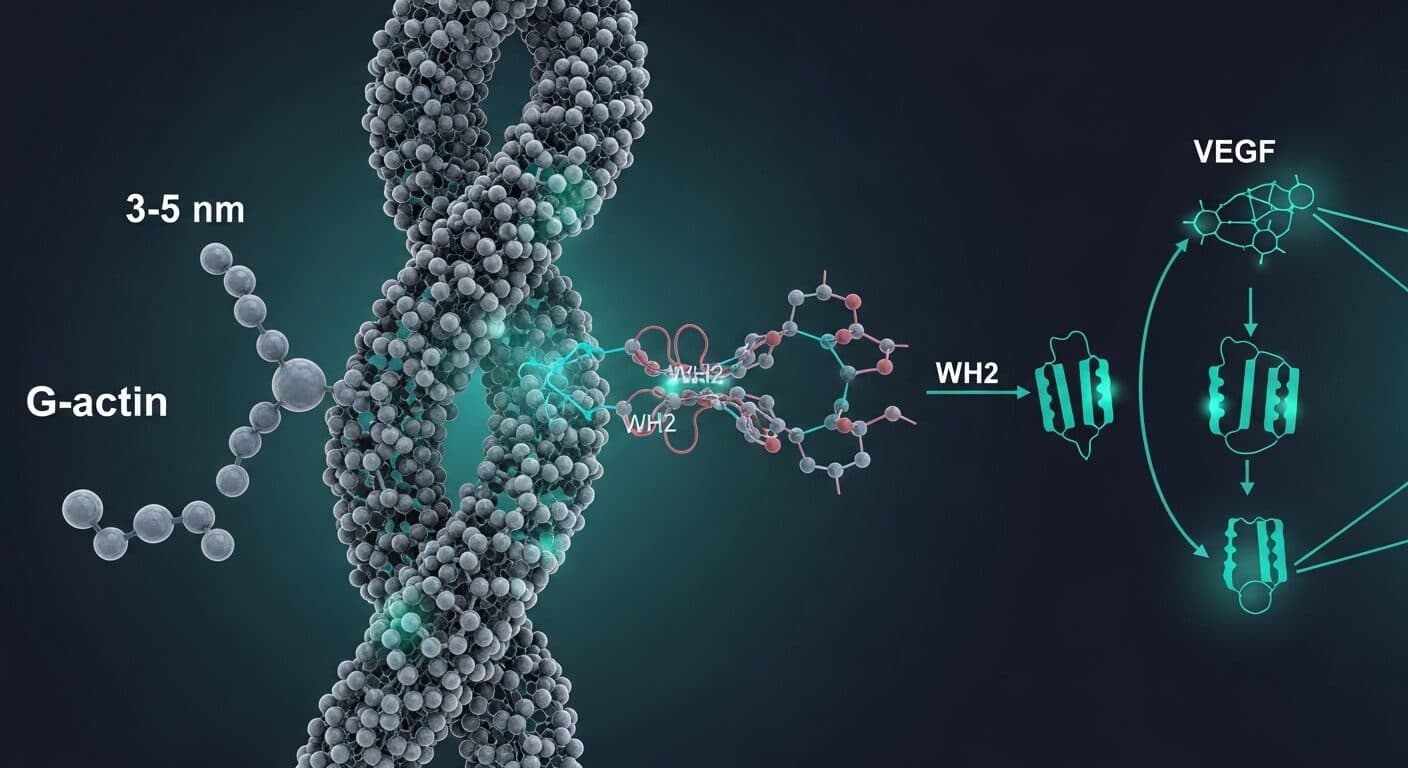
The foundational function of Thymosin Beta-4 is to serve as the major intracellular G-actin sequestering peptide in vertebrate cells. Hannappel’s 2007 review of beta-thymosins describes how TB4 maintains a reservoir of polymerization-competent actin monomers in the cytoplasm and nucleus, using its conserved WH2 (WASP-homology 2) domain to bind G-actin in a 1:1 stoichiometry (Hannappel, 2007).
The biological significance of this sequestration function is not passive storage. When cells receive signals to migrate, extend protrusions, or undergo division, the demand for free actin monomers spikes rapidly. TB4’s sequestration role means it effectively acts as an actin buffer, releasing monomers on demand to fuel protrusion formation (lamellipodia, filopodia) and cytoskeletal reorganisation. In cells with high TB4 expression, the G-actin reservoir is large, migration responses are faster, and migration kinetics in scratch assays are quicker.
This mechanism is studied in cell-migration and scratch assays. Malinda and colleagues (1999) linked TB4 to enhanced keratinocyte and fibroblast migration at the cellular level, driven by actin-cytoskeletal remodelling (Malinda et al., 1999).
At the structural level, the WH2 module of TB4 makes specific contacts with G-actin spanning the hydrophobic cleft between actin subdomains 1 and 3. The dissociation constant of the TB4:G-actin complex is in the low micromolar range — tight enough to sequester a significant monomeric pool, but loose enough to permit rapid release when nucleation factors (such as Arp2/3 or formins) compete for the available monomer supply. This kinetic tuning is central to the regulatory elegance of the G-actin sequestration mechanism.
Pathway 2: VEGF Upregulation via HIF-1alpha Stabilisation
A second mechanistic axis links TB4 directly to angiogenesis through the hypoxia-inducible factor (HIF) signalling pathway. Ock and colleagues demonstrated that TB4 stabilises HIF-1α protein in an oxygen-independent manner — a finding with significant implications for angiogenic signalling under normoxic conditions (Ock et al., 2012).
HIF-1α is the master transcriptional regulator of the cellular hypoxic response. Under low-oxygen conditions, HIF-1α accumulates and activates transcription of VEGF (vascular endothelial growth factor), the primary driver of new blood vessel formation. Under normoxic conditions, HIF-1α is rapidly degraded via prolyl hydroxylase-dependent ubiquitination. TB4’s ability to stabilise HIF-1α even under normal oxygen tension means it can activate VEGF expression — and therefore angiogenic programmes — without requiring hypoxic conditions. This makes TB4 a relevant tool for studying angiogenesis in normoxic in vitro systems.
The angiogenic effects of TB4 had been observed empirically before this mechanistic explanation was established. Malinda and colleagues had already shown in 1997 that TB4 stimulated directional migration of human umbilical vein endothelial cells (HUVECs), a standard in vitro angiogenesis assay, suggesting a direct role in vessel formation biology (Malinda et al., 1997). The HIF-1α stabilisation mechanism provides the upstream molecular explanation for these downstream vascular observations.
The combined picture is that TB4 is studied in angiogenesis through at least two complementary mechanisms: direct G-actin-dependent endothelial cell migration, and VEGF transcriptional upregulation via HIF-1α stabilisation. Scaffolds incorporating TB4 have been used to leverage these mechanisms in tissue engineering contexts — Ti and colleagues used a collagen-chitosan scaffold with controlled TB4 release to study the angiogenic signalling axis in vivo (Ti et al., 2015).
Pathway 3: Integrin-Linked Kinase Activation and Cardiac Cell Signalling
The cardiac literature on TB4 identifies a third mechanistic axis that operates independently of G-actin sequestration. In a landmark 2004 paper published in Nature, Bock-Marquette and colleagues showed that TB4 activates integrin-linked kinase (ILK) — a critical kinase in the PI3K/Akt cell survival pathway — and promotes cardiac cell migration and survival following simulated ischemic injury in both cultured cardiomyocytes and mouse models (Bock-Marquette et al., 2004).
ILK activation by TB4 leads to phosphorylation of Akt (also known as protein kinase B) and GSK-3β, engaging a canonical cell survival signal that reduces apoptosis in post-ischemic cardiomyocytes. This pathway is mechanistically distinct from G-actin sequestration and does not require TB4’s WH2 domain activity — suggesting that TB4 has independent functional modules, each engaging different downstream signals.
Smart and colleagues extended this understanding by demonstrating that TB4 stimulates epicardial progenitor cell migration and differentiation into coronary vessel-forming lineages in adult mouse cardiac explant models (Smart et al., 2007). The adult epicardium is normally quiescent, but TB4 appears capable of reactivating an embryonic-like migratory programme in epicardial cells — a finding with obvious relevance to cardiac cell biology. Pipes and Yang subsequently summarised the broader cardioprotection literature, summarising TB4’s antifibrotic, proangiogenic, and cytoprotective signalling roles across preclinical cardiac models (Pipes & Yang, 2016).
Where the Mechanisms Converge
The pathways described above — actin-dependent cell migration, HIF-1α/VEGF angiogenic signalling, and ILK-mediated cell-survival signalling — converge in cell-migration and angiogenesis model systems, which is why TB4 appears across much of the preclinical cell-biology literature.
What the Mechanism Does NOT Tell Us
Several critical limitations constrain interpretation of the TB4 mechanism literature. TB4 does not bind to a characterised membrane receptor in the classical GPCR or RTK sense — its intracellular activity is receptor-independent, and the biology of extracellular TB4 signalling remains incompletely mapped. Additionally, some TB4 effects in cardiovascular and renal models may be mediated by Ac-SDKP, a tetrapeptide cleavage product of TB4, rather than by TB4 itself — confounding mechanistic attribution when both parent peptide and metabolite are present.
Most importantly: the mechanistic data summarised here are preclinical. They describe what TB4 does in cell culture systems and animal models. They do not demonstrate equivalent mechanisms in human subjects under research or other conditions. TB-500 is not for human use and is supplied for laboratory research purposes only.
Key Takeaways
- TB-500 (Thymosin Beta-4) operates through at least three mechanistically distinct pathways: G-actin sequestration, VEGF upregulation via HIF-1α stabilisation, and ILK/Akt-dependent cardiac cell survival signalling.
- G-actin sequestration is the primary canonical function; it explains TB4’s pro-migratory effects across keratinocytes, fibroblasts, and endothelial cells.
- VEGF upregulation via HIF-1α stabilisation provides a mechanistic link between TB4 and angiogenesis independent of hypoxic conditions.
- ILK activation is a distinct cardiac-specific signalling axis identified by Bock-Marquette et al. (2004) that does not depend on actin sequestration.
Sources
- Hannappel E. beta-Thymosins. Ann N Y Acad Sci. 2007;1112:21-37. PMID: 17468232. DOI: 10.1196/annals.1415.018
- Malinda KM, Sidhu GS, Mani H, et al. Thymosin beta4 accelerates wound healing. J Invest Dermatol. 1999;113(3):364-8. PMID: 10469335. DOI: 10.1046/j.1523-1747.1999.00708.x
- Malinda KM, Goldstein AL, Kleinman HK. Thymosin beta 4 stimulates directional migration of human umbilical vein endothelial cells. FASEB J. 1997;11(6):474-81. PMID: 9194528. DOI: 10.1096/fasebj.11.6.9194528
- Ock MS, Song KS, Kleinman H, Cha HJ. Thymosin beta4 stabilizes hypoxia-inducible factor-1alpha protein in an oxygen-independent manner. Ann N Y Acad Sci. 2012;1270:46-53. PMID: 23045974. DOI: 10.1111/j.1749-6632.2012.06657.x
- Ti D, Hao H, Xia L, et al. Controlled release of thymosin beta 4 using a collagen-chitosan sponge scaffold augments cutaneous wound healing and increases angiogenesis in diabetic rats with hindlimb ischemia. Tissue Eng Part A. 2015;21(3-4):541-9. PMID: 25204972. DOI: 10.1089/ten.TEA.2013.0750
- Bock-Marquette I, Saxena A, White MD, Dimaio JM, Srivastava D. Thymosin beta4 activates integrin-linked kinase and promotes cardiac cell migration, survival and cardiac repair. Nature. 2004;432(7016):466-72. PMID: 15565145. DOI: 10.1038/nature03000
- Smart N, Risebro CA, Melville AA, et al. Thymosin beta-4 is essential for coronary vessel development and promotes neovascularization via adult epicardium. Ann N Y Acad Sci. 2007;1112:171-88. PMID: 17495252. DOI: 10.1196/annals.1415.000
- Pipes GT, Yang J. Cardioprotection by Thymosin Beta 4. Vitam Horm. 2016;102:209-26. PMID: 27450736. DOI: 10.1016/bs.vh.2016.04.004
- Kleinman HK, Sosne G. Thymosin beta4 Promotes Dermal Healing. Vitam Horm. 2016;102:251-75. PMID: 27450738. DOI: 10.1016/bs.vh.2016.04.005
- Sosne G, Dunn SP, Kim C. Thymosin beta4 significantly improves signs and symptoms of severe dry eye in a phase 2 randomized trial. Cornea. 2015;34(5):491-6. PMID: 25826322. DOI: 10.1097/ICO.0000000000000379
Disclaimer: This article is for educational and research purposes only. The information provided does not constitute medical advice. TB-500 (Thymosin Beta-4) is not approved for human therapeutic use.
Verify before you research
Every compound we list ships against a supplier batch specification, and selected lots carry an independent third-party COA.