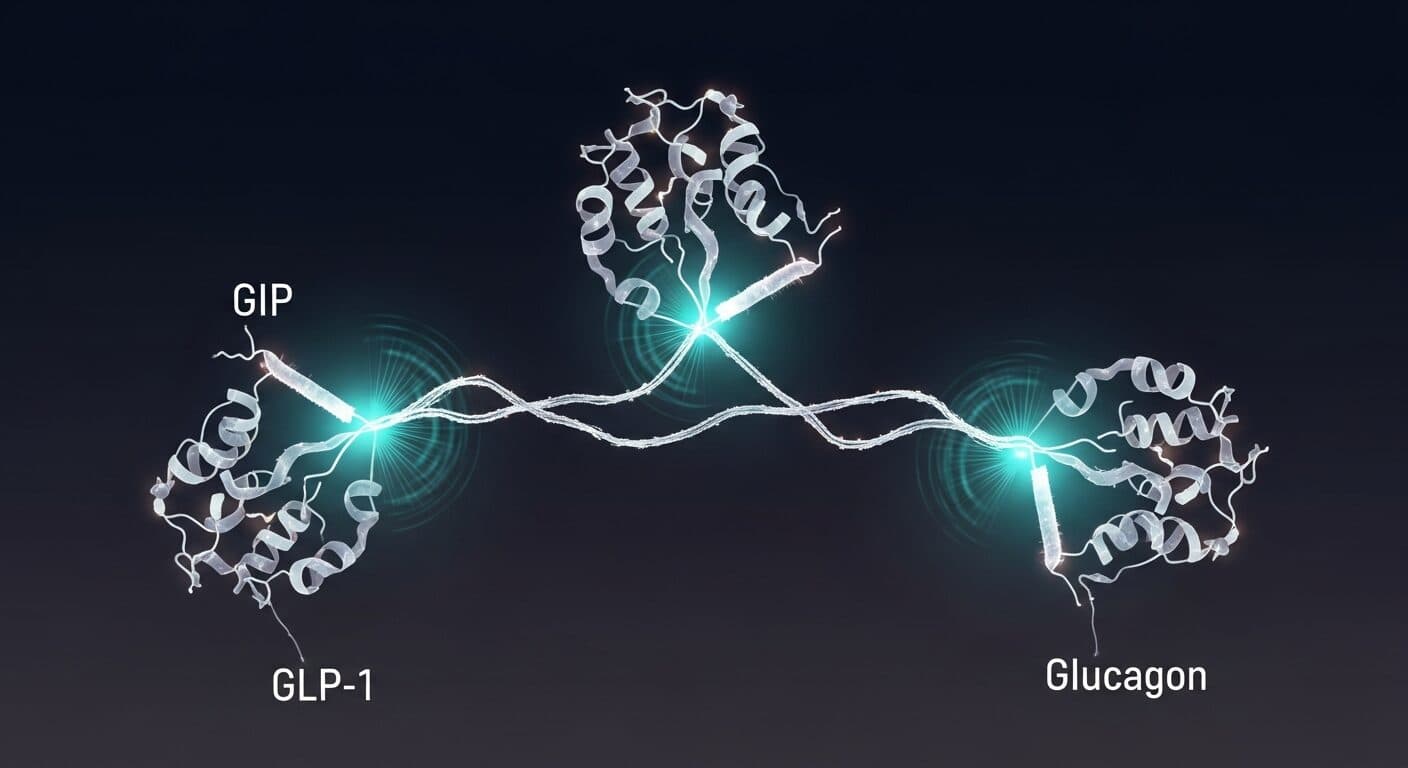
Retatrutide: How Triple Receptor Agonism Works at the Molecular Level
A detailed research overview of how retatrutide (LY3437943) simultaneously engages GIP, GLP-1, and glucagon receptors — and why this triple mechanism represents a different approach from single and dual agonist peptides. For research purposes only.
Introduction to triple receptor agonism
The concept of targeting multiple metabolic hormone receptors with a single peptide molecule has reshaped how researchers think about metabolic regulation. While single receptor agonists such as semaglutide (targeting GLP-1R alone) and dual agonists like tirzepatide (targeting GIP and GLP-1 receptors) have generated significant research interest, retatrutide occupies a distinct position: it is the first peptide to reach advanced clinical evaluation as a simultaneous agonist of three receptor systems — the glucose-dependent insulinotropic polypeptide receptor (GIPR), the glucagon-like peptide-1 receptor (GLP-1R), and the glucagon receptor (GCGR).[1]
This triple agonist approach is grounded in a straightforward biological premise. Each of these three receptors governs a different facet of metabolic regulation. GLP-1R activation has been extensively studied for its role in incretin signaling and appetite modulation. GIPR activation contributes to nutrient sensing and lipid metabolism. Glucagon receptor activation drives hepatic energy expenditure and lipid oxidation. Research shows engaging all three pathways simultaneously may produce metabolic effects that are not merely additive but potentially synergistic, as the downstream signaling cascades interact in ways that reinforce one another.[5]
Originally designated LY3437943 during preclinical development at the drug sponsor, retatrutide was rationally designed as a 39-amino-acid peptide built on a GIP receptor backbone, with modifications engineered to confer agonist activity at GLP-1 and glucagon receptors simultaneously. This article examines the molecular underpinnings of that design — how each receptor functions individually, why triple agonism differs mechanistically from dual or single approaches, and what published research has revealed about retatrutide’s pharmacological profile. All information presented here is for research purposes only. For more background on this peptide, see our overview of retatrutide as a triple agonist peptide advancing metabolic research.
How each receptor works individually
To understand why triple agonism matters, it is necessary to examine what each receptor does on its own. All three belong to the class B1 subfamily of G protein-coupled receptors (GPCRs), and all three signal primarily through the Gs protein pathway, increasing intracellular cyclic adenosine monophosphate (cAMP) upon activation. However, their tissue distribution, endogenous ligands, and downstream physiological effects are distinct.
The GIP receptor: nutrient sensing and lipid metabolism
Glucose-dependent insulinotropic polypeptide (GIP) is secreted by K-cells in the upper small intestine in response to nutrient ingestion, particularly fats and carbohydrates. The GIP receptor (GIPR) is expressed in pancreatic beta cells, adipose tissue, bone, and the central nervous system.
Studies show that GIPR activation in pancreatic beta cells potentiates glucose-stimulated insulin secretion in a glucose-dependent manner, meaning its insulinotropic effect is naturally attenuated when blood glucose levels are low. This glucose-dependency is an important feature from a safety perspective in research models. Beyond its pancreatic role, studies suggest that GIP signaling in adipose tissue influences lipid storage and mobilization, and emerging research points to GIPR activity in the brain as a contributor to appetite regulation and energy balance.[3]
In the context of retatrutide, GIP receptor activation is the strongest component of the molecule’s pharmacology. Preclinical binding assays have indicated that retatrutide exhibits the highest relative potency at GIPR compared to its activity at GLP-1R and GCGR, which is consistent with its GIP-derived peptide backbone.[3]
The GLP-1 receptor: the incretin effect and satiety signaling
Glucagon-like peptide-1 (GLP-1) is produced by intestinal L-cells and is perhaps the most extensively studied incretin hormone. GLP-1 receptor (GLP-1R) activation has several well-characterized effects in research models: potentiation of glucose-stimulated insulin secretion, suppression of glucagon secretion from pancreatic alpha cells, delayed gastric emptying, and centrally mediated appetite reduction.
The GLP-1 receptor is expressed in pancreatic islets, the gastrointestinal tract, kidneys, heart, and multiple brain regions including the hypothalamus and brainstem — areas critically involved in appetite and energy homeostasis. Studies show GLP-1R agonism in the hypothalamic arcuate nucleus and the nucleus tractus solitarius (NTS) in the brainstem activates pro-opiomelanocortin (POMC) neurons and inhibits neuropeptide Y/agouti-related peptide (NPY/AgRP) neurons, shifting the balance toward reduced food intake.[5]
The clinical significance of GLP-1R agonism is well established through approved research compounds like semaglutide and liraglutide. In retatrutide, GLP-1R agonism provides the incretin and satiety signaling component that complements the metabolic effects driven by the other two receptors.
The glucagon receptor: hepatic glucose and lipid metabolism
The glucagon receptor (GCGR) has historically received less attention than GLP-1R in metabolic peptide research, partly because glucagon’s primary known role — raising blood glucose by stimulating hepatic glycogenolysis and gluconeogenesis — seems counterproductive in contexts where glucose lowering is desired. However, research over the past decade has revealed that GCGR activation produces metabolic effects beyond glucose mobilization that are relevant to energy expenditure and lipid metabolism.
Studies show GCGR activation in the liver increases fatty acid oxidation, reduces hepatic lipid accumulation, stimulates thermogenesis, and increases resting energy expenditure. The glucagon receptor is predominantly expressed in the liver and kidney, but also in the heart, gastrointestinal smooth muscle, brain, and adipose tissue. In the context of a multi-receptor agonist, research suggests that the catabolic and energy-expending properties of glucagon receptor signaling can complement the anorexigenic effects of GLP-1R and the nutrient-sensing effects of GIPR, provided that the hyperglycemic tendency of isolated glucagon action is counterbalanced by the insulin-promoting effects of GIP and GLP-1.[3]
Research Note: The inclusion of glucagon receptor agonism is the key differentiator between triple agonists like retatrutide and dual agonists like tirzepatide. Preclinical studies suggest that GCGR activation contributes to increased energy expenditure via hepatic lipid oxidation and thermogenesis — metabolic pathways not substantially engaged by GLP-1 or GIP receptor activation alone.[5]
Why triple agonism differs from dual and single approaches
The progression from single to dual to triple receptor agonism represents an evolution in peptide design philosophy. Each step adds a distinct metabolic pathway, but the interaction between these pathways is not simply additive — research suggests that combining receptor activities can produce effects that exceed what any individual agonist could achieve alone.
Single agonists: GLP-1R alone
Semaglutide, the most widely studied single GLP-1R agonist, primarily reduces caloric intake through centrally mediated appetite suppression and delayed gastric emptying. Research in phase 3 trials has documented significant body weight reductions in study populations. However, single GLP-1R agonism does not substantially increase energy expenditure and does not directly target hepatic lipid metabolism.
Dual agonists: GIP + GLP-1R
Tirzepatide targets both GIPR and GLP-1R. Published research suggests that the addition of GIP receptor agonism to GLP-1R agonism enhances insulin secretion and may improve the tolerability profile compared to GLP-1R agonism alone, potentially by modulating the rate of gastric emptying delay. Phase 3 data have shown body weight reductions exceeding those observed with semaglutide. However, tirzepatide does not engage the glucagon receptor and therefore does not access the energy expenditure and hepatic lipid oxidation pathways associated with GCGR activation.
Triple agonists: GIP + GLP-1R + GCGR
Retatrutide adds glucagon receptor agonism to the dual incretin mechanism. The foundational preclinical work on unimolecular triple agonists, published by Finan et al. in 2015, demonstrated in rodent models that balanced triple agonism at GLP-1R, GIPR, and GCGR was superior to dual co-agonists and best-in-class mono-agonists for reducing body weight, improving glycemic parameters, and reversing hepatic steatosis.[5]
Studies show the potential synergy arises from complementary mechanisms: GLP-1R and GIPR activation reduce caloric intake and enhance insulin secretion (which counterbalances glucagon’s hyperglycemic potential), while GCGR activation increases energy expenditure by promoting hepatic fatty acid oxidation and thermogenesis. The net effect observed in research models is that more energy is being expended while less is being consumed — a dual-axis approach that neither single nor dual agonists fully achieve.
| Property | Semaglutide (Single) | Tirzepatide (Dual) | Retatrutide (Triple) |
|---|---|---|---|
| Receptors Targeted | GLP-1R | GIPR + GLP-1R | GIPR + GLP-1R + GCGR |
| Appetite Suppression | Yes (central GLP-1R) | Yes (central GLP-1R + GIPR) | Yes (central GLP-1R + GIPR) |
| Insulin Potentiation | GLP-1R mediated | GLP-1R + GIPR mediated | GLP-1R + GIPR mediated |
| Energy Expenditure | Minimal direct effect | Minimal direct effect | Increased via GCGR |
| Hepatic Lipid Oxidation | Indirect | Indirect | Direct via GCGR |
| Administration | Weekly | Weekly | Weekly |
Retatrutide’s molecular structure: one peptide, three receptor families
Retatrutide is a 39-amino-acid synthetic peptide. Its design began with a GIP receptor agonist backbone — a peptide sequence that has native high affinity for GIPR. From this starting scaffold, specific amino acid substitutions were introduced at key positions to confer agonist activity at GLP-1R and GCGR without abolishing the native GIP receptor binding.[3]
Structural basis of multi-receptor binding
Cryo-electron microscopy (cryo-EM) studies published in 2024 in Cell Discovery resolved the structures of retatrutide bound to each of its three target receptors coupled to Gs protein complexes. These structural data revealed several important features of how a single peptide achieves agonism at three distinct GPCRs.[4]
Studies show that the C-terminal region of retatrutide interacts with the extracellular domain (ECD) of each receptor, and these interactions are largely conserved across all three receptors — the peptide’s C-terminus is a common anchor. The N-terminal region, by contrast, inserts into the transmembrane domain (TMD) helical bundle and makes receptor-specific contacts that are critical for activating the intracellular signaling cascade. The middle region of the peptide is a linker that can be optimized for tuning the relative potency at each receptor.[4]
The cryo-EM data also highlighted the role of extracellular loop 1 (ECL1) in receptor-specific conformational responses. Each receptor’s ECL1 adopts a distinct conformation upon retatrutide binding, and these differences contribute to the varying degrees of activation at each receptor. This structural insight provides a molecular template for designing future multi-agonist peptides with customized receptor potency profiles.
Relative potency across receptors
In vitro functional assays published by Coskun et al. demonstrated that retatrutide exhibits the highest relative potency at GIPR, followed by balanced but lower potency at GLP-1R and GCGR. This potency profile is a deliberate design choice: the strong GIPR activity maintains the GIP-derived backbone’s metabolic effects, while the GLP-1R and GCGR activities are calibrated to provide meaningful agonism without triggering excessive activation of any single pathway.[3]
All three receptors signal through the Gs-adenylyl cyclase-cAMP pathway upon activation. The downstream cAMP elevation activates protein kinase A (PKA), which phosphorylates cellular targets specific to each tissue type — insulin granule exocytosis in beta cells, lipase activation in hepatocytes, or neuropeptide modulation in hypothalamic neurons. The tissue-specific expression of each receptor ensures that retatrutide’s triple agonism produces distinct effects in different organs.
Pharmacokinetics: why weekly administration works
Native GIP, GLP-1, and glucagon peptides have extremely short circulating half-lives — typically two to seven minutes — due to rapid enzymatic degradation by dipeptidyl peptidase-4 (DPP-4) and neutral endopeptidases, followed by renal clearance. Retatrutide achieves a dramatically extended half-life of approximately six days through two key structural modifications.
Fatty acid acylation and albumin binding
Retatrutide is conjugated to a C20 fatty diacid moiety. This lipid side chain binds reversibly to serum albumin in the bloodstream, creating a circulating reservoir of albumin-bound peptide. Because albumin has a half-life of approximately 19 days in humans and the albumin-peptide complex is too large for glomerular filtration, this binding dramatically slows renal clearance. The peptide dissociates from albumin gradually, maintaining steady-state plasma concentrations suitable for once-weekly subcutaneous administration.[3]
DPP-4 resistance
In addition to albumin binding, specific amino acid modifications at the N-terminus of retatrutide confer resistance to DPP-4 cleavage. DPP-4 is the primary enzyme responsible for inactivating native GLP-1 and GIP by cleaving the two N-terminal amino acids. By incorporating non-native amino acids at the DPP-4 cleavage site, retatrutide resists this enzymatic degradation while retaining the ability to activate its target receptors.
Subcutaneous absorption kinetics
Following subcutaneous injection, retatrutide forms a depot at the injection site. The fatty acid moiety promotes self-association and slow absorption into the systemic circulation. Research from phase 1 and phase 2 trials indicates that steady-state plasma concentrations are typically reached after approximately four to five weekly doses, with predictable dose-proportional pharmacokinetics across the studied dose range.[2]
Researchers interested in peptide handling may find our reconstitution guide and peptide calculator helpful for general reference on lyophilized peptide preparation.
Published research: key clinical and preclinical findings
Preclinical discovery: coskun et al. 2022 (Cell metabolism)
The foundational preclinical and early clinical data for retatrutide (then designated LY3437943) were published by Coskun et al. in Cell Metabolism in September 2022. This study described the peptide’s discovery, in vitro receptor pharmacology, and preclinical efficacy in obese mouse models.[3]
Research from this study indicated that in diet-induced obese (DIO) mice, LY3437943 administration produced body weight reductions that were significantly greater than those achieved by matched doses of dual GIP/GLP-1 agonists or selective GLP-1R agonists. The study established that the weight reduction mechanism involved two complementary components: GIPR and GLP-1R-driven reductions in caloric intake, and GCGR-mediated increases in energy expenditure, as measured by indirect calorimetry. The study also demonstrated improved glycemic parameters and reductions in hepatic lipid content in the treated animals.
Phase 2 obesity trial: jastreboff et al. 2023 (NEJM)
The phase 2 clinical trial evaluating retatrutide in participants with obesity (without type 2 diabetes) was published in the New England Journal of Medicine in August 2023. This randomized, double-blind, placebo-controlled trial enrolled approximately 338 adults and evaluated multiple dose levels over 48 weeks.[1]
The published results indicated dose-dependent body weight reductions across all retatrutide dose groups. The least-squares mean percentage change in body weight at 48 weeks was reported as -8.7% in the 1 mg group, -17.1% in the combined 4 mg group, -22.8% in the combined 8 mg group, and -24.2% in the 12 mg group, compared to -2.1% in the placebo group. The most commonly reported adverse events were gastrointestinal in nature, including nausea, diarrhea, vomiting, and constipation, which is consistent with the known pharmacology of incretin-based peptides.
Phase 2 type 2 diabetes trial: rosenstock et al. 2023 (The lancet)
A parallel phase 2 trial evaluating retatrutide in participants with type 2 diabetes was published in The Lancet in August 2023. This randomized, double-blind, placebo-controlled and active-controlled trial included a dulaglutide comparator arm and evaluated retatrutide over 36 weeks.[2]
Research from this trial indicated that retatrutide produced dose-dependent reductions in HbA1c from baseline, with improvements in glycemic control observed across all dose groups. Body weight reductions in this population with type 2 diabetes were also dose-dependent, reaching up to -16.9% in the highest dose group at 36 weeks. The safety profile was generally consistent with the obesity trial findings.
Structural biology: cryo-eM studies (Cell discovery 2024)
In 2024, cryo-EM structures of retatrutide bound to each of its three target receptors were published in Cell Discovery by Sun et al., providing the first detailed molecular-level visualization of how a single peptide achieves simultaneous agonism at GLP-1R, GIPR, and GCGR.[4]
These structural studies revealed that retatrutide adopts a largely alpha-helical conformation when bound to all three receptors, and that the conserved C-terminal interactions with receptor ECDs provide a common binding mode, while receptor-specific N-terminal contacts and ECL1 conformational differences account for the differential potency at each receptor. These findings provide a structural roadmap for future rational design of multi-receptor agonist peptides.
Key takeaways
- Three receptors, three mechanisms: Retatrutide simultaneously activates GIPR (nutrient sensing, insulin potentiation), GLP-1R (incretin effect, appetite modulation), and GCGR (hepatic energy expenditure, lipid oxidation). Each receptor contributes a distinct metabolic pathway.
- Glucagon receptor agonism is the differentiator: The inclusion of GCGR activity distinguishes triple agonists from dual agonists (tirzepatide) and single agonists (semaglutide), adding an energy expenditure component that the other approaches do not directly engage.
- Rational molecular design: Retatrutide is a 39-amino-acid peptide built on a GIP backbone with engineered substitutions for GLP-1R and GCGR activity. Cryo-EM structures show that N-terminal receptor-specific contacts and ECL1 conformational differences enable binding to three distinct GPCRs.
- Extended pharmacokinetics: C20 fatty diacid acylation enables albumin binding, extending the half-life to approximately six days and permitting once-weekly subcutaneous administration.
- Published phase 2 data: Dose-dependent effects have been reported in both obesity (Jastreboff et al., NEJM 2023) and type 2 diabetes (Rosenstock et al., Lancet 2023) populations, building on preclinical data showing complementary mechanisms of reduced caloric intake and increased energy expenditure.
- Ongoing research: Phase 3 clinical trials are underway to further characterize the efficacy and safety profile of retatrutide across multiple metabolic conditions.
For researchers exploring retatrutide, CertaPeptides offers research-grade retatrutide with certificates of analysis and purity documentation.
Frequently asked questions
What does “triple receptor agonist” mean in the context of retatrutide?
A triple receptor agonist is a single molecule that activates three different receptor targets. Retatrutide activates the GIP receptor, the GLP-1 receptor, and the glucagon receptor simultaneously. Each receptor governs different aspects of metabolic regulation — nutrient sensing, incretin signaling, and hepatic energy metabolism, respectively. The term “agonist” means the molecule binds to and activates these receptors, as opposed to blocking them. All research with retatrutide is conducted for investigational purposes only.
How does retatrutide differ from tirzepatide and semaglutide at the molecular level?
Semaglutide is a selective GLP-1 receptor agonist — it activates only one receptor. Tirzepatide is a dual GIP/GLP-1 receptor agonist that targets two receptors. Retatrutide adds a third target, the glucagon receptor (GCGR). Research shows this additional receptor activation pathway drives increased energy expenditure through hepatic lipid oxidation and thermogenesis — metabolic effects not substantially engaged by GLP-1R or GIPR agonism alone. All three peptides use fatty acid acylation for extended half-life, but their receptor binding profiles and downstream effects differ substantially.
Why is glucagon receptor activation included if glucagon raises blood glucose?
This is one of the most frequently raised questions about triple agonist design. While glucagon does stimulate hepatic glucose production, research indicates that in the context of simultaneous GIP and GLP-1 receptor agonism, the insulin-promoting and glucose-lowering effects of these two receptors counterbalance glucagon’s hyperglycemic tendency. Meanwhile, the beneficial aspects of GCGR activation — increased fatty acid oxidation, reduced hepatic lipid accumulation, and enhanced thermogenesis — are preserved. Published preclinical and phase 2 clinical data suggest that this balance is achievable with appropriate dosing in research settings.
What is the half-life of retatrutide, and how is it achieved?
Studies show that retatrutide has a half-life of approximately six days, which supports once-weekly subcutaneous administration in research protocols. This extended duration is achieved through two structural modifications: conjugation of a C20 fatty diacid moiety that binds reversibly to serum albumin (slowing renal clearance), and amino acid substitutions at the N-terminus that confer resistance to DPP-4 enzymatic degradation. These pharmacokinetic properties have been characterized in phase 1 and phase 2 clinical research.
What were the key findings from the phase 2 clinical trials of retatrutide?
Two phase 2 trials were published in 2023. The obesity trial (Jastreboff et al., NEJM) reported dose-dependent body weight reductions up to -24.2% at 48 weeks in the 12 mg group, compared to -2.1% with placebo. The type 2 diabetes trial (Rosenstock et al., The Lancet) reported dose-dependent HbA1c reductions and body weight reductions up to -16.9% at 36 weeks. Gastrointestinal adverse events (nausea, diarrhea, vomiting) were the most commonly reported side effects, consistent with incretin-based pharmacology. These findings are from controlled clinical research and are for informational purposes only.
How does retatrutide’s molecular structure enable binding to three different receptors?
Retatrutide is a 39-amino-acid peptide designed on a GIP receptor agonist backbone. Cryo-EM structural studies published in 2024 revealed that the peptide’s C-terminal region makes conserved interactions with the extracellular domains of all three receptors, serving as a common anchor. The N-terminal region, which inserts into each receptor’s transmembrane domain, makes receptor-specific contacts that drive activation. Different conformations of extracellular loop 1 (ECL1) on each receptor contribute to differential signaling. This structural architecture allows a single peptide chain to achieve distinct agonist activity at three separate GPCR targets.
What is the current stage of retatrutide clinical development?
As of early 2026, retatrutide has completed phase 2 clinical trials in both obesity and type 2 diabetes populations, with results published in the New England Journal of Medicine and The Lancet respectively. Phase 3 trials are underway to further evaluate its efficacy and safety profile. Retatrutide is not currently approved for any clinical use and remains an investigational compound available for research purposes only.
Related CertaPeptides resources
References
- Jastreboff AM, Kaplan LM, Frías JP, et al. Triple-hormone-receptor agonist retatrutide for obesity — a phase 2 trial. New England Journal of Medicine. 2023;389(6):514–526. DOI: 10.1056/NEJMoa2301972 | PMID: 37385275
- Rosenstock J, Frías JP, Jastreboff AM, et al. Retatrutide, a GIP, GLP-1 and glucagon receptor agonist, for people with type 2 diabetes: a randomised, double-blind, placebo and active-controlled, parallel-group, phase 2 trial conducted in the USA. The Lancet. 2023;402(10401):529–544. DOI: 10.1016/S0140-6736(23)01053-X
- Coskun T, Urva S, Roell WC, et al. LY3437943, a novel triple glucagon, GIP, and GLP-1 receptor agonist for glycemic control and weight loss: from discovery to clinical proof of concept. Cell Metabolism. 2022;34(9):1234–1247.e9. DOI: 10.1016/j.cmet.2022.07.013 | PMID: 36041438
- Sun W, Chen L, Zhou J, et al. Structural insights into the triple agonism at GLP-1R, GIPR and GCGR manifested by retatrutide. Cell Discovery. 2024;10:72. DOI: 10.1038/s41421-024-00700-0
- Finan B, Yang B, Ottaway N, et al. A rationally designed monomeric peptide triagonist corrects obesity and diabetes in rodents. Nature Medicine. 2015;21(1):27–36. DOI: 10.1038/nm.3761 | PMID: 25485909
This article is provided for educational and informational purposes only and is intended exclusively for qualified researchers. All content pertains to investigational compounds intended for research purposes only. Retatrutide (LY3437943) is not approved by the FDA, EMA, or any other regulatory body for human therapeutic use. Nothing in this article constitutes medical advice, a recommendation for treatment, or an endorsement of any specific therapy. CertaPeptides does not make any claims regarding the therapeutic efficacy or safety of retatrutide for any condition in humans. The research findings discussed herein are drawn from published peer-reviewed literature and are presented without modification or clinical interpretation. Researchers should consult applicable institutional guidelines, ethics boards, and regulatory frameworks before conducting any research involving peptide compounds. CertaPeptides products are sold strictly for in vitro research and laboratory use. Not for human consumption.