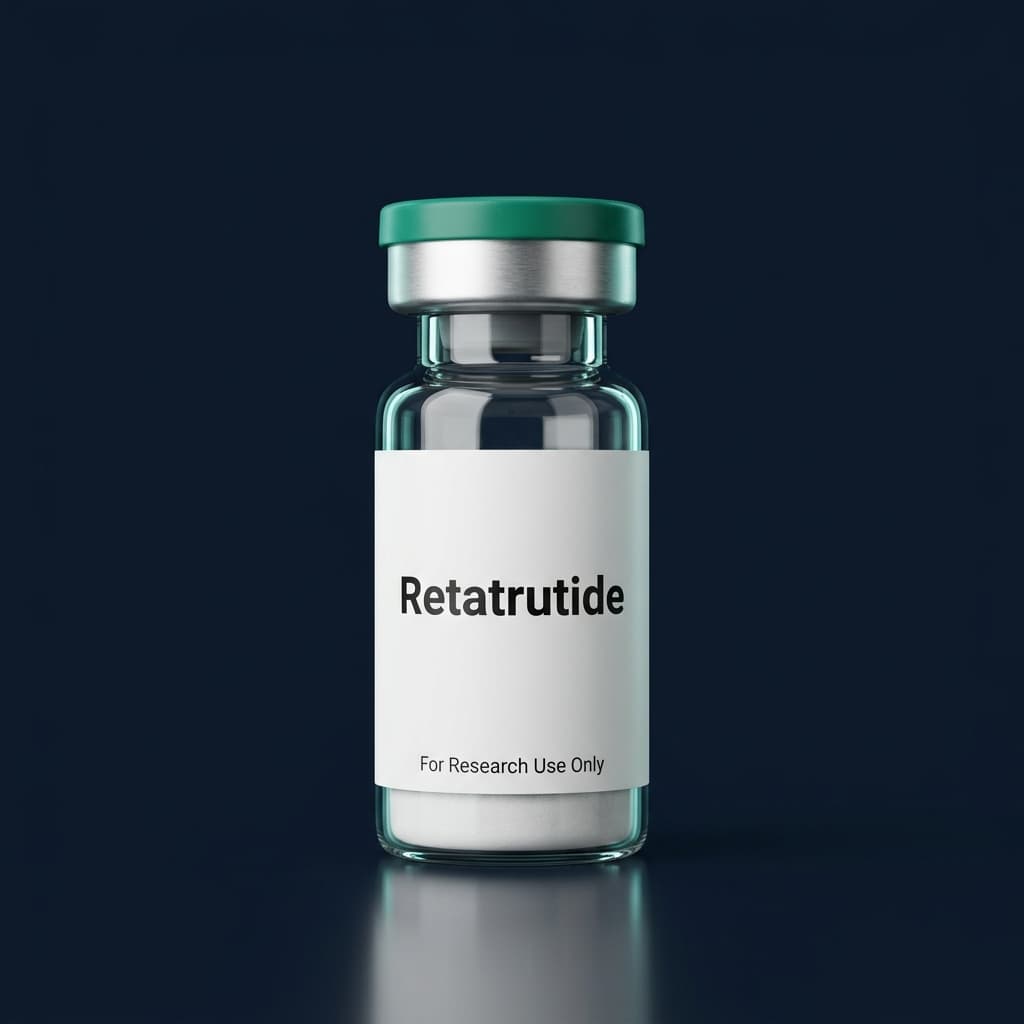
This comprehensive guide covers research-grade dosing protocols for the three major GLP-1 receptor agonists: Semaglutide, Tirzepatide, and Retatrutide. All information is provided for laboratory research purposes only and should not be interpreted as medical advice.
Understanding GLP-1 Receptor Agonists
GLP-1 (Glucagon-Like Peptide-1) receptor agonists are a class of incretin mimetics that have been extensively studied for their effects on glucose metabolism, appetite regulation, and body composition. The three compounds covered in this guide represent different generations of this drug class:
- Semaglutide — Selective GLP-1 receptor agonist (single-acting)
- Tirzepatide — Dual GIP/GLP-1 receptor agonist (dual-acting)
- Retatrutide — Triple GLP-1/GIP/Glucagon receptor agonist (triple-acting)
Semaglutide Research Dosing Protocol
Semaglutide is typically administered once weekly in research settings. The standard titration schedule follows a gradual dose escalation over 16-20 weeks:
Standard Titration Schedule
| Week | Dose | Frequency | Notes |
|---|---|---|---|
| Weeks 1-4 | 0.25 mg | Once weekly | Initial titration |
| Weeks 5-8 | 0.5 mg | Once weekly | First dose increase |
| Weeks 9-12 | 1.0 mg | Once weekly | Standard maintenance dose |
| Weeks 13-16 | 1.7 mg | Once weekly | Increased dose if needed |
| Week 17+ | 2.4 mg | Once weekly | Maximum studied dose |
Reconstitution
Reconstitute lyophilized Semaglutide with bacteriostatic water. For a 5mg vial with 2ml BAC water, the concentration is 2.5mg/ml. Use our Reconstitution Calculator for precise dilution calculations.
Tirzepatide Research Dosing Protocol
Tirzepatide follows a similar weekly injection schedule but with different dose targets due to its dual-action mechanism on both GIP and GLP-1 receptors.
Standard Titration Schedule
| Week | Dose | Frequency | Notes |
|---|---|---|---|
| Weeks 1-4 | 2.5 mg | Once weekly | Initial titration |
| Weeks 5-8 | 5.0 mg | Once weekly | First increase |
| Weeks 9-12 | 7.5 mg | Once weekly | Intermediate dose |
| Weeks 13-16 | 10.0 mg | Once weekly | Standard target dose |
| Week 17+ | 15.0 mg | Once weekly | Maximum studied dose |
Reconstitution
For a 10mg vial reconstituted with 2ml BAC water, the concentration is 5mg/ml. Tirzepatide is stable for up to 28 days when stored at 2-8C after reconstitution.
Retatrutide Research Dosing Protocol
Retatrutide is the newest of the three compounds and the first triple-acting agonist (GLP-1/GIP/Glucagon). Its titration schedule reflects the Phase 2 trial protocols published in the New England Journal of Medicine.
Standard Titration Schedule
| Week | Dose | Frequency | Notes |
|---|---|---|---|
| Weeks 1-4 | 2.0 mg | Once weekly | Initial titration |
| Weeks 5-8 | 4.0 mg | Once weekly | First increase |
| Weeks 9-12 | 8.0 mg | Once weekly | Intermediate dose |
| Week 13+ | 12.0 mg | Once weekly | Maximum studied dose (Phase 2) |
Reconstitution
For a 10mg vial reconstituted with 2ml BAC water, the concentration is 5mg/ml. Retatrutide should be stored at -20C in lyophilized form and 2-8C after reconstitution.
General Research Guidelines
Storage Recommendations
- Lyophilized (powder): Store at -20C for long-term, 2-8C for short-term (up to 3 months)
- Reconstituted: Store at 2-8C, use within 28 days
- Avoid: Repeated freeze-thaw cycles, direct sunlight, temperatures above 25C
Comparison Summary
| Feature | Semaglutide | Tirzepatide | Retatrutide |
|---|---|---|---|
| Receptor targets | GLP-1 | GLP-1 + GIP | GLP-1 + GIP + Glucagon |
| Frequency | Weekly | Weekly | Weekly |
| Max studied dose | 2.4 mg/wk | 15 mg/wk | 12 mg/wk |
| Titration period | 16-20 weeks | 16-20 weeks | 12-16 weeks |
| Generation | 1st gen | 2nd gen | 3rd gen |
Tools and Resources
- Peptide Reconstitution Calculator — Calculate precise dilution volumes
- Our Quality Testing Process — HPLC, Mass Spec, Endotoxin, Bioburden
- FAQ — Common questions about research peptides
Disclaimer: All information is provided for educational and research purposes only. These products are not intended for human consumption. Always consult published literature and institutional protocols when designing research experiments. CertaPeptides does not provide medical advice.
